


Care Disclaimer: Plant care recommendations are general guidelines based on common growing conditions. Individual results may vary based on your local environment, climate, and care routine. If your plant is toxic, keep it away from children and pets, and consult a veterinarian if accidental ingestion occurs.
1.Asimina Triloba — Overview
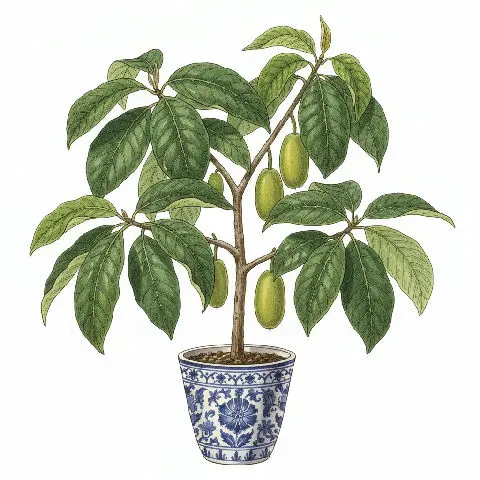
Asimina triloba, commonly known as the Pawpaw, is a remarkable deciduous tree belonging to the Annonaceae family, a group predominantly found in tropical regions, making the Pawpaw a unique cold-hardy outlier native to the eastern United States and parts of Canada. This fascinating plant is celebrated for producing the largest edible fruit indigenous to North America. Its natural habitat stretches from southern Ontario, Canada, south to Florida, and west to Nebraska, where it thrives in the understory of hardwood forests, particularly in rich, moist, well-drained soils along riverbanks and streams.
The tree exhibits a distinctive growth habit, often forming dense, clonal thickets through root suckers. Its large, simple, obovate leaves lend a lush, tropical appearance during the growing season, transforming into a striking golden-yellow in autumn. Historically, Indigenous peoples such as the Cherokee, Shawnee, and Iroquois deeply valued the Pawpaw fruit as a nutritious staple, particularly during the late summer and early autumn harvest.
Early European explorers and settlers, including Hernando de Soto, also documented its consumption, recognizing its unique custard-like texture and complex flavor profile, often described as a delightful blend of banana, mango, and pineapple. Beyond its culinary appeal, various parts of the Asimina triloba tree, notably the bark, twigs, and seeds, have been traditionally explored for their medicinal properties. Modern scientific inquiry has increasingly focused on the complex phytochemical makeup of the Pawpaw, revealing a rich array of bioactive compounds, particularly annonaceous acetogenins, which are gaining significant attention for their potential pharmacological activities, including natural pesticidal and anticarcinogenic research.
Trusted Scientific References
1. Authoritative external sources for Asimina triloba
1.1 Wikipedia — Asimina triloba
1.2 Kew POWO (Plants of the World Online)
1.3 PubMed — peer-reviewed research
1.4 NCBI Taxonomy Browser
1.5 GBIF — Global Biodiversity
1.1.Asimina Triloba — Key Features
- ✓ <strong>North America's largest</strong> — North America's largest indigenous edible fruit.
- ✓ <strong>Temperate member of</strong> — Temperate member of the predominantly tropical Annonaceae family.
- ✓ <strong>Fruit has a creamy, custard</strong> — like texture with a tropical flavor profile.
- ✓ <strong>Contains potent annonaceous</strong> — Contains potent annonaceous acetogenins, studied for anticancer and pesticidal effects.
- ✓ <strong>Forms clonal colonies</strong> — Forms clonal colonies through root suckers, creating dense thickets.
- ✓ <strong>Deciduous tree with</strong> — Deciduous tree with large, simple leaves that turn golden-yellow in autumn.
- ✓ <strong>Historically a vital</strong> — Historically a vital food source for Indigenous peoples.
- ✓ <strong>Requires cross</strong> — pollination for optimal fruit production, often by flies and beetles.
- ✓ <strong>Known for its</strong> — Known for its cold hardiness, thriving in temperate climates.
- ✓ <strong>Fruit is rich</strong> — Fruit is rich in vitamins, minerals, and antioxidants.
1.2.Asimina Triloba — Quick Summary
- ✓ Asimina triloba, or Pawpaw, is North America's largest native edible fruit, belonging to the tropical Annonaceae family.
- ✓ The fruit boasts a unique tropical flavor, often likened to a blend of banana, mango, and pineapple.
- ✓ Its bark and twigs contain potent annonaceous acetogenins, which are subjects of significant research for their anticarcinogenic and pesticidal properties.
- ✓ Traditionally, Indigenous peoples utilized the fruit as a food source and various parts for medicinal purposes.
- ✓ While the fruit is generally safe for consumption, medicinal extracts carry potential side effects, including gastrointestinal upset, skin rashes, and neurotoxicity concerns.
- ✓ Further scientific evidence is needed to fully establish the efficacy and safety of Pawpaw for many purported medicinal uses.
2.Asimina Triloba — Scientific Identity
3.Asimina Triloba — Quick Facts
4.Asimina Triloba — Appearance & Identification
5.Asimina Triloba — Native Habitat
6.Asimina Triloba — Water Requirements
- ✓ Site Selection — Prefers rich, moist, well-drained, slightly acidic soils (pH 5.5-7.0) and thrives in protected locations.
- ✓ Sunlight Requirements — Young Pawpaw trees benefit from partial shade for the first 1-2 years; mature trees require full sun for optimal fruit production.
- ✓ Propagation — Can be grown from seeds (requiring cold stratification for 90-120 days) or propagated clonally from root suckers.
- ✓ Pollination — Most varieties are not self-fertile and require cross-pollination from at least two genetically distinct trees for fruit set, often by flies and beetles.
- ✓ Watering — Requires consistent moisture, especially during dry periods and fruit development; avoid waterlogging.
- ✓ Pruning — Minimal pruning is needed, primarily for shaping, removing dead or diseased branches, and maintaining light penetration.
- ✓ Pest and Disease Management — Generally resistant to most pests and diseases, though some insect larvae may feed on leaves, and fungal spots can occur.
- ✓ Cold Hardiness — Highly cold-hardy, tolerating temperatures down to -20°F (-29°C), making it suitable for temperate climates.
Reviewed by the Flora Medical Global Botanical Review Panel
Multi-disciplinary editorial group · Botany · Ethnobotany · Herbal-medicine literature
Who reviewed this: This page was checked by the Flora Medical Global Botanical Review Panel — an in-house editorial group of botany graduates, ethnobotany researchers, and horticulture practitioners who collectively maintain our 7,000+ plant encyclopedia. Meet the team.
Our 4-step verification process
1. Taxonomic verification
Scientific names and synonyms cross-checked against Kew POWO, World Flora Online, and The Plant List.
2. Phytochemical & medicinal cross-reference
Active compounds, traditional uses, and reported activities are cross-referenced with PubMed, USDA Dr. Duke's database, and peer-reviewed ethnobotanical literature.
3. Conservation & distribution check
Distribution, ecology, and conservation status confirmed against GBIF occurrence records and the IUCN Red List.
4. Editorial & safety review
Every entry passes an editorial pass for clarity, originality, and safety notices (toxicity, contraindications, dosage caveats) before publication.
Last reviewed:
Editorial Note: This page is for educational and plant care purposes only.
Written by: Flora Medical Global Editorial Team
Reviewed by: Flora Medical Global Botanical Review Panel
Last Updated: June 15, 2026







Asimina Triloba — Comments & Community Reviews
Rate this plant