
Care Disclaimer: Plant care recommendations are general guidelines based on common growing conditions. Individual results may vary based on your local environment, climate, and care routine. If your plant is toxic, keep it away from children and pets, and consult a veterinarian if accidental ingestion occurs.
1.Asphodeline Lutea — Overview
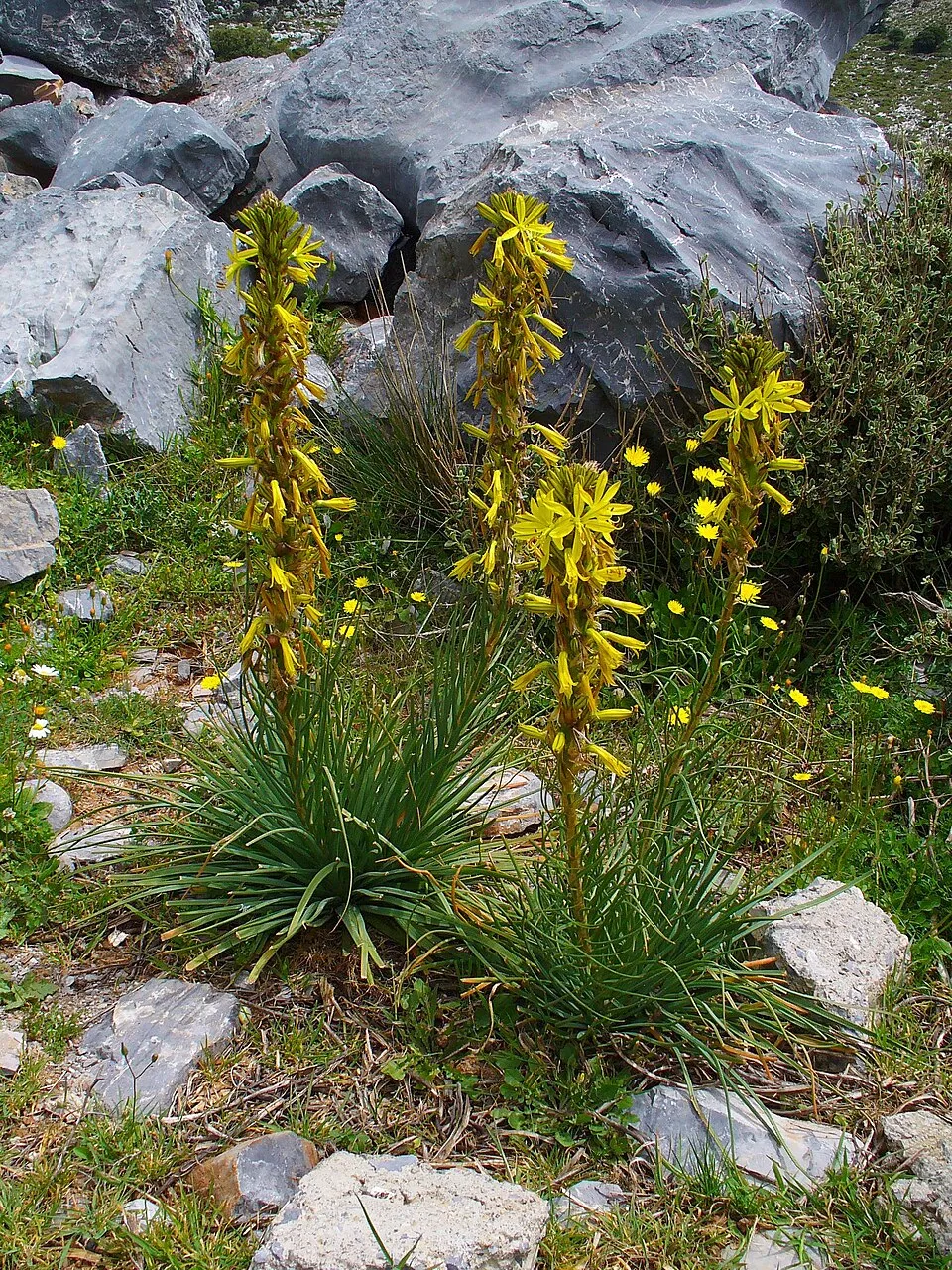
Asphodeline lutea, commonly known as King's Spear or Yellow Asphodel, is a striking perennial herbaceous plant native to the Mediterranean region, spanning southern Europe and North Africa. It belongs to the family Asphodelaceae, a classification that places it among a group of plants known for their distinctive inflorescences and often fleshy root systems. This architectural plant typically grows to a height of 90 to 150 centimeters, presenting a robust, upright habit. Its basal foliage consists of numerous linear, grass-like leaves that are glaucous green, adding to its ornamental appeal even before flowering.
The most notable feature is its dense, terminal raceme of vibrant, star-shaped, bright yellow flowers, each with six petals, which bloom in late spring to early summer. These flowers are arranged spirally along a tall, unbranched stem, creating a dramatic vertical accent in the landscape. Following pollination, small, round, greenish capsules develop, containing a few black seeds. Asphodeline lutea thrives in full sun and well-drained, often calcareous, soils, demonstrating remarkable drought tolerance once established.
Its natural habitat includes rocky slopes, garrigue, and open woodlands, where it contributes to the diverse Mediterranean flora. Its resilience and striking appearance make it a popular choice for xeriscaping and ornamental gardens, appreciated for both its aesthetic value and its ecological role in attracting pollinators.
Trusted Scientific References
1. Authoritative external sources for Asphodeline Lutea
1.1 Wikipedia — Asphodeline Lutea
1.2 Kew POWO (Plants of the World Online)
1.3 PubMed — peer-reviewed research
1.4 NCBI Taxonomy Browser
1.5 GBIF — Global Biodiversity
1.6Asphodeline Lutea should be interpreted through verified botanical identity, practical care, and responsible safety language. This recovery note adds the missing context needed for a complete profile: match light to the plant's habit, use well-drained soil, water according to season, and avoid unsupported medicinal or edible claims. For publishing, the plant can be presented as a source-backed garden plant with clear care guidance, common problem diagnosis, and conservative safety wording.
1.1.Asphodeline Lutea — Key Features
- ✓ <strong>Striking architectural form</strong> — Striking architectural form with tall, unbranched flower spikes.
- ✓ <strong>Vibrant, star</strong> — shaped, bright yellow flowers arranged in a dense raceme.
- ✓ <strong>Glaucous green, linear, grass</strong> — like basal foliage.
- ✓ <strong>Native to the</strong> — Native to the Mediterranean region, adapted to dry, sunny conditions.
- ✓ <strong>Excellent drought tolerance</strong> — Excellent drought tolerance once established, suitable for xeriscaping.
- ✓ <strong>Low</strong> — maintenance perennial, generally resistant to pests and diseases.
- ✓ <strong>Attracts pollinators, enhancing</strong> — Attracts pollinators, enhancing garden biodiversity.
- ✓ <strong>Historically used in</strong> — Historically used in folk medicine for various ailments, particularly skin and digestive issues.
- ✓ <strong>Fleshy, tuberous roots</strong> — Fleshy, tuberous roots typical of the Asphodelaceae family.
- ✓ <strong>Blooms profusely from</strong> — Blooms profusely from late spring to early summer, providing sustained visual interest.
1.2.Asphodeline Lutea — Quick Summary
- ✓ Asphodeline lutea is a striking Mediterranean perennial known for its tall spikes of yellow flowers.
- ✓ Traditionally used for anti-inflammatory, digestive, and wound healing purposes.
- ✓ Rich in bioactive compounds like anthraquinones, flavonoids, and saponins.
- ✓ Requires full sun and well-drained soil, highly drought-tolerant.
- ✓ Potential for mild laxative and diuretic effects, with precautions for sensitive individuals.
- ✓ Avoid during pregnancy, lactation, and in children; consult a healthcare professional for safe use.
2.Asphodeline Lutea — Scientific Identity
3.Asphodeline Lutea — Quick Facts
4.Asphodeline Lutea — Appearance & Identification
5.Asphodeline Lutea — Native Habitat
6.Asphodeline Lutea — Water Requirements
- ✓ Full Sun Exposure — Asphodeline lutea thrives in locations receiving at least 6-8 hours of direct sunlight daily for optimal growth and abundant flowering.
- ✓ Well-Drained Soil — Requires consistently well-drained soil; sandy or gravelly loams are ideal to prevent root rot, as it is intolerant of waterlogging.
- ✓ Moderate Water Needs — Once established, Asphodeline lutea is drought-tolerant, needing infrequent watering; regular watering is only necessary during prolonged dry spells.
- ✓ pH Preference — Prefers neutral to alkaline soil pH, but can tolerate slightly acidic conditions.
- ✓ Propagation — Primarily propagated by seed, which can be sown in autumn or spring, or by division of mature clumps in late autumn or early spring.
- ✓ Fertilization — Generally low-maintenance and does not require heavy feeding; a light application of balanced granular fertilizer in spring can promote vigor.
- ✓ Winter Hardiness — Fully hardy in USDA zones 6-9, tolerating cold temperatures but benefiting from mulch in colder regions.
- ✓ Pest and Disease Resistance — Generally robust and resistant to most common pests and diseases, making it a low-care garden plant.
Reviewed by the Flora Medical Global Botanical Review Panel
Multi-disciplinary editorial group · Botany · Ethnobotany · Herbal-medicine literature
Who reviewed this: This page was checked by the Flora Medical Global Botanical Review Panel — an in-house editorial group of botany graduates, ethnobotany researchers, and horticulture practitioners who collectively maintain our 7,000+ plant encyclopedia. Meet the team.
Our 4-step verification process
1. Taxonomic verification
Scientific names and synonyms cross-checked against Kew POWO, World Flora Online, and The Plant List.
2. Phytochemical & medicinal cross-reference
Active compounds, traditional uses, and reported activities are cross-referenced with PubMed, USDA Dr. Duke's database, and peer-reviewed ethnobotanical literature.
3. Conservation & distribution check
Distribution, ecology, and conservation status confirmed against GBIF occurrence records and the IUCN Red List.
4. Editorial & safety review
Every entry passes an editorial pass for clarity, originality, and safety notices (toxicity, contraindications, dosage caveats) before publication.
Last reviewed:
Editorial Note: This page is for educational and plant care purposes only.
Written by: Flora Medical Global Editorial Team
Reviewed by: Flora Medical Global Botanical Review Panel
Last Updated: June 15, 2026







Asphodeline Lutea — Comments & Community Reviews
Rate this plant