
Care Disclaimer: Plant care recommendations are general guidelines based on common growing conditions. Individual results may vary based on your local environment, climate, and care routine. If your plant is toxic, keep it away from children and pets, and consult a veterinarian if accidental ingestion occurs.
1.Astilbe Chinensis — Overview
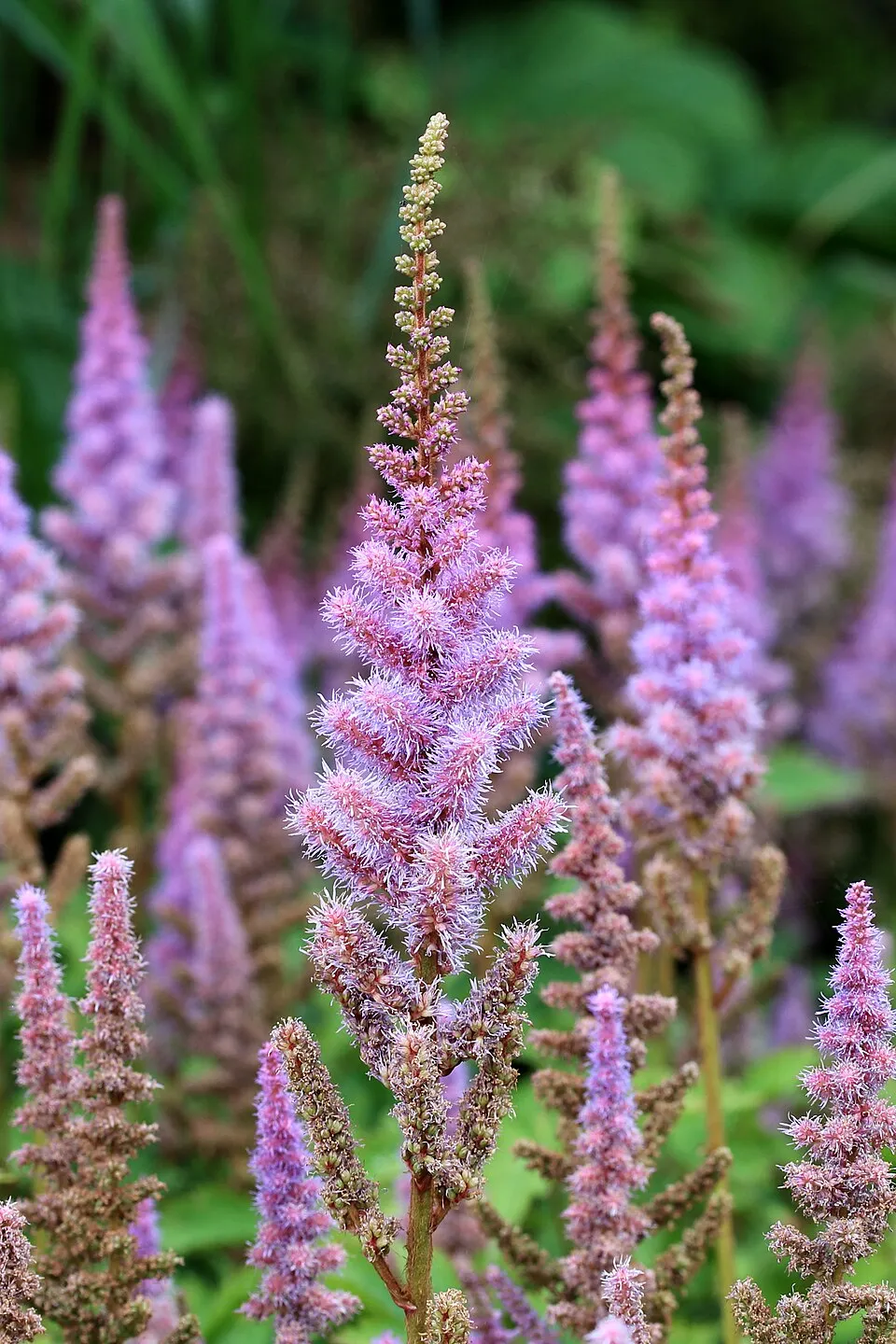
Astilbe chinensis, commonly known as Chinese astilbe, false goat's beard, or tall false-buck's-beard, is a captivating herbaceous perennial belonging to the Saxifragaceae family. This species typically grows in dense clumps, reaching heights of 45 to 90 centimeters. Its foliage is notably attractive, consisting predominantly of basal, ternately compound leaves with sharply-toothed, often biserrated, elliptic to oval leaflets that are frequently hairy, creating a fern-like texture.
The genus name 'Astilbe' originates from Greek, meaning 'without brightness,' referring to the dullness of leaves in some species, contrasting with the vibrant inflorescence of A. chinensis. The tiny, intricate flowers are borne on slender, erect, or arching stems, forming dense, plume-like panicles.
These inflorescences can display a range of colors, from white and pink to various shades of purple or red, blooming profusely in the summer months and persisting as ornamental dried seed heads into autumn. Native to Eastern China, the Japanese archipelago, and Korea, Astilbe chinensis thrives in its natural habitat near shaded streams and rivers, as well as within and along the margins of damp, open broadleaf forests, at altitudes ranging from 400 to 3600 meters. It prefers well-drained, organically rich soils and partial to full shade, though it exhibits more drought tolerance than many of its congeners.
Trusted Scientific References
1. Authoritative external sources for Astilbe Chinensis
1.1 Wikipedia — Astilbe Chinensis
1.2 Kew POWO (Plants of the World Online)
1.3 PubMed — peer-reviewed research
1.4 NCBI Taxonomy Browser
1.5 GBIF — Global Biodiversity
1.6Astilbe Chinensis should be interpreted through verified botanical identity, practical care, and responsible safety language. This recovery note adds the missing context needed for a complete profile: match light to the plant's habit, use well-drained soil, water according to season, and avoid unsupported medicinal or edible claims. For publishing, the plant can be presented as a source-backed garden plant with clear care guidance, common problem diagnosis, and conservative safety wording.
1.1.Astilbe Chinensis — Key Features
- ✓ <strong>Striking Panicle Flowers</strong> — Displays dense, feathery plumes of minuscule flowers in various colors, providing strong visual interest.
- ✓ <strong>Fern</strong> — like Foliage — Features attractive, deeply cut, often hairy basal leaves that resemble ferns.
- ✓ <strong>Shade</strong> — Loving Perennial — Thrives in partial to full shade, making it ideal for woodland gardens and shaded borders.
- ✓ <strong>Native to East Asia</strong> — Naturally found in damp, forested areas of China, Japan, and Korea.
- ✓ <strong>Traditional Medicinal Uses</strong> — Employed in herbal medicine for its anti-inflammatory, digestive, and diuretic actions.
- ✓ <strong>Rich in Phytochemicals</strong> — Contains beneficial compounds such as flavonoids, saponins, and phenolic acids.
- ✓ <strong>Drought Tolerant (for Astilbe)</strong> — Exhibits greater tolerance to drier conditions compared to other species within its genus.
- ✓ <strong>Low Maintenance</strong> — Generally resistant to pests and diseases, requiring minimal care once established.
- ✓ <strong>Winter Interest</strong> — Dried seed heads can provide architectural interest in the garden during colder months.
- ✓ <strong>Adaptable to Various Soils</strong> — Prefers rich, moist, well-drained soil but can adapt to a range of conditions.
1.2.Astilbe Chinensis — Quick Summary
- ✓ Astilbe chinensis is a striking perennial known for its fern-like foliage and plume-like flowers.
- ✓ Native to East Asia, it thrives in shaded, moist forest environments.
- ✓ Traditionally used for its anti-inflammatory, digestive, and diuretic properties.
- ✓ Rich in flavonoids, saponins, and phenolic acids, contributing to its medicinal value.
- ✓ Popular ornamental plant, prized for its aesthetic appeal and hardiness.
- ✓ Requires consistent moisture and shade, but is more drought-tolerant than other astilbes.
2.Astilbe Chinensis — Scientific Identity
3.Astilbe Chinensis — Quick Facts
4.Astilbe Chinensis — Appearance & Identification
5.Astilbe Chinensis — Native Habitat
6.Astilbe Chinensis — Water Requirements
- ✓ Site Selection — Plant Astilbe chinensis in a location that receives partial to full shade, ideally with morning sun and afternoon shade, to prevent leaf scorch.
- ✓ Soil Preparation — Ensure the soil is rich in organic matter, consistently moist, and well-drained; a slightly acidic to neutral pH (6.0-7.0) is preferred for optimal growth.
- ✓ Watering Regimen — Maintain consistent soil moisture, especially during dry periods, as Chinese astilbe dislikes drying out; however, avoid waterlogging to prevent root rot.
- ✓ Fertilization — Apply a balanced, slow-release granular fertilizer or organic compost lightly in early spring to support vigorous growth and flowering.
- ✓ Pruning and Maintenance — Deadhead spent flower plumes to encourage reblooming and maintain a tidy appearance, or leave them for winter interest; cut back foliage in late fall or early spring.
- ✓ Propagation — Propagate by dividing clumps every 3-4 years in early spring, or by sowing seeds indoors in late winter for transplanting after the last frost.
- ✓ Pest and Disease Management — Generally resistant, but monitor for common garden pests like slugs or snails in damp conditions, and ensure good air circulation to prevent fungal issues.
- ✓ Winter Care — In colder climates, a layer of mulch around the base can help protect the crowns during harsh winters, though it is quite hardy.
Reviewed by the Flora Medical Global Botanical Review Panel
Multi-disciplinary editorial group · Botany · Ethnobotany · Herbal-medicine literature
Who reviewed this: This page was checked by the Flora Medical Global Botanical Review Panel — an in-house editorial group of botany graduates, ethnobotany researchers, and horticulture practitioners who collectively maintain our 7,000+ plant encyclopedia. Meet the team.
Our 4-step verification process
1. Taxonomic verification
Scientific names and synonyms cross-checked against Kew POWO, World Flora Online, and The Plant List.
2. Phytochemical & medicinal cross-reference
Active compounds, traditional uses, and reported activities are cross-referenced with PubMed, USDA Dr. Duke's database, and peer-reviewed ethnobotanical literature.
3. Conservation & distribution check
Distribution, ecology, and conservation status confirmed against GBIF occurrence records and the IUCN Red List.
4. Editorial & safety review
Every entry passes an editorial pass for clarity, originality, and safety notices (toxicity, contraindications, dosage caveats) before publication.
Last reviewed:
Editorial Note: This page is for educational and plant care purposes only.
Written by: Flora Medical Global Editorial Team
Reviewed by: Flora Medical Global Botanical Review Panel
Last Updated: June 15, 2026







Astilbe Chinensis — Comments & Community Reviews
Rate this plant