
Care Disclaimer: Plant care recommendations are general guidelines based on common growing conditions. Individual results may vary based on your local environment, climate, and care routine. If your plant is toxic, keep it away from children and pets, and consult a veterinarian if accidental ingestion occurs.
1.Astrantia Maxima — Overview
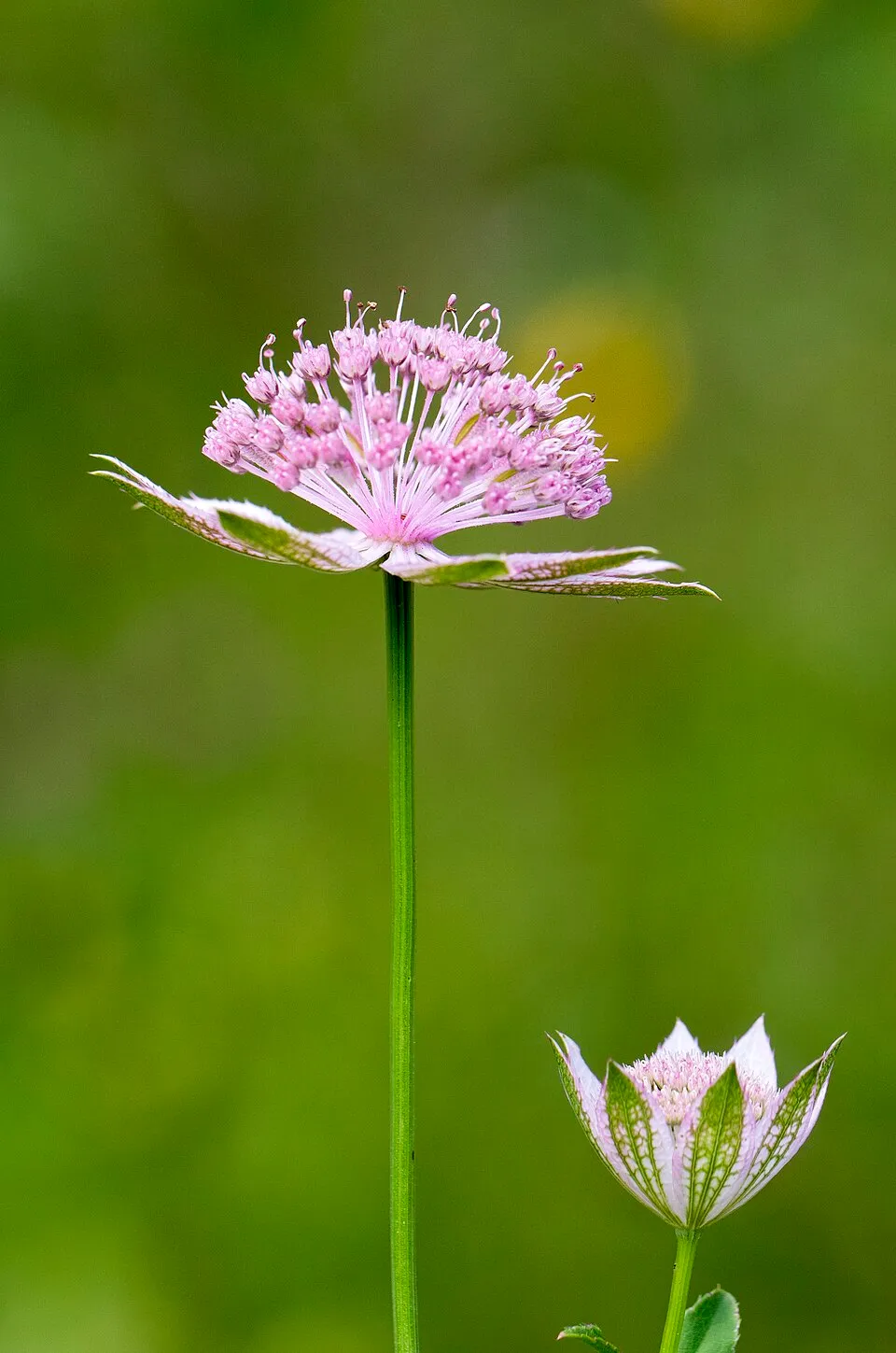
Astrantia maxima, commonly known as Great Masterwort or Masterwort, is an elegant herbaceous perennial belonging to the Apiaceae (carrot) family. Native to the mountain meadows, grasslands, woodland clearings, and stream banks across Europe and western Asia, this species thrives in cool, moist environments. While closely related to Astrantia major, A.
maxima is distinguished by its generally taller stature, with its unique "pincushion" flowers positioned somewhat closer to the basal foliage compared to its cousin. The plant forms attractive mounded clumps, typically exceeding 1.5 feet in height, and gradually spreads through stolons, creating a lush groundcover. Its medium green basal leaves are a prominent feature, palmate in shape with 3 to 7 deeply divided, toothed lobes, often reaching 3 to 6 inches in length.
The sparse leaves along the branched flower stems are narrower, featuring three shallower divisions, maintaining their appeal throughout the growing season without significant fall color.
Flowering from early summer through autumn, Astrantia maxima produces dense, compact, domed compound umbels, each about an inch across, atop slender, wiry stems. These distinctive inflorescences are encircled by numerous (typically 19-20) showy, papery, petal-like involucral bracts, which create a captivating pincushion-like effect. The tiny, tightly packed individual flowers, subtly colored in shades of red, pink, or white, possess five petals and prominent long stamens, emitting a faint fragrance.
These blooms are highly attractive to a variety of pollinators, including bees, flies, and beetles. The decorative bracts hold their form remarkably well, making them excellent for both fresh cut flower arrangements and dried floral displays. Astrantia maxima prefers part shade and rich, consistently moist soil enriched with organic matter, tolerating some standing water, making it a suitable choice for woodland gardens, perennial borders, and even bog garden edges, particularly in regions with cool night temperatures.
Trusted Scientific References
1. Authoritative external sources for Astrantia Maxima
1.1 Wikipedia — Astrantia Maxima
1.2 Kew POWO (Plants of the World Online)
1.3 PubMed — peer-reviewed research
1.4 NCBI Taxonomy Browser
1.5 GBIF — Global Biodiversity
1.1.Astrantia Maxima — Key Features
- ✓ <strong>Unique "Pincushion" Flowers</strong> — Characterized by intricate, domed umbels surrounded by showy, papery bracts.
- ✓ <strong>Taller Growth Habit</strong> — Typically exhibits a more upright and taller stature compared to Astrantia major.
- ✓ <strong>Palmate Basal Leaves</strong> — Features attractive, deeply lobed leaves that form a dense basal clump.
- ✓ <strong>Hardy Perennial</strong> — Resilient in USDA Hardiness Zones 4-7, returning year after year.
- ✓ <strong>Pollinator Magnet</strong> — Flowers are highly attractive to a diverse range of insects, including bees, flies, and beetles.
- ✓ <strong>Versatile Floral Use</strong> — Excellent for fresh cut flower arrangements and retains beauty when dried for everlasting displays.
- ✓ <strong>Shade</strong> — Loving Plant — Thrives in partial shade, making it ideal for woodland gardens and shaded borders.
- ✓ <strong>Moist Soil Preference</strong> — Requires consistently moist, rich, organic-rich soil to flourish.
- ✓ <strong>Low Maintenance</strong> — Generally easy to care for with few significant pest or disease issues.
- ✓ <strong>Stolonoferous Spread</strong> — Gradually expands its clumps through underground stolons, forming attractive patches.
1.2.Astrantia Maxima — Quick Summary
- ✓ Ornamental Perennial — Astrantia maxima is a striking perennial known for its distinctive "pincushion" flowers and attractive foliage.
- ✓ Habitat & Growth — Native to European and Asian woodlands, it thrives in cool, moist, partial shade conditions with rich, organic soil.
- ✓ Traditional Uses (Genus) — Historically, its close relative A. major has been used as an astringent, diuretic, and expectorant in folk medicine.
- ✓ Key Constituents — Contains notable phytochemicals such as coumarins, triterpenoid saponins, flavonoids, and tannins.
- ✓ Safety Considerations — Potential for photosensitivity and allergic reactions exists; caution advised for pregnant individuals and those on certain medications.
- ✓ Low Maintenance — Generally pest-resistant and easy to grow, making it a popular choice for shade gardens.
2.Astrantia Maxima — Scientific Identity
3.Astrantia Maxima — Quick Facts
4.Astrantia Maxima — Appearance & Identification
5.Astrantia Maxima — Native Habitat
6.Astrantia Maxima — Water Requirements
- Cultivating Astrantia maxima successfully hinges on replicating its native woodland edge environment.
- ✓ Site Selection — Plant in a location offering partial shade, ideally receiving a few hours of morning sun followed by dappled shade throughout the afternoon. While tolerant of full shade, blooming may be reduced.
- ✓ Soil Requirements — Thrives in rich, continuously moist soil abundant in organic matter. Amend heavy soils with compost to improve drainage and fertility.
- ✓ Water Management — Consistent moisture is crucial; the plant does not tolerate dry conditions. Regular irrigation is necessary if natural rainfall is insufficient. It can even tolerate some standing water.
- ✓ Climate Preference — Performs optimally in cooler climates where night temperatures consistently remain below 70°F (21°C), making it well-suited for temperate regions.
- ✓ Fertilization — In rich, organically amended soils, additional fertilization may not be necessary. Otherwise, a balanced slow-release fertilizer can be applied in early spring and again mid-summer.
- ✓ Propagation — Can be propagated from fresh seeds, which require 2-3 months of cold stratification for successful germination. Alternatively, established clumps can be divided in early spring or fall.
- ✓ Pest and Disease Management — Generally a robust plant with few serious pest issues, though occasional attacks by aphids or slugs may occur, requiring minimal intervention.
- ✓ Maintenance — Deadheading spent flowers can encourage a longer blooming period. Foliage and stems can be cut back in fall or left for winter interest.
Reviewed by the Flora Medical Global Botanical Review Panel
Multi-disciplinary editorial group · Botany · Ethnobotany · Herbal-medicine literature
Who reviewed this: This page was checked by the Flora Medical Global Botanical Review Panel — an in-house editorial group of botany graduates, ethnobotany researchers, and horticulture practitioners who collectively maintain our 7,000+ plant encyclopedia. Meet the team.
Our 4-step verification process
1. Taxonomic verification
Scientific names and synonyms cross-checked against Kew POWO, World Flora Online, and The Plant List.
2. Phytochemical & medicinal cross-reference
Active compounds, traditional uses, and reported activities are cross-referenced with PubMed, USDA Dr. Duke's database, and peer-reviewed ethnobotanical literature.
3. Conservation & distribution check
Distribution, ecology, and conservation status confirmed against GBIF occurrence records and the IUCN Red List.
4. Editorial & safety review
Every entry passes an editorial pass for clarity, originality, and safety notices (toxicity, contraindications, dosage caveats) before publication.
Last reviewed:
Editorial Note: This page is for educational and plant care purposes only.
Written by: Flora Medical Global Editorial Team
Reviewed by: Flora Medical Global Botanical Review Panel
Last Updated: June 15, 2026







Astrantia Maxima — Comments & Community Reviews
Rate this plant