


Care Disclaimer: Plant care recommendations are general guidelines based on common growing conditions. Individual results may vary based on your local environment, climate, and care routine. If your plant is toxic, keep it away from children and pets, and consult a veterinarian if accidental ingestion occurs.
1.Autumn Sage — Overview
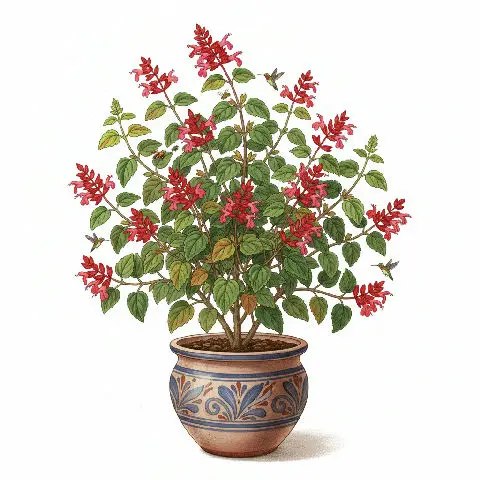
Salvia greggii, widely known as Autumn Sage, is a captivating and resilient perennial subshrub belonging to the Lamiaceae family, native to the arid and semi-arid regions spanning from West Texas across to Mexico. This species thrives in challenging environments, commonly found gracing rocky slopes, limestone outcrops, and canyons where other plants struggle. Its ecological history is deeply rooted in these landscapes, adapting to harsh conditions with remarkable tenacity. Botanically, Autumn Sage is characterized by its small, typically ovate to oblong leaves, which are evergreen to semi-evergreen and usually measure between 1 to 3 cm in length.
These leaves are borne on slender, woody stems and emit a distinct, pleasant aroma when crushed, a characteristic common to many Salvia species. The plant is celebrated for its vibrant, often two-lipped flowers that appear in a profusion of colors, including various shades of red, pink, purple, white, and coral. These blooms emerge prolifically from late spring through fall, and frequently continue sporadically through winter in milder climates, hence the descriptive 'Autumn' in its common name. The flowers are arranged in terminal racemes, serving as a significant attractant for local pollinators such as hummingbirds, butterflies, and bees, playing a crucial role in its ecological niche.
While not historically central to Old World traditional medicine systems like Ayurveda or TCM, indigenous communities in its native range likely utilized its aromatic properties for various local remedies and practical applications. Contemporary scientific inquiry is now actively exploring its rich phytochemical profile and potential health benefits.
Trusted Scientific References
1. Authoritative external sources for Salvia greggii
1.1 Wikipedia — Salvia greggii
1.2 Kew POWO (Plants of the World Online)
1.3 PubMed — peer-reviewed research
1.4 NCBI Taxonomy Browser
1.5 GBIF — Global Biodiversity
1.6Autumn Sage should be interpreted through verified botanical identity, practical care, and responsible safety language. This recovery note adds the missing context needed for a complete profile: match light to the plant's habit, use well-drained soil, water according to season, and avoid unsupported medicinal or edible claims. For publishing, the plant can be presented as a source-backed garden plant with clear care guidance, common problem diagnosis, and conservative safety wording.
1.1.Autumn Sage — Key Features
- ✓ <strong>Native to West</strong> — Native to West Texas and Mexico, thriving in arid and semi-arid landscapes.
- ✓ <strong>Evergreen to semi</strong> — evergreen subshrub with woody stems and small, aromatic leaves.
- ✓ <strong>Produces profuse, vibrant, two</strong> — lipped flowers in various colors from spring through fall.
- ✓ <strong>Distinctive, pleasant aroma</strong> — Distinctive, pleasant aroma when the leaves are crushed.
- ✓ <strong>Significant pollinator plant,</strong> — Significant pollinator plant, attracting hummingbirds, butterflies, and bees.
- ✓ <strong>Exceptional drought tolerance</strong> — Exceptional drought tolerance and low water requirements, ideal for xeriscaping.
- ✓ <strong>Rich in antioxidant</strong> — Rich in antioxidant compounds, particularly phenolic acids like caffeic acid and flavonoids.
- ✓ <strong>Demonstrated inhibitory effects on α</strong> — glucosidase enzyme, suggesting anti-diabetic potential.
- ✓ <strong>Low maintenance requirements,</strong> — Low maintenance requirements, making it a popular choice for sustainable gardening.
- ✓ <strong>Belongs to the</strong> — Belongs to the Lamiaceae (mint) family, known for its aromatic and medicinal species.
1.2.Autumn Sage — Quick Summary
- ✓ Resilient ornamental and medicinal perennial subshrub native to West Texas and Mexico.
- ✓ Celebrated for its vibrant, long-lasting blooms and distinctively aromatic foliage.
- ✓ Exhibits significant antioxidant activity and promising α-glucosidase inhibitory effects, relevant for metabolic health.
- ✓ Rich in beneficial phytochemicals including phenolic acids, flavonoids, and diterpenoids.
- ✓ Highly valued for its drought tolerance, low maintenance, and ability to attract beneficial pollinators.
- ✓ Not a primary herb in Old World traditional systems, but gaining attention in modern research for its therapeutic potential.
2.Autumn Sage — Scientific Identity
3.Autumn Sage — Quick Facts
4.Autumn Sage — Appearance & Identification
5.Autumn Sage — Native Habitat
6.Autumn Sage — Water Requirements
- ✓ Climate Preference — Thrives in warm, arid to semi-arid climates, tolerant of high temperatures.
- ✓ Sunlight Requirements — Prefers full sun exposure, requiring at least 6 hours of direct sunlight daily for optimal growth and flowering.
- ✓ Soil Composition — Requires well-drained soil; tolerates poor, rocky, or sandy soil types and is adaptable to various pH levels.
- ✓ Watering Needs — Highly drought-tolerant once established; water sparingly, allowing the soil to dry out completely between waterings.
- ✓ Pruning Techniques — Prune lightly after flowering or in late winter to maintain shape, encourage bushiness, and promote new blooms.
- ✓ Propagation Methods — Can be successfully propagated from seeds, semi-hardwood stem cuttings taken in spring or summer, or by division.
- ✓ Pest and Disease Resistance — Generally robust and resistant to most common garden pests and diseases, making it a low-maintenance choice.
- ✓ Fertilization — Requires minimal fertilization; excessive nitrogen can lead to lush foliage at the expense of flower production.
Reviewed by the Flora Medical Global Botanical Review Panel
Multi-disciplinary editorial group · Botany · Ethnobotany · Herbal-medicine literature
Who reviewed this: This page was checked by the Flora Medical Global Botanical Review Panel — an in-house editorial group of botany graduates, ethnobotany researchers, and horticulture practitioners who collectively maintain our 7,000+ plant encyclopedia. Meet the team.
Our 4-step verification process
1. Taxonomic verification
Scientific names and synonyms cross-checked against Kew POWO, World Flora Online, and The Plant List.
2. Phytochemical & medicinal cross-reference
Active compounds, traditional uses, and reported activities are cross-referenced with PubMed, USDA Dr. Duke's database, and peer-reviewed ethnobotanical literature.
3. Conservation & distribution check
Distribution, ecology, and conservation status confirmed against GBIF occurrence records and the IUCN Red List.
4. Editorial & safety review
Every entry passes an editorial pass for clarity, originality, and safety notices (toxicity, contraindications, dosage caveats) before publication.
Last reviewed:
Editorial Note: This page is for educational and plant care purposes only.
Written by: Flora Medical Global Editorial Team
Reviewed by: Flora Medical Global Botanical Review Panel
Last Updated: June 15, 2026







Autumn Sage — Comments & Community Reviews
Rate this plant