


Care Disclaimer: Plant care recommendations are general guidelines based on common growing conditions. Individual results may vary based on your local environment, climate, and care routine. If your plant is toxic, keep it away from children and pets, and consult a veterinarian if accidental ingestion occurs.
1.Bamboo — Overview
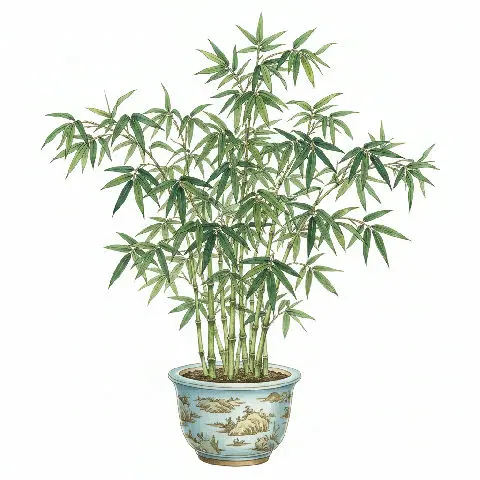
Bamboo, primarily encompassing species within the genus Bambusa, represents a vast and diverse group of evergreen perennial flowering plants belonging to the grass family Poaceae, specifically the subfamily Bambusoideae. With over 1,600 identified species, bamboos exhibit remarkable morphological variation, ranging from diminutive ornamental varieties to towering timber bamboos that can exceed 30 meters in height.
These resilient plants are characterized by their woody, hollow, jointed stems known as culms, which emerge from an extensive underground rhizome system.
Globally distributed across tropical and subtropical regions, with a significant concentration in East and Southeast Asia, bamboo thrives in a variety of habitats. Its rapid growth rate, unparalleled by most other plants, coupled with its renewability, has established it as a profoundly sustainable resource for millennia.
Archaeological findings in China indicate its utility dating back over 7,000 years, serving as a fundamental material for tools, shelter, and cultural artifacts.
Ecologically, bamboo plays a crucial role as a natural carbon sink, efficiently sequestering atmospheric carbon dioxide. Its dense rhizome networks are instrumental in stabilizing soil, preventing erosion, and supporting biodiversity.
Beyond its material and ecological significance, bamboo holds deep cultural symbolism in many Asian societies, representing strength, resilience, flexibility, and longevity, often influencing art, philosophy, and traditional practices. Medicinally, various parts, particularly the siliceous exudate known as 'Banslochan' or 'Tabasheer' from species like Bambusa arundinacea, have been revered in traditional systems such as Ayurveda and Traditional Chinese Medicine for their therapeutic properties.
Trusted Scientific References
1. Authoritative external sources for Bambusa spp.
1.1 Wikipedia — Bambusa spp.
1.2 Kew POWO (Plants of the World Online)
1.3 PubMed — peer-reviewed research
1.4 NCBI Taxonomy Browser
1.5 GBIF — Global Biodiversity
1.1.Bamboo — Key Features
- ✓ <strong>Rapidly Renewable Resource</strong> — Known for its exceptionally fast growth rate and sustainable harvesting.
- ✓ <strong>High Silica Content</strong> — Banslochan (Tabasheer) is a natural source of highly bioavailable silica.
- ✓ <strong>Diverse Species</strong> — Encompasses over 1,600 species with varied characteristics and uses.
- ✓ <strong>Ecological Benefits</strong> — Acts as a significant carbon sink and helps stabilize soil against erosion.
- ✓ <strong>Traditional Medicinal Staple</strong> — Widely used in Ayurvedic and Traditional Chinese Medicine systems.
- ✓ <strong>Antioxidant & Anti</strong> — inflammatory Properties — Attributed to its rich flavonoid and phenolic compound profile.
- ✓ <strong>Culinary Value</strong> — Young bamboo shoots are a popular and nutritious food source in many cultures.
- ✓ <strong>Symbol of Resilience</strong> — Culturally revered in Asia for its strength, flexibility, and longevity.
- ✓ <strong>Global Distribution</strong> — Found across tropical and subtropical regions worldwide, predominantly in Asia.
- ✓ <strong>Versatile Material</strong> — Used extensively for construction, crafts, textiles, and paper.
1.2.Bamboo — Quick Summary
- ✓ Bamboo (Bambusa spp.) is a versatile grass with significant medicinal value.
- ✓ Banslochan, a silica-rich exudate, is a primary medicinal component.
- ✓ Rich in natural silica, flavonoids, and phenolic acids.
- ✓ Traditionally used for bone, skin, respiratory, and digestive health.
- ✓ Exhibits strong antioxidant and anti-inflammatory properties.
- ✓ A sustainable resource with important ecological benefits.
2.Bamboo — Scientific Identity
3.Bamboo — Quick Facts
4.Bamboo — Appearance & Identification
5.Bamboo — Native Habitat
6.Bamboo — Water Requirements
- ✓ Climate — Thrives in tropical and subtropical climates, requiring warm temperatures and high humidity for optimal growth.
- ✓ Soil — Prefers well-drained, fertile loamy soils with a slightly acidic to neutral pH (6.0-7.0).
- ✓ Propagation — Primarily propagated through rhizome division or culm cuttings; some species can be grown from seeds, though seed viability is often low.
- ✓ Watering — Requires consistent moisture, especially during establishment and dry periods; avoid waterlogging.
- ✓ Sunlight — Most species prefer full sun to partial shade, with some ornamental varieties tolerating more shade.
- ✓ Maintenance — Regular pruning of old or dead culms is necessary for plant health and vigor; containment barriers may be needed for 'running' bamboo types.
- ✓ Harvesting — Shoots are harvested when young and tender, while culms are harvested for timber or medicinal parts when mature, typically after 3-5 years.
- ✓ Pest & Disease Management — Generally robust, but can be susceptible to fungal diseases in overly wet conditions or pests like bamboo mites.
Reviewed by the Flora Medical Global Botanical Review Panel
Multi-disciplinary editorial group · Botany · Ethnobotany · Herbal-medicine literature
Who reviewed this: This page was checked by the Flora Medical Global Botanical Review Panel — an in-house editorial group of botany graduates, ethnobotany researchers, and horticulture practitioners who collectively maintain our 7,000+ plant encyclopedia. Meet the team.
Our 4-step verification process
1. Taxonomic verification
Scientific names and synonyms cross-checked against Kew POWO, World Flora Online, and The Plant List.
2. Phytochemical & medicinal cross-reference
Active compounds, traditional uses, and reported activities are cross-referenced with PubMed, USDA Dr. Duke's database, and peer-reviewed ethnobotanical literature.
3. Conservation & distribution check
Distribution, ecology, and conservation status confirmed against GBIF occurrence records and the IUCN Red List.
4. Editorial & safety review
Every entry passes an editorial pass for clarity, originality, and safety notices (toxicity, contraindications, dosage caveats) before publication.
Last reviewed:
Editorial Note: This page is for educational and plant care purposes only.
Written by: Flora Medical Global Editorial Team
Reviewed by: Flora Medical Global Botanical Review Panel
Last Updated: June 15, 2026







Bamboo — Comments & Community Reviews
Rate this plant