


Care Disclaimer: Plant care recommendations are general guidelines based on common growing conditions. Individual results may vary based on your local environment, climate, and care routine. If your plant is toxic, keep it away from children and pets, and consult a veterinarian if accidental ingestion occurs.
1.Bamboo Giant — Overview
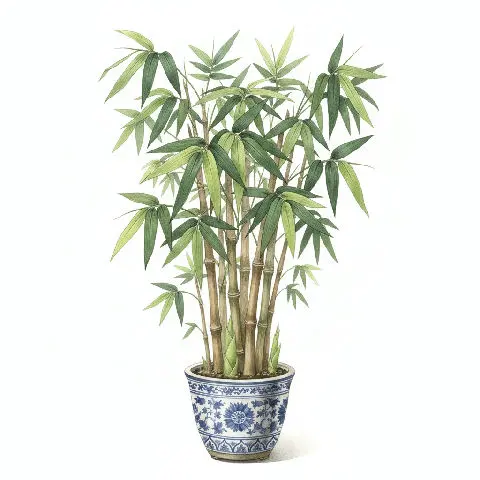
Dendrocalamus giganteus, widely recognized as Giant Bamboo or Dragon Bamboo, is an awe-inspiring species of clumping bamboo indigenous to the verdant landscapes of Southeast Asia, particularly Myanmar and Thailand. This formidable plant holds the distinction of being one of the tallest and largest bamboos globally, with woody culms capable of soaring over 30 meters in height and boasting diameters exceeding 30 centimeters near the base.
Its rapid growth rate and colossal size have cemented its status as a significant economic and ecological asset within its native range and beyond. Historically, Giant Bamboo has been an indispensable resource for local communities, providing robust building materials for construction and scaffolding, crafting resources for furniture and musical instruments, and sustenance through its edible young shoots.
Ecologically, Dendrocalamus giganteus forms dense, non-invasive clumps due to its pachymorph rhizome system, making it an excellent natural solution for erosion control and establishing effective windbreaks. It plays a crucial role in forest ecosystems, contributing substantially to biomass accumulation and providing vital habitat. Botanically, the species is characterized by its striking glaucous-green culms when young, which gradually mature to a dull green or yellowish-green hue.
The culm sheaths are notably large, persistent, and covered with stiff, dark brown hairs, adding to its distinctive appearance. Its leaves are large, lanceolate, and arranged in attractive sprays. A remarkable botanical feature is its gregarious flowering, which is exceptionally rare, occurring only once every 40 to 120 years, a phenomenon often associated with the subsequent death of the entire stand after successful seed production.
From a pharmacological perspective, while not as extensively documented as some traditional herbs, preliminary research on Dendrocalamus giganteus has highlighted the nutritional value of its young shoots and the presence of beneficial phytochemicals like phenolic compounds, flavonoids, and triterpenoids in its leaves and culms, suggesting potential antioxidant and anti-inflammatory properties.
Trusted Scientific References
1. Authoritative external sources for Dendrocalamus giganteus
1.1 Wikipedia — Dendrocalamus giganteus
1.2 Kew POWO (Plants of the World Online)
1.3 PubMed — peer-reviewed research
1.4 NCBI Taxonomy Browser
1.5 GBIF — Global Biodiversity
1.1.Bamboo Giant — Key Features
- ✓ <strong>World's Tallest Bamboo</strong> — Reaches impressive heights exceeding 30 meters, making it a botanical giant.
- ✓ <strong>Robust Culms</strong> — Features thick-walled culms with diameters often over 30 cm, highly valued for timber.
- ✓ <strong>Clumping Growth Habit</strong> — Grows in dense, non-invasive clumps due to its pachymorph rhizome system.
- ✓ <strong>Edible Young Shoots</strong> — A prized culinary ingredient in many Asian cuisines, requiring proper cooking.
- ✓ <strong>High Silica Content</strong> — Exceptionally rich in silica, beneficial for connective tissues, bones, skin, and hair.
- ✓ <strong>Rich in Antioxidants</strong> — Contains significant levels of flavonoids and phenolic acids that combat oxidative stress.
- ✓ <strong>Versatile Economic Resource</strong> — Used extensively for construction, scaffolding, furniture, crafts, and as a food source.
- ✓ <strong>Rapid Growth Rate</strong> — Exhibits a fast growth cycle, producing substantial biomass annually.
- ✓ <strong>Effective for Erosion Control</strong> — Its dense root system and clumping habit help stabilize soil and prevent erosion.
- ✓ <strong>Rare Gregarious Flowering</strong> — Flowers synchronously at long intervals (40-120 years), a unique biological event.
1.2.Bamboo Giant — Quick Summary
- ✓ Giant Bamboo (Dendrocalamus giganteus) is one of the world's largest and tallest bamboo species, native to Southeast Asia.
- ✓ It is economically vital for construction, crafts, and as a food source through its edible young shoots.
- ✓ Medicinally, it is valued for its high silica content, antioxidant, and anti-inflammatory properties.
- ✓ The plant is rich in beneficial phytochemicals including flavonoids, phenolic acids, and essential minerals.
- ✓ Raw bamboo shoots contain cyanogenic glycosides and must be thoroughly cooked before consumption to ensure safety.
- ✓ It supports bone, skin, hair, and digestive health, offering a wide range of wellness benefits.
2.Bamboo Giant — Scientific Identity
3.Bamboo Giant — Quick Facts
4.Bamboo Giant — Appearance & Identification
5.Bamboo Giant — Native Habitat
6.Bamboo Giant — Water Requirements
- ✓ Climate Requirements — Thrives in humid tropical and subtropical regions, ideally with annual daytime temperatures between 20-27°C, tolerating 15-34°C.
- ✓ Rainfall Needs — Prefers a mean annual rainfall range of 1,800-3,600mm, although it can tolerate 1,200-4,500mm.
- ✓ Sunlight Exposure — Grows best in full sun but can also succeed in areas with light shade, adapting to various light conditions.
- ✓ Soil Preferences — Requires rich, alluvial, well-draining soil with moderate fertility, ideally maintaining a pH between 5.5 and 6.5.
- ✓ Propagation Techniques — Most commonly propagated using offsets, which are young shoots with attached rhizome portions; seed propagation is rare due to infrequent flowering.
- ✓ Growth Cycle — Offsets produce smaller culms initially, with subsequent culms increasing in size annually, reaching significant girth and height after 7 years and full maturity around 15-16 years.
- ✓ Watering Regime — Demands consistent moisture, especially during dry periods and for young plants, to support its rapid growth and large biomass.
- ✓ Harvesting Practices — Young shoots are harvested for food, while mature culms are cut for timber and construction, typically from established clumps.
Reviewed by the Flora Medical Global Botanical Review Panel
Multi-disciplinary editorial group · Botany · Ethnobotany · Herbal-medicine literature
Who reviewed this: This page was checked by the Flora Medical Global Botanical Review Panel — an in-house editorial group of botany graduates, ethnobotany researchers, and horticulture practitioners who collectively maintain our 7,000+ plant encyclopedia. Meet the team.
Our 4-step verification process
1. Taxonomic verification
Scientific names and synonyms cross-checked against Kew POWO, World Flora Online, and The Plant List.
2. Phytochemical & medicinal cross-reference
Active compounds, traditional uses, and reported activities are cross-referenced with PubMed, USDA Dr. Duke's database, and peer-reviewed ethnobotanical literature.
3. Conservation & distribution check
Distribution, ecology, and conservation status confirmed against GBIF occurrence records and the IUCN Red List.
4. Editorial & safety review
Every entry passes an editorial pass for clarity, originality, and safety notices (toxicity, contraindications, dosage caveats) before publication.
Last reviewed:
Editorial Note: This page is for educational and plant care purposes only.
Written by: Flora Medical Global Editorial Team
Reviewed by: Flora Medical Global Botanical Review Panel
Last Updated: June 15, 2026







Bamboo Giant — Comments & Community Reviews
Rate this plant