


Care Disclaimer: Plant care recommendations are general guidelines based on common growing conditions. Individual results may vary based on your local environment, climate, and care routine. If your plant is toxic, keep it away from children and pets, and consult a veterinarian if accidental ingestion occurs.
1.Bamboo Golden — Overview
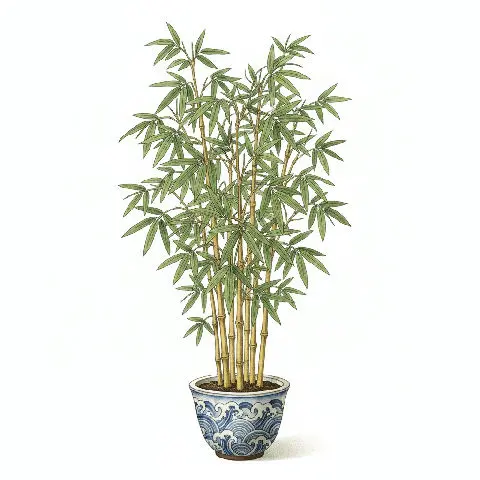
Phyllostachys aurea, widely recognized as Golden Bamboo or Fishpole Bamboo, is a distinctive and ornamental species belonging to the extensive Poaceae family. Native to the southeastern provinces of Fujian and Zhejiang in China, its cultivation and appreciation in Asian landscapes span many centuries, valued for its striking appearance, economic utility, and symbolic resonance with resilience and longevity. The epithet 'aurea,' Latin for golden, accurately describes its culms which progressively adopt a rich yellowish hue upon maturation and exposure to sunlight.
A defining morphological characteristic of Golden Bamboo is its irregularly swollen lower internodes, often likened to 'tortoise shell' nodes or 'knees.' These unique formations are particularly pronounced on older culms and contribute to its common name, Fishpole Bamboo, due to their resemblance to fishing rod joints. While often categorized as a clumping bamboo, Phyllostachys aurea can exhibit aggressive running characteristics in warmer, more humid climates, spreading extensively through its robust rhizome system and forming dense thickets. Its adaptability to a broad spectrum of soil types and climatic conditions, from temperate to subtropical, has facilitated its widespread introduction and cultivation globally, including significant naturalized populations in the southern United States and other regions outside its native range.
Ecologically, it can become an invasive species if not properly managed, outcompeting native flora.
Trusted Scientific References
1. Authoritative external sources for Phyllostachys aurea
1.1 Wikipedia — Phyllostachys aurea
1.2 Kew POWO (Plants of the World Online)
1.3 PubMed — peer-reviewed research
1.4 NCBI Taxonomy Browser
1.5 GBIF — Global Biodiversity
1.6Bamboo Golden should be interpreted through verified botanical identity, practical care, and responsible safety language. This recovery note adds the missing context needed for a complete profile: match light to the plant's habit, use well-drained soil, water according to season, and avoid unsupported medicinal or edible claims. For publishing, the plant can be presented as a source-backed garden plant with clear care guidance, common problem diagnosis, and conservative safety wording.
1.1.Bamboo Golden — Key Features
- ✓ <strong>Botanical Name</strong> — Phyllostachys aurea.
- ✓ <strong>Common Names</strong> — Golden Bamboo, Fishpole Bamboo, Golden Temple Bamboo.
- ✓ <strong>Distinctive Culms</strong> — Mature culms develop a characteristic golden-yellow color, especially with sun exposure.
- ✓ <strong>Unique Internodes</strong> — Features irregularly swollen 'tortoise shell' nodes on the lower culms, a key identifying feature.
- ✓ <strong>Growth Habit</strong> — Can be clumping in cooler climates but is a vigorous runner in warmer, wetter environments.
- ✓ <strong>Native Region</strong> — Indigenous to the southeastern provinces of China (Fujian and Zhejiang).
- ✓ <strong>Key Chemical Compounds</strong> — Noted for high silica content, along with beneficial flavonoids and phenolic acids.
- ✓ <strong>Traditional Uses</strong> — Valued ornamentally, for construction (fishing poles, crafts), and in some traditional medicine systems.
- ✓ <strong>Medicinal Potential</strong> — Researched for its anti-inflammatory, antioxidant, and connective tissue supporting properties.
- ✓ <strong>Environmental Adaptability</strong> — Highly adaptable to a wide range of soil conditions and climates, contributing to its global spread.
1.2.Bamboo Golden — Quick Summary
- ✓ Golden Bamboo (Phyllostachys aurea) is a distinctive bamboo species known for its golden culms and unique 'tortoise shell' nodes.
- ✓ Traditionally valued for ornamental purposes and structural uses, it also holds emerging interest for its medicinal potential.
- ✓ Rich in beneficial compounds like silica, flavonoids, and various phenolic acids, contributing to its health properties.
- ✓ Offers potential benefits including anti-inflammatory, antioxidant, and significant support for bone, skin, and hair health.
- ✓ Raw bamboo shoots require careful and thorough boiling to neutralize naturally occurring cyanogenic glycosides before consumption.
- ✓ While adaptable and vigorous, its running growth habit necessitates proper containment in cultivation to prevent invasiveness.
2.Bamboo Golden — Scientific Identity
3.Bamboo Golden — Quick Facts
4.Bamboo Golden — Appearance & Identification
5.Bamboo Golden — Native Habitat
6.Bamboo Golden — Water Requirements
- ✓ Climate — Thrives in temperate to subtropical zones, tolerating a range of temperatures but preferring mild conditions.
- ✓ Soil — Prefers well-draining, fertile soil rich in organic matter; adaptable to various soil types once established.
- ✓ Water — Requires consistent moisture, especially during establishment; mature plants are somewhat drought-tolerant but benefit from regular watering.
- ✓ Sun Exposure — Grows best in full sun to partial shade; full sun promotes the golden coloration of culms.
- ✓ Propagation — Primarily propagated through rhizome division; culm cuttings can also be used but are less reliable.
- ✓ Containment — Essential for running varieties like *Phyllostachys aurea* to prevent invasive spread; use sturdy rhizome barriers.
- ✓ Fertilization — Apply a balanced, slow-release fertilizer in spring and mid-summer to support vigorous growth.
- ✓ Pruning — Prune annually in late winter or early spring to remove old, dead, or damaged culms and manage density.
Reviewed by the Flora Medical Global Botanical Review Panel
Multi-disciplinary editorial group · Botany · Ethnobotany · Herbal-medicine literature
Who reviewed this: This page was checked by the Flora Medical Global Botanical Review Panel — an in-house editorial group of botany graduates, ethnobotany researchers, and horticulture practitioners who collectively maintain our 7,000+ plant encyclopedia. Meet the team.
Our 4-step verification process
1. Taxonomic verification
Scientific names and synonyms cross-checked against Kew POWO, World Flora Online, and The Plant List.
2. Phytochemical & medicinal cross-reference
Active compounds, traditional uses, and reported activities are cross-referenced with PubMed, USDA Dr. Duke's database, and peer-reviewed ethnobotanical literature.
3. Conservation & distribution check
Distribution, ecology, and conservation status confirmed against GBIF occurrence records and the IUCN Red List.
4. Editorial & safety review
Every entry passes an editorial pass for clarity, originality, and safety notices (toxicity, contraindications, dosage caveats) before publication.
Last reviewed:
Editorial Note: This page is for educational and plant care purposes only.
Written by: Flora Medical Global Editorial Team
Reviewed by: Flora Medical Global Botanical Review Panel
Last Updated: June 15, 2026







Bamboo Golden — Comments & Community Reviews
Rate this plant