


Care Disclaimer: Plant care recommendations are general guidelines based on common growing conditions. Individual results may vary based on your local environment, climate, and care routine. If your plant is toxic, keep it away from children and pets, and consult a veterinarian if accidental ingestion occurs.
1.Bee Balm — Overview
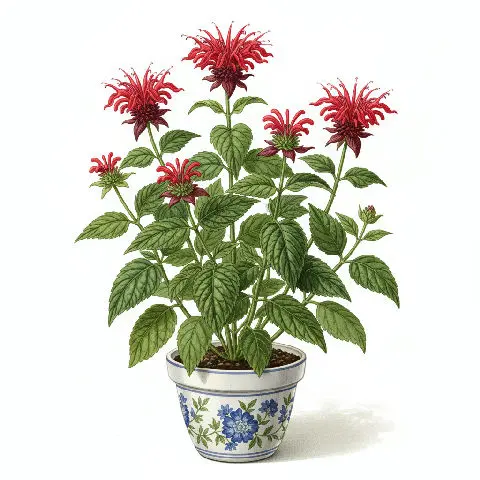
Monarda didyma, commonly known as Bee Balm, Bergamot, or Oswego Tea, is a captivating herbaceous perennial belonging to the Lamiaceae (mint) family. Native to the eastern regions of North America, its natural habitat spans moist woodlands, stream banks, and open meadows, where it thrives in conditions ranging from full sun to partial shade. The plant typically reaches heights of 2 to 5 feet (60-150 cm) with a spread of similar dimensions, forming attractive clumps. Its distinctive morphology includes square stems, a hallmark of the mint family, and opposite, ovate to lanceolate leaves with serrated margins, which emit a strong, minty-citrus aroma when bruised, reminiscent of Bergamot orange peel, hence one of its common names.
The vibrant, tubular flowers, typically scarlet, but also appearing in shades of pink, purple, or white depending on the cultivar, are arranged in dense, terminal, head-like clusters. These striking inflorescences, blooming from mid-summer to early autumn, are a powerful attractant for a diverse array of pollinators, including bees, hummingbirds, and butterflies, playing a crucial role in local ecosystems. The genus name 'Monarda' commemorates Nicolás Monardes, a 16th-century Spanish physician and botanist who documented New World plants, while 'didyma' refers to the plant's characteristic 'twin' stamens. Culturally and historically, Monarda didyma holds profound significance for various indigenous peoples of North America, including the Oswego, Cherokee, and Iroquois nations.
These tribes extensively utilized the leaves and flowers for both medicinal purposes and as a culinary ingredient. The Oswego Nation, in particular, famously prepared an aromatic and stimulating tea from its leaves, known as 'Oswego Tea,' which gained popularity as a substitute for imported tea during the American Revolution. This rich history underscores Bee Balm's enduring legacy as both a functional and culturally important plant, often used interchangeably with Monarda fistulosa for similar applications, particularly in traditional herbal practices across North America.
Trusted Scientific References
1. Authoritative external sources for Monarda didyma
1.1 Wikipedia — Monarda didyma
1.2 Kew POWO (Plants of the World Online)
1.3 PubMed — peer-reviewed research
1.4 NCBI Taxonomy Browser
1.5 GBIF — Global Biodiversity
1.1.Bee Balm — Key Features
- ✓ <strong>Native to Eastern</strong> — Native to Eastern North America, thriving in moist woodlands and meadows.
- ✓ <strong>Part of the</strong> — Part of the Lamiaceae (mint) family, characterized by square stems and opposite leaves.
- ✓ <strong>Produces vibrant, tubular</strong> — Produces vibrant, tubular flowers in shades of red, pink, purple, or white.
- ✓ <strong>Leaves emit a distinct minty</strong> — citrus aroma, reminiscent of Bergamot orange.
- ✓ <strong>Highly attractive to</strong> — Highly attractive to pollinators like bees, hummingbirds, and butterflies.
- ✓ <strong>Historically used as</strong> — Historically used as 'Oswego Tea' by Native Americans and American colonists.
- ✓ <strong>Contains thymol, a</strong> — Contains thymol, a powerful antiseptic and antimicrobial compound.
- ✓ <strong>Traditionally employed for</strong> — Traditionally employed for respiratory, digestive, and topical skin issues.
- ✓ <strong>Reaches heights of 2</strong> — 5 feet, forming attractive clumps.
- ✓ <strong>Adaptable to various</strong> — Adaptable to various light conditions from full sun to partial shade.
1.2.Bee Balm — Quick Summary
- ✓ Monarda didyma, or Bee Balm, is a North American native perennial in the mint family.
- ✓ Known for its vibrant flowers, square stems, and minty-citrus aroma.
- ✓ Traditionally used by Indigenous peoples for medicinal teas and culinary purposes.
- ✓ Key active compound is thymol, offering strong antimicrobial and antiseptic benefits.
- ✓ Used to support respiratory health, digestion, and topical wound healing.
- ✓ Valued for its role as a pollinator attractant and its historical significance during the American Revolution.
2.Bee Balm — Scientific Identity
3.Bee Balm — Quick Facts
4.Bee Balm — Appearance & Identification
5.Bee Balm — Native Habitat
6.Bee Balm — Water Requirements
- ✓ Site Selection — Plant Monarda didyma in a location with full sun to partial shade for optimal growth and flowering.
- ✓ Soil Requirements — Prefers moist, well-draining soil, but can tolerate heavy clay soils if kept consistently moist.
- ✓ Propagation — Best propagated by root division in spring or by seeds; seeds require stratification and take 10-40 days to germinate.
- ✓ Watering — Requires consistent moisture, especially during dry periods; avoid letting the soil dry out completely.
- ✓ Pest and Disease Management — Prone to powdery mildew, particularly in humid conditions; select resistant cultivars or ensure good air circulation to mitigate.
- ✓ Harvesting — Harvest young leaves before flowering and fully opened flowers; a second flush of blooms can sometimes be encouraged by cutting back after the first flowering.
- ✓ Winter Care — A hardy perennial in USDA Zones 4-9, it generally requires minimal winter protection.
Reviewed by the Flora Medical Global Botanical Review Panel
Multi-disciplinary editorial group · Botany · Ethnobotany · Herbal-medicine literature
Who reviewed this: This page was checked by the Flora Medical Global Botanical Review Panel — an in-house editorial group of botany graduates, ethnobotany researchers, and horticulture practitioners who collectively maintain our 7,000+ plant encyclopedia. Meet the team.
Our 4-step verification process
1. Taxonomic verification
Scientific names and synonyms cross-checked against Kew POWO, World Flora Online, and The Plant List.
2. Phytochemical & medicinal cross-reference
Active compounds, traditional uses, and reported activities are cross-referenced with PubMed, USDA Dr. Duke's database, and peer-reviewed ethnobotanical literature.
3. Conservation & distribution check
Distribution, ecology, and conservation status confirmed against GBIF occurrence records and the IUCN Red List.
4. Editorial & safety review
Every entry passes an editorial pass for clarity, originality, and safety notices (toxicity, contraindications, dosage caveats) before publication.
Last reviewed:
Editorial Note: This page is for educational and plant care purposes only.
Written by: Flora Medical Global Editorial Team
Reviewed by: Flora Medical Global Botanical Review Panel
Last Updated: June 15, 2026







Bee Balm — Comments & Community Reviews
Rate this plant