
Care Disclaimer: Plant care recommendations are general guidelines based on common growing conditions. Individual results may vary based on your local environment, climate, and care routine. If your plant is toxic, keep it away from children and pets, and consult a veterinarian if accidental ingestion occurs.
1.Begonia Grandis — Overview
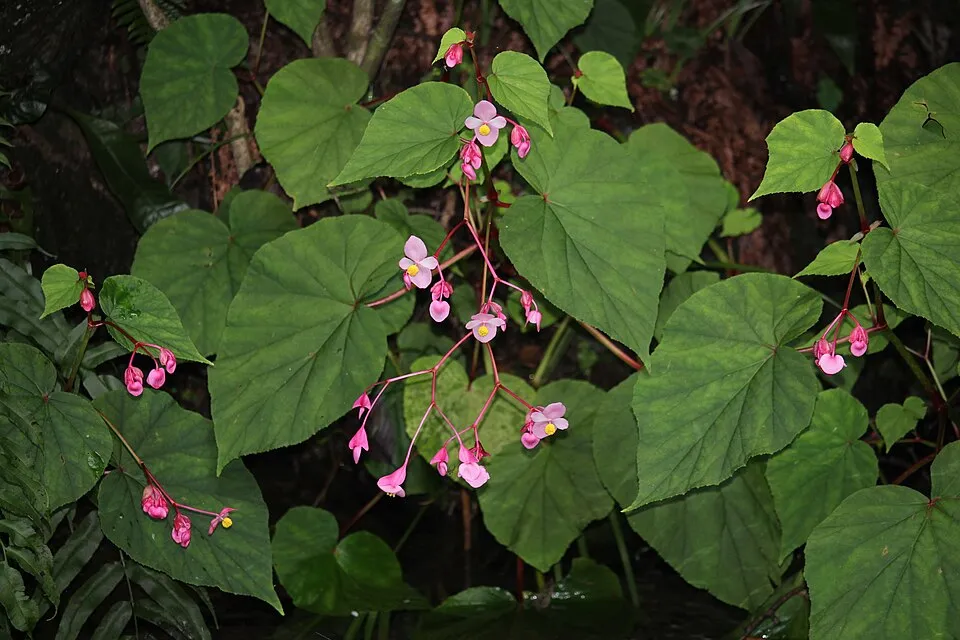
Begonia grandis, commonly known as the Hardy Begonia, is a captivating herbaceous perennial belonging to the Begoniaceae family. Native to the woodlands of southern China and Japan, this species stands out among its relatives for its remarkable cold hardiness. It typically forms a bushy mound, reaching heights of 18 inches to three feet and spreading 18 inches to two feet wide.
Its striking foliage features ovate, often reddish-backed leaves that provide year-round interest in suitable climates. From mid-summer through early fall, Begonia grandis produces loose, floppy clusters of delicate, fragrant pink flowers, adding a graceful touch to shaded garden spaces. A unique characteristic of this plant is its production of small, pea-sized bulbils in the leaf axils as the days shorten, which drop to the ground and self-propagate, forming charming colonies over time.
The species epithet 'grandis' is Latin for 'large,' referring to its comparatively robust growth habit within the genus. Adaptable to various shade conditions, it thrives in moist, organically rich, well-drained soils, making it a popular choice for naturalized settings, borders, and containers in USDA hardiness zones 5 through 9.
Trusted Scientific References
1. Authoritative external sources for Begonia grandis
1.1 Wikipedia — Begonia grandis
1.2 Kew POWO (Plants of the World Online)
1.3 PubMed — peer-reviewed research
1.4 NCBI Taxonomy Browser
1.5 GBIF — Global Biodiversity
1.6Begonia Grandis should be interpreted through verified botanical identity, practical care, and responsible safety language. This recovery note adds the missing context needed for a complete profile: match light to the plant's habit, use well-drained soil, water according to season, and avoid unsupported medicinal or edible claims. For publishing, the plant can be presented as a source-backed garden plant with clear care guidance, common problem diagnosis, and conservative safety wording.
1.7Begonia Grandis (Begonia grandis) is maintained in this recovery file as a complete garden profile with practical care, safety, and identification context. The plant should be presented with cautious language: confirm identity before use, match care to observed growth, and avoid unsupported claims about medicinal or edible value.
1.1.Begonia Grandis — Key Features
- ✓ <strong>Herbaceous perennial with</strong> — Herbaceous perennial with a bushy growth habit.
- ✓ <strong>Native to southern</strong> — Native to southern China and Japan.
- ✓ <strong>Produces delicate, fragrant</strong> — Produces delicate, fragrant pink flowers from summer to fall.
- ✓ <strong>Known for its</strong> — Known for its exceptional cold hardiness among Begonias.
- ✓ <strong>Unique propagation via</strong> — Unique propagation via leaf axil bulbils.
- ✓ <strong>Thrives in partial</strong> — Thrives in partial to deep shade conditions.
- ✓ <strong>Contains a rich</strong> — Contains a rich profile of flavonoids and terpenoids.
- ✓ <strong>Notable for its traditional anti</strong> — inflammatory and skin-soothing uses.
- ✓ <strong>Contains toxic oxalic</strong> — Contains toxic oxalic acid, requiring cautious handling and use.
- ✓ <strong>Ideal for shade</strong> — Ideal for shade gardens, woodland settings, and container planting.
1.2.Begonia Grandis — Quick Summary
- ✓ Begonia grandis, the Hardy Begonia, is an ornamental perennial native to East Asia, known for its pink flowers and shade tolerance.
- ✓ Traditionally used in Ayurveda and Unani for anti-inflammatory, digestive, and respiratory support, and topically for skin soothing.
- ✓ Rich in beneficial flavonoids and terpenoids, but also contains significant levels of toxic oxalic acid.
- ✓ Due to its oxalate content, internal consumption is strongly cautioned against, making it primarily suitable for external applications.
- ✓ Propagates easily via unique bulbils and thrives in moist, well-drained, organically rich soil in shaded environments.
2.Begonia Grandis — Scientific Identity
3.Begonia Grandis — Quick Facts
4.Begonia Grandis — Appearance & Identification
5.Begonia Grandis — Native Habitat
6.Begonia Grandis — Water Requirements
- ✓ Soil Preference — Thrives in moist, organically rich, well-drained loamy soil, which is crucial for root health and preventing rot.
- ✓ Light Requirements — Prefers partial to deep shade; direct afternoon sun can scorch its delicate leaves, especially in warmer climates.
- ✓ Watering Schedule — Requires moderate, consistent watering, ensuring the soil remains evenly moist but never waterlogged. Allow the topsoil to dry slightly between waterings.
- ✓ Temperature and Hardiness — Hardy in USDA zones 5 to 9, tolerating temperatures down to 23°F; heavy mulching is recommended for winter protection in zones 6 and 7.
- ✓ Fertilization — Benefits from regular feeding with a balanced, slow-release granular fertilizer or liquid feed during its active growing season from spring to late summer.
- ✓ Propagation — Easily propagated from the bulbils that form in leaf axils in late summer/early fall, which can be harvested and planted, or by division of tubers in spring.
- ✓ Maintenance — Deadhead spent flowers to encourage prolonged blooming and maintain a tidy appearance; trim back foliage as it goes dormant in late fall.
Reviewed by the Flora Medical Global Botanical Review Panel
Multi-disciplinary editorial group · Botany · Ethnobotany · Herbal-medicine literature
Who reviewed this: This page was checked by the Flora Medical Global Botanical Review Panel — an in-house editorial group of botany graduates, ethnobotany researchers, and horticulture practitioners who collectively maintain our 7,000+ plant encyclopedia. Meet the team.
Our 4-step verification process
1. Taxonomic verification
Scientific names and synonyms cross-checked against Kew POWO, World Flora Online, and The Plant List.
2. Phytochemical & medicinal cross-reference
Active compounds, traditional uses, and reported activities are cross-referenced with PubMed, USDA Dr. Duke's database, and peer-reviewed ethnobotanical literature.
3. Conservation & distribution check
Distribution, ecology, and conservation status confirmed against GBIF occurrence records and the IUCN Red List.
4. Editorial & safety review
Every entry passes an editorial pass for clarity, originality, and safety notices (toxicity, contraindications, dosage caveats) before publication.
Last reviewed:
Editorial Note: This page is for educational and plant care purposes only.
Written by: Flora Medical Global Editorial Team
Reviewed by: Flora Medical Global Botanical Review Panel
Last Updated: June 15, 2026







Begonia Grandis — Comments & Community Reviews
Rate this plant