
Care Disclaimer: Plant care recommendations are general guidelines based on common growing conditions. Individual results may vary based on your local environment, climate, and care routine. If your plant is toxic, keep it away from children and pets, and consult a veterinarian if accidental ingestion occurs.
1.Belamcanda Chinensis — Overview
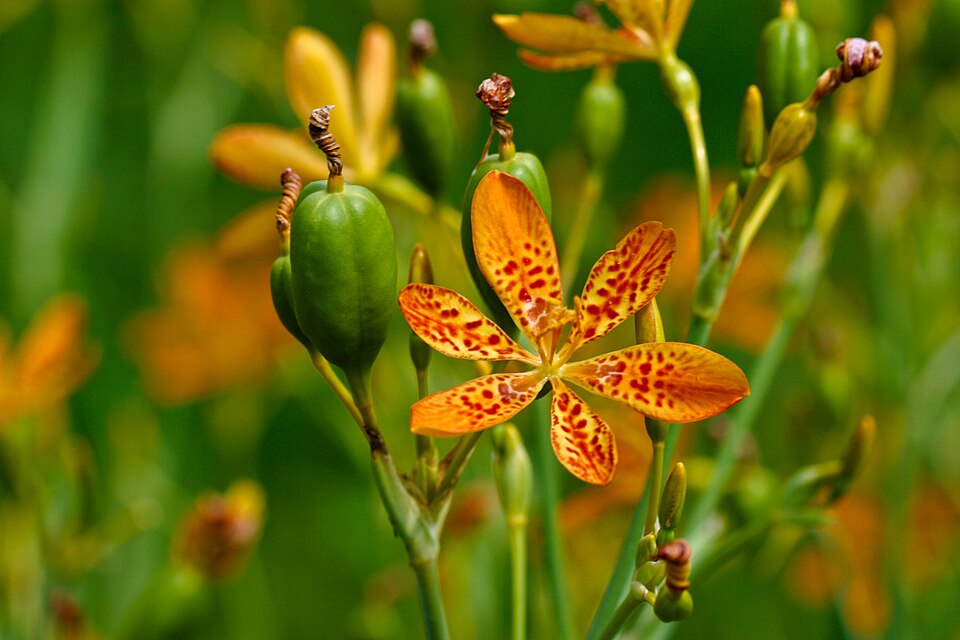
Belamcanda chinensis, commonly known as Blackberry Lily or Leopard Flower, and now scientifically classified as Iris domestica, is a captivating perennial herbaceous plant belonging to the Iridaceae family. Native to East Asia, including China, Japan, Korea, and parts of India, it thrives in well-drained soils and sunny to partially shaded environments, often found at woodland edges or in open fields. This plant exhibits a distinctive clumping growth habit, typically reaching heights of 60 to 100 cm.
Its leaves are sword-shaped, arranged in a fan-like manner at the base, resembling those of an iris. The most striking feature is its flowers, which emerge in late summer. These beautiful blooms are typically orange or yellow, adorned with dark red spots, giving rise to its 'Leopard Flower' moniker.
After flowering, the petals twist and fall away, revealing clusters of glossy, pea-sized black seeds that resemble blackberries, hence the 'Blackberry Lily' name. These seed pods persist through autumn, adding ornamental interest. The plant's robust rhizomatous root system allows it to spread and establish itself effectively, contributing to its resilience in various temperate climates.
Trusted Scientific References
1. Authoritative external sources for Belamcanda Chinensis
1.1 Wikipedia — Belamcanda Chinensis
1.2 Kew POWO (Plants of the World Online)
1.3 PubMed — peer-reviewed research
1.4 NCBI Taxonomy Browser
1.5 GBIF — Global Biodiversity
1.6Belamcanda Chinensis should be interpreted through verified botanical identity, practical care, and responsible safety language. This recovery note adds the missing context needed for a complete profile: match light to the plant's habit, use well-drained soil, water according to season, and avoid unsupported medicinal or edible claims. For publishing, the plant can be presented as a source-backed garden plant with clear care guidance, common problem diagnosis, and conservative safety wording.
1.7Belamcanda Chinensis (Belamcanda chinensis) is maintained in this recovery file as a complete garden profile with practical care, safety, and identification context. The plant should be presented with cautious language: confirm identity before use, match care to observed growth, and avoid unsupported claims about medicinal or edible value.
1.1.Belamcanda Chinensis — Key Features
- ✓ <strong>Botanical Name</strong> — Belamcanda chinensis (syn. Iris domestica), belonging to the Iridaceae family.
- ✓ <strong>Common Names</strong> — Blackberry Lily, Leopard Flower, She Gan.
- ✓ <strong>Primary Medicinal Part</strong> — The rhizome is the most medicinally valued part.
- ✓ <strong>Key Bioactives</strong> — Rich in isoflavones (tectorigenin, tectoridin), xanthone glycosides, and stilbenes.
- ✓ <strong>Traditional Use</strong> — Widely used in TCM for respiratory ailments, sore throats, and anti-inflammatory purposes.
- ✓ <strong>Modern Research Focus</strong> — Investigated for antioxidant, phytoestrogenic, anti-mutagenic, and hypoglycemic properties.
- ✓ <strong>Ornamental Value</strong> — Highly prized in gardens for its distinctive orange-spotted flowers and unique 'blackberry' seed pods.
- ✓ <strong>Growth Habit</strong> — A resilient perennial herbaceous plant with sword-shaped leaves and a clumping growth.
- ✓ <strong>Habitat</strong> — Native to East Asia, thriving in well-drained soil and sunny locations.
1.2.Belamcanda Chinensis — Quick Summary
- ✓ Belamcanda chinensis, or Blackberry Lily, is a striking perennial known for its distinctive flowers and unique seed pods.
- ✓ Its rhizome, She Gan, is a key herb in Traditional Chinese Medicine, primarily for respiratory issues and inflammation.
- ✓ Rich in isoflavones like tectorigenin, it exhibits significant anti-inflammatory, antioxidant, and phytoestrogenic activities.
- ✓ Modern research explores its potential in supporting respiratory health, modulating hormones, and as a potent antioxidant.
- ✓ Requires careful use and professional consultation, especially in hormone-sensitive individuals and during pregnancy.
2.Belamcanda Chinensis — Scientific Identity
3.Belamcanda Chinensis — Quick Facts
4.Belamcanda Chinensis — Appearance & Identification
5.Belamcanda Chinensis — Native Habitat
6.Belamcanda Chinensis — Water Requirements
- ✓ Soil Requirements — Thrives best in well-drained soil that is moderately fertile and rich in organic matter, with an ideal pH range of 6.0 to 7.0.
- ✓ Sunlight Exposure — Prefers full sun, requiring at least 6-8 hours of direct sunlight daily to ensure robust growth and abundant flowering.
- ✓ Watering Schedule — Maintain consistent soil moisture, especially during dry spells; water regularly but ensure proper drainage to prevent rhizome rot.
- ✓ Fertilization — Apply a balanced, slow-release granular fertilizer or a layer of compost in early spring to support vigorous foliage and flower development.
- ✓ Propagation — Easily propagated by dividing the rhizomes in late summer after flowering or in early spring before new growth begins, or by sowing seeds.
- ✓ Pruning and Maintenance — Deadhead spent flowers to encourage continuous blooming and prevent self-seeding; cut back faded foliage in late autumn or early winter.
- ✓ Climate Zone — Hardy in USDA zones 5-10, demonstrating good tolerance to both cold and heat within these temperate and subtropical ranges.
Reviewed by the Flora Medical Global Botanical Review Panel
Multi-disciplinary editorial group · Botany · Ethnobotany · Herbal-medicine literature
Who reviewed this: This page was checked by the Flora Medical Global Botanical Review Panel — an in-house editorial group of botany graduates, ethnobotany researchers, and horticulture practitioners who collectively maintain our 7,000+ plant encyclopedia. Meet the team.
Our 4-step verification process
1. Taxonomic verification
Scientific names and synonyms cross-checked against Kew POWO, World Flora Online, and The Plant List.
2. Phytochemical & medicinal cross-reference
Active compounds, traditional uses, and reported activities are cross-referenced with PubMed, USDA Dr. Duke's database, and peer-reviewed ethnobotanical literature.
3. Conservation & distribution check
Distribution, ecology, and conservation status confirmed against GBIF occurrence records and the IUCN Red List.
4. Editorial & safety review
Every entry passes an editorial pass for clarity, originality, and safety notices (toxicity, contraindications, dosage caveats) before publication.
Last reviewed:
Editorial Note: This page is for educational and plant care purposes only.
Written by: Flora Medical Global Editorial Team
Reviewed by: Flora Medical Global Botanical Review Panel
Last Updated: June 15, 2026







Belamcanda Chinensis — Comments & Community Reviews
Rate this plant