


Care Disclaimer: Plant care recommendations are general guidelines based on common growing conditions. Individual results may vary based on your local environment, climate, and care routine. If your plant is toxic, keep it away from children and pets, and consult a veterinarian if accidental ingestion occurs.
1.Berberis Darwinii — Overview
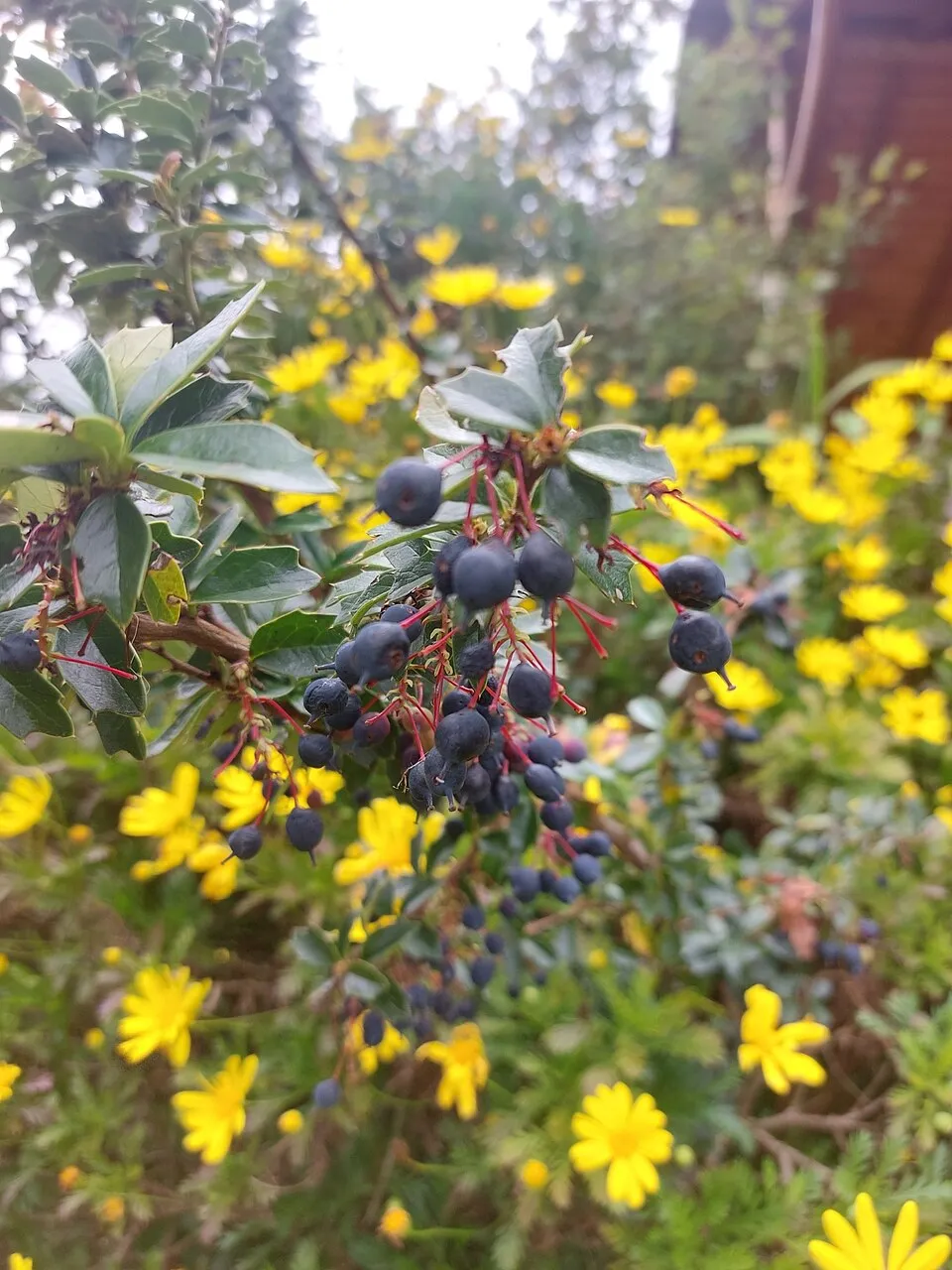
Berberis darwinii, commonly known as Darwin's Barberry, is a striking evergreen shrub belonging to the Berberidaceae family. Native to the moist, shady woodlands of the Patagonian mountains in Southern Argentina and Chile, this species is highly valued for both its ornamental beauty and its medicinal properties. The plant typically grows as a dense, spiny shrub, reaching heights of up to 3 meters and spreading up to 3.5 meters.
Its foliage consists of small, glossy, dark green leaves that provide year-round visual interest. From April to May, it produces a profusion of vibrant orange-yellow flowers, often described as golden chalices, which are a significant draw for pollinators. These flowers develop into small, tart, blue-black berries by July and August, which are edible and contribute to its appeal.
Beyond its aesthetic qualities, Darwin's Barberry's robust nature allows it to thrive in various conditions, including heavy clay and nutritionally poor soils, and it exhibits tolerance to maritime exposure. Its dense growth habit also makes it an excellent choice for hedges, providing shelter and food for local wildlife.
Trusted Scientific References
1. Authoritative external sources for Berberis darwinii
1.1 Wikipedia — Berberis darwinii
1.2 Kew POWO (Plants of the World Online)
1.3 PubMed — peer-reviewed research
1.4 NCBI Taxonomy Browser
1.5 GBIF — Global Biodiversity
1.6Berberis Darwinii should be interpreted through verified botanical identity, practical care, and responsible safety language. This recovery note adds the missing context needed for a complete profile: match light to the plant's habit, use well-drained soil, water according to season, and avoid unsupported medicinal or edible claims. For publishing, the plant can be presented as a source-backed garden plant with clear care guidance, common problem diagnosis, and conservative safety wording.
1.7Berberis Darwinii (Berberis darwinii) is maintained in this recovery file as a complete garden profile with practical care, safety, and identification context. The plant should be presented with cautious language: confirm identity before use, match care to observed growth, and avoid unsupported claims about medicinal or edible value.
1.1.Berberis Darwinii — Key Features
- ✓ <strong>Vibrant Evergreen Shrub</strong> — Features glossy, dark green leaves and prolific orange-yellow flowers in spring.
- ✓ <strong>Edible Berries</strong> — Produces tart, blue-black fruits that can be eaten raw or cooked into preserves.
- ✓ <strong>Rich in Berberine</strong> — Root bark is a primary source of the powerful isoquinoline alkaloid, berberine.
- ✓ <strong>Potent Antibacterial</strong> — Highly effective against a broad spectrum of bacterial infections, especially in the gut and urinary tract.
- ✓ <strong>Digestive Aid</strong> — Supports healthy digestion and helps alleviate symptoms of indigestion and bloating.
- ✓ <strong>Attractive Hedge Plant</strong> — Its dense, spiny growth habit makes it an excellent choice for protective hedges and wildlife habitat.
- ✓ <strong>Pollinator Magnet</strong> — Flowers are rich in nectar and pollen, attracting bees and other beneficial insects.
- ✓ <strong>Natural Dye Source</strong> — The root and bark can be used to extract a yellow dye.
- ✓ <strong>Hardy and Adaptable</strong> — Tolerates a wide range of soil conditions, from full sun to semi-shade, and maritime exposure.
1.2.Berberis Darwinii — Quick Summary
- Evergreen shrub known for vibrant orange flowers and edible blue-black berries.
- Medicinally valued for its root bark, rich in the potent alkaloid berberine.
- Offers significant antibacterial, digestive, and general tonic benefits.
- Traditionally used for urinary tract infections, gastrointestinal issues, and as an antiseptic.
- Caution advised; strictly contraindicated in pregnancy and with certain medications.
- Also a popular ornamental plant, providing shelter and food for wildlife.
2.Berberis Darwinii — Scientific Identity
3.Berberis Darwinii — Quick Facts
4.Berberis Darwinii — Appearance & Identification
5.Berberis Darwinii — Native Habitat
6.Berberis Darwinii — Water Requirements
- ✓ Planting Location — Darwin's Barberry thrives in full sun to semi-shade; full sun exposure generally promotes more abundant flowering and fruit production.
- ✓ Soil Requirements — Highly adaptable to various soil types, including light sandy, medium loamy, and heavy clay, and can tolerate nutritionally poor or very acidic soils, though it prefers moist, well-drained conditions.
- ✓ Watering Regime — Requires regular watering, especially during dry periods, to ensure the soil remains consistently moist but never waterlogged.
- ✓ Timing for Planting — Optimal planting is typically in spring or early autumn, allowing the plant sufficient time to establish its root system before extreme temperatures.
- ✓ Spacing and Pruning — Provide adequate spacing (up to 3.5 meters) for air circulation; prune annually after flowering to maintain shape, encourage dense growth, and remove dead or crossing branches.
- ✓ Fertilization — Enhance growth and flowering by incorporating organic compost or a balanced slow-release fertilizer into the soil each spring.
- ✓ Hardiness — Hardy in USDA zones 7-9 and UK zone 7, capable of tolerating moderate frost and exposure to maritime conditions.
Reviewed by the Flora Medical Global Botanical Review Panel
Multi-disciplinary editorial group · Botany · Ethnobotany · Herbal-medicine literature
Who reviewed this: This page was checked by the Flora Medical Global Botanical Review Panel — an in-house editorial group of botany graduates, ethnobotany researchers, and horticulture practitioners who collectively maintain our 7,000+ plant encyclopedia. Meet the team.
Our 4-step verification process
1. Taxonomic verification
Scientific names and synonyms cross-checked against Kew POWO, World Flora Online, and The Plant List.
2. Phytochemical & medicinal cross-reference
Active compounds, traditional uses, and reported activities are cross-referenced with PubMed, USDA Dr. Duke's database, and peer-reviewed ethnobotanical literature.
3. Conservation & distribution check
Distribution, ecology, and conservation status confirmed against GBIF occurrence records and the IUCN Red List.
4. Editorial & safety review
Every entry passes an editorial pass for clarity, originality, and safety notices (toxicity, contraindications, dosage caveats) before publication.
Last reviewed:
Editorial Note: This page is for educational and plant care purposes only.
Written by: Flora Medical Global Editorial Team
Reviewed by: Flora Medical Global Botanical Review Panel
Last Updated: June 15, 2026







Berberis Darwinii — Comments & Community Reviews
Rate this plant