
Care Disclaimer: Plant care recommendations are general guidelines based on common growing conditions. Individual results may vary based on your local environment, climate, and care routine. If your plant is toxic, keep it away from children and pets, and consult a veterinarian if accidental ingestion occurs.
1.Bergenia — Overview
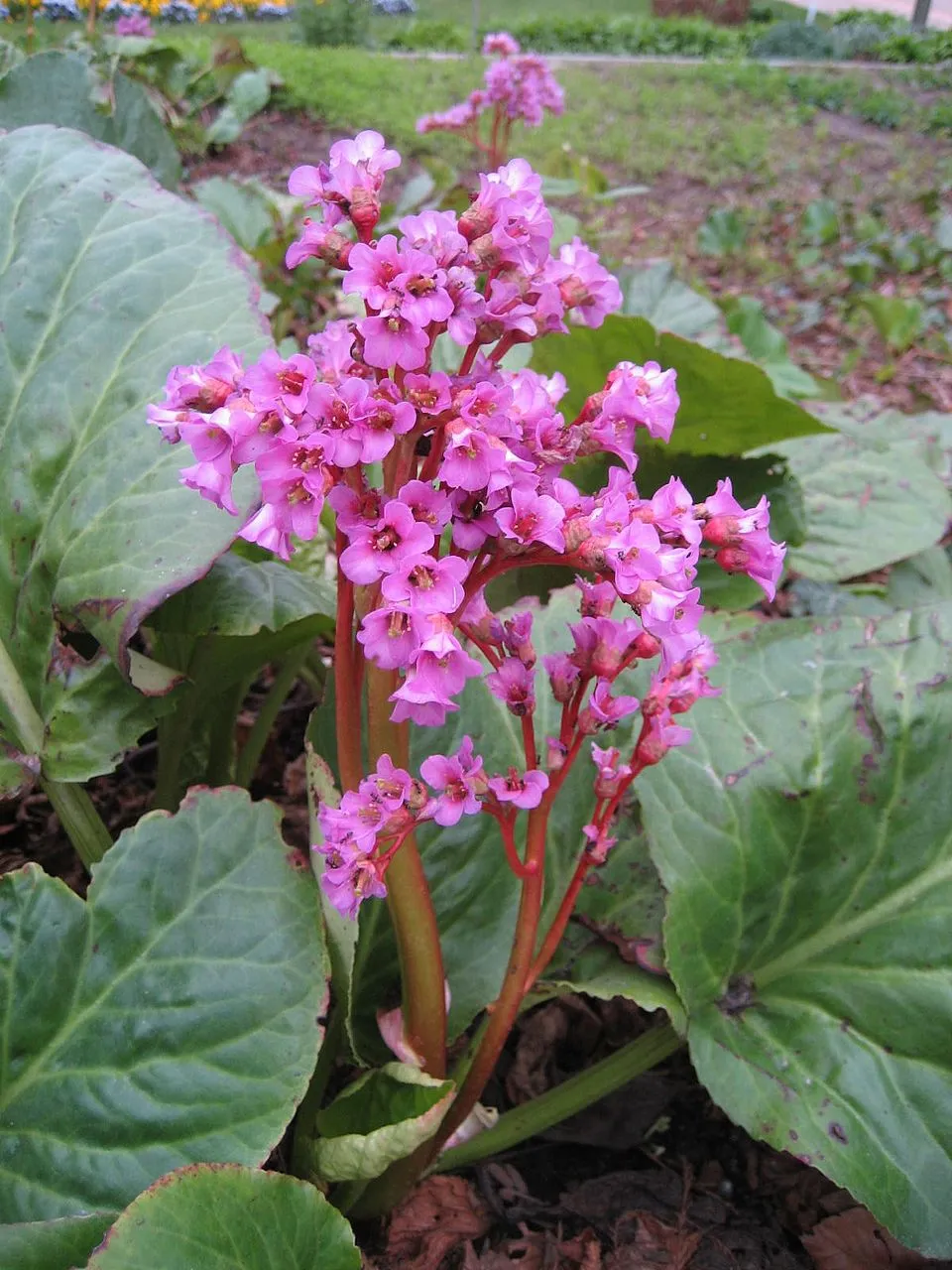
Bergenia cordifolia, widely recognized as Heartleaf Bergenia or Pigsqueak, is a robust and resilient evergreen perennial belonging to the Saxifragaceae family. This distinctive plant is indigenous to the formidable mountainous regions of Central Asia, including Siberia, Mongolia, and Northern China, where it thrives in cool, consistently moist, and shaded environments. Its historical significance is deeply rooted in the traditional folk medicine of these native regions, where for centuries it has been highly valued for its potent astringent and anti-inflammatory properties. The plant's most striking feature is its large, glossy, leathery, heart-shaped leaves, which are the origin of both its common name and the botanical epithet 'cordifolia' (derived from Latin 'cor' meaning heart and 'folius' meaning leaf).
These attractive leaves form dense, lush clumps, providing exceptional ground cover and often developing beautiful shades of red or bronze as temperatures cool. In early spring, Bergenia cordifolia produces sturdy, erect stalks adorned with clusters of delicate, bell-shaped flowers, ranging in color from soft pink to vibrant magenta, adding a welcome splash of color to the awakening garden. From a pharmacological standpoint, Bergenia cordifolia is notably rich in diverse polyphenolic compounds, particularly arbutin and a variety of tannins, which are largely responsible for its documented medicinal activities. Modern scientific inquiry has increasingly validated many of its traditional applications, with research focusing on its significant antioxidant, anti-inflammatory, antimicrobial, and gastroprotective effects.
Studies have explored its therapeutic potential in managing conditions such as gastrointestinal ulcers, inflammatory bowel disease, and various infectious ailments. Its remarkable adaptability and low-maintenance characteristics have also made it a highly popular choice in Western horticulture for creating serene shade gardens, charming rockeries, and elegant border plantings. While not explicitly detailed in ancient Ayurvedic or Traditional Chinese Medicine (TCM) texts, its long-standing recognition in Siberian and Mongolian ethnobotany underscores its enduring value as both a medicinal and ornamental plant. Trusted Scientific References Authoritative external sources for Bergenia cordifolia : Wikipedia — Bergenia cordifolia Kew POWO (Plants of the World Online) PubMed — peer-reviewed research NCBI Taxonomy Browser GBIF — Global Biodiversi ...[CURRENT TEXT EXISTS: 2502 chars]
1.1.Bergenia — Key Features
- ✓ <strong>Evergreen Perennial</strong> — Provides year-round interest with its robust, persistent foliage.
- ✓ <strong>Heart</strong> — Shaped Leaves — Distinctive large, glossy, leathery leaves that give the plant its common name.
- ✓ <strong>Cold Hardiness</strong> — Highly tolerant of cold temperatures, often displaying bronze or red foliage in winter.
- ✓ <strong>Shade Loving</strong> — Thrives in partial to full shade, making it ideal for difficult garden spots.
- ✓ <strong>Spring Flowers</strong> — Produces attractive clusters of pink to magenta bell-shaped flowers in early spring.
- ✓ <strong>Medicinal Rhizomes</strong> — The primary part used in traditional medicine, rich in active compounds.
- ✓ <strong>High in Polyphenols</strong> — Contains significant levels of arbutin, bergenin, and tannins, responsible for its therapeutic effects.
- ✓ <strong>Anti</strong> — Urolithiatic Action — Renowned in traditional medicine for its ability to help dissolve kidney and bladder stones.
- ✓ <strong>Ground Cover Plant</strong> — Forms dense clumps, providing excellent coverage and suppressing weeds.
- ✓ <strong>Native to Central Asia</strong> — Originates from mountainous regions, indicating its resilience and specific habitat preferences.
1.2.Bergenia — Quick Summary
- ✓ Heartleaf Bergenia (Bergenia cordifolia) is an evergreen perennial native to Central Asia, prized for its ornamental value and medicinal properties.
- ✓ Rich in potent polyphenols like bergenin and arbutin, it's traditionally used as an anti-inflammatory, astringent, and 'stone breaker' in folk medicine.
- ✓ Modern research supports its antioxidant, gastroprotective, and antimicrobial effects, validating many historical applications.
- ✓ Key benefits include support for urological health, digestive wellness, and anti-inflammatory relief.
- ✓ It thrives in cool, shaded environments and is valued for its low-maintenance nature in horticulture.
- ✓ Caution is advised for pregnant/nursing women, individuals with kidney issues, and those on certain medications.
2.Bergenia — Scientific Identity
3.Bergenia — Quick Facts
4.Bergenia — Appearance & Identification
5.Bergenia — Native Habitat
6.Bergenia — Water Requirements
- ✓ Site Selection — Choose a location with partial to full shade, as Bergenia cordifolia thrives in cooler, less intense light conditions.
- ✓ Soil Preparation — Plant in well-drained, humus-rich soil with a slightly acidic to neutral pH (6.0-7.0) to ensure optimal growth.
- ✓ Watering — Maintain consistent soil moisture, especially during dry periods, but avoid waterlogging to prevent root rot.
- ✓ Propagation — Easily propagated by dividing the rhizomes in spring or fall, or by sowing seeds, though seed propagation is slower.
- ✓ Fertilization — Apply a balanced, slow-release granular fertilizer or compost in early spring to support vigorous growth.
- ✓ Mulching — A layer of organic mulch helps retain soil moisture, suppress weeds, and regulate soil temperature.
- ✓ Pest and Disease Control — Generally resistant, but monitor for slugs and snails, especially on young leaves, and address any fungal issues with good air circulation.
Reviewed by the Flora Medical Global Botanical Review Panel
Multi-disciplinary editorial group · Botany · Ethnobotany · Herbal-medicine literature
Who reviewed this: This page was checked by the Flora Medical Global Botanical Review Panel — an in-house editorial group of botany graduates, ethnobotany researchers, and horticulture practitioners who collectively maintain our 7,000+ plant encyclopedia. Meet the team.
Our 4-step verification process
1. Taxonomic verification
Scientific names and synonyms cross-checked against Kew POWO, World Flora Online, and The Plant List.
2. Phytochemical & medicinal cross-reference
Active compounds, traditional uses, and reported activities are cross-referenced with PubMed, USDA Dr. Duke's database, and peer-reviewed ethnobotanical literature.
3. Conservation & distribution check
Distribution, ecology, and conservation status confirmed against GBIF occurrence records and the IUCN Red List.
4. Editorial & safety review
Every entry passes an editorial pass for clarity, originality, and safety notices (toxicity, contraindications, dosage caveats) before publication.
Last reviewed:
Editorial Note: This page is for educational and plant care purposes only.
Written by: Flora Medical Global Editorial Team
Reviewed by: Flora Medical Global Botanical Review Panel
Last Updated: June 15, 2026







Bergenia — Comments & Community Reviews
Rate this plant