

Care Disclaimer: Plant care recommendations are general guidelines based on common growing conditions. Individual results may vary based on your local environment, climate, and care routine. If your plant is toxic, keep it away from children and pets, and consult a veterinarian if accidental ingestion occurs.
1.Bergenia Crassifolia — Overview
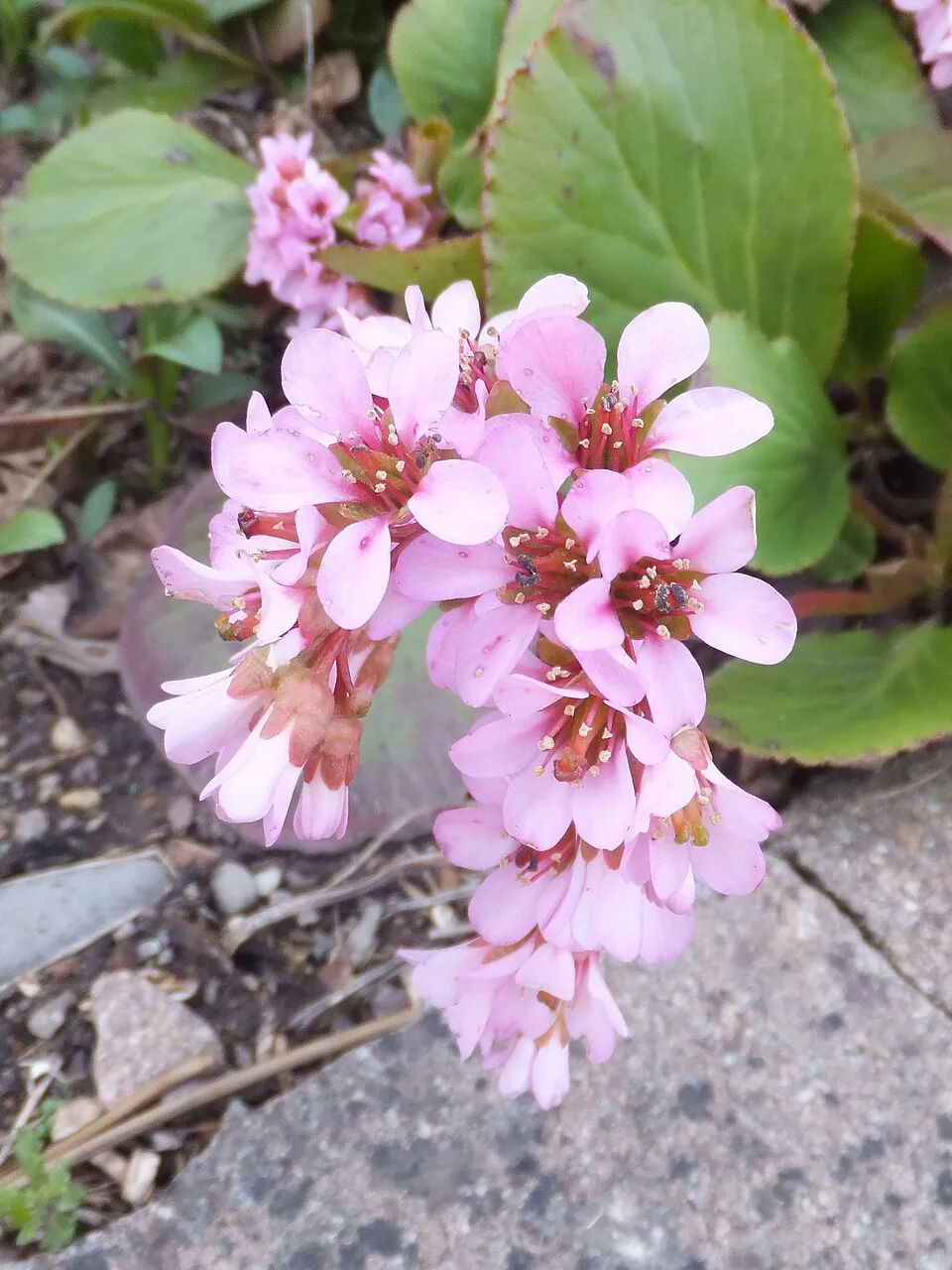
Bergenia crassifolia, commonly known as Heartleaf Bergenia, Elephant-Ears, Siberian Tea, or Badan, is a robust, rhizomatous perennial belonging to the Saxifragaceae family. This ornamental and medicinal plant is native to the cold, mountainous regions of Siberia, Altay, and Mongolia, thriving in semi-shady to shady environments with moderately dry, fertile soil. It typically forms dense clumps, reaching heights of 30 to 50 centimeters. The species epithet 'crassifolia' aptly describes its thick, leathery leaves, which are arranged in a prominent basal rosette.
These leaves are broadly elliptical to almost rounded, often cordate (heart-shaped) at the base, with obtuse or indistinctly dentate margins. Initially dark green, they famously transform into striking rust-brown or red hues in autumn, persisting through winter in warmer climates. The plant's creeping, fleshy rhizome can extend several meters, anchoring it firmly and contributing to its vigorous growth. In late spring to early summer, before the full emergence of new leaves, leafless, pinkish-red stems ascend, bearing dense, paniculately-corymbiform inflorescences of small, regular flowers.
These charming blooms are typically purple-red or pink, featuring obovate petals and ten prominent stamens. Following flowering, ellipsoidal capsules develop, containing numerous small, dark seeds that ripen by mid to late summer. Its resilience and striking foliage make it a popular choice for groundcover, rock gardens, and borders in temperate landscapes.
Trusted Scientific References
1. Authoritative external sources for Bergenia Crassifolia
1.1 Wikipedia — Bergenia Crassifolia
1.2 Kew POWO (Plants of the World Online)
1.3 PubMed — peer-reviewed research
1.4 NCBI Taxonomy Browser
1.5 GBIF — Global Biodiversity
1.6Bergenia Crassifolia should be interpreted through verified botanical identity, practical care, and responsible safety language. This recovery note adds the missing context needed for a complete profile: match light to the plant's habit, use well-drained soil, water according to season, and avoid unsupported medicinal or edible claims. For publishing, the plant can be presented as a source-backed garden plant with clear care guidance, common problem diagnosis, and conservative safety wording.
1.1.Bergenia Crassifolia — Key Features
- ✓ <strong>Resilient, clump</strong> — forming rhizomatous perennial.
- ✓ <strong>Striking basal rosette of thick, leathery, heart</strong> — shaped leaves.
- ✓ <strong>Leaves change from dark green to rust</strong> — red in autumn.
- ✓ <strong>Produces pink to purple</strong> — red flowers in late spring/early summer.
- ✓ <strong>Native to cold,</strong> — Native to cold, mountainous regions of Siberia and Mongolia.
- ✓ <strong>High concentrations of</strong> — High concentrations of medicinal compounds like tannins and arbutin.
- ✓ <strong>Traditional uses include digestive aid, anti</strong> — inflammatory, and expectorant.
- ✓ <strong>Commonly known as Heartleaf Bergenia, Elephant</strong> — Ears, and Siberian Tea.
- ✓ <strong>Adaptable ornamental plant</strong> — Adaptable ornamental plant for groundcover and rock gardens.
- ✓ <strong>Propagated effectively by</strong> — Propagated effectively by rhizome division.
1.2.Bergenia Crassifolia — Quick Summary
- ✓ Bergenia crassifolia, or Heartleaf Bergenia, is a rhizomatous perennial from Siberia.
- ✓ Valued for its anti-inflammatory, antioxidant, and digestive support properties.
- ✓ Rich in tannins, arbutin, and flavonoids, contributing to its medicinal efficacy.
- ✓ Traditionally used as Siberian tea and for various gastrointestinal and respiratory ailments.
- ✓ Requires semi-shady conditions and well-drained soil for optimal cultivation.
- ✓ Should be used with caution, especially by pregnant women or those with iron deficiency.
2.Bergenia Crassifolia — Scientific Identity
3.Bergenia Crassifolia — Quick Facts
4.Bergenia Crassifolia — Appearance & Identification
5.Bergenia Crassifolia — Native Habitat
6.Bergenia Crassifolia — Water Requirements
- Plant in early spring or fall to allow for optimal root establishment before extreme temperatures.
- Prefers semi-shady to shady locations, mimicking its natural forest understory habitat, though it can tolerate some morning sun.
- Thrives in well-drained, moderately moist, and fertile soil rich in organic matter; avoid waterlogged conditions.
- Water regularly during dry spells, especially during the initial establishment phase, but it shows good drought tolerance once mature.
- Propagate primarily by dividing the established rhizomes in the fall or early spring, ensuring each section has roots and a bud.
- Fertilize sparingly with a balanced, slow-release organic fertilizer in early spring to support vigorous growth and flowering.
- Remove spent flower stalks to encourage plant vigor, and prune any damaged or old leaves to maintain aesthetic appeal.
- Mulch around the base with organic material to conserve soil moisture, regulate temperature, and suppress weeds.
Reviewed by the Flora Medical Global Botanical Review Panel
Multi-disciplinary editorial group · Botany · Ethnobotany · Herbal-medicine literature
Who reviewed this: This page was checked by the Flora Medical Global Botanical Review Panel — an in-house editorial group of botany graduates, ethnobotany researchers, and horticulture practitioners who collectively maintain our 7,000+ plant encyclopedia. Meet the team.
Our 4-step verification process
1. Taxonomic verification
Scientific names and synonyms cross-checked against Kew POWO, World Flora Online, and The Plant List.
2. Phytochemical & medicinal cross-reference
Active compounds, traditional uses, and reported activities are cross-referenced with PubMed, USDA Dr. Duke's database, and peer-reviewed ethnobotanical literature.
3. Conservation & distribution check
Distribution, ecology, and conservation status confirmed against GBIF occurrence records and the IUCN Red List.
4. Editorial & safety review
Every entry passes an editorial pass for clarity, originality, and safety notices (toxicity, contraindications, dosage caveats) before publication.
Last reviewed:
Editorial Note: This page is for educational and plant care purposes only.
Written by: Flora Medical Global Editorial Team
Reviewed by: Flora Medical Global Botanical Review Panel
Last Updated: June 15, 2026







Bergenia Crassifolia — Comments & Community Reviews
Rate this plant