
Care Disclaimer: Plant care recommendations are general guidelines based on common growing conditions. Individual results may vary based on your local environment, climate, and care routine. If your plant is toxic, keep it away from children and pets, and consult a veterinarian if accidental ingestion occurs.
1.Bignonia Capreolata — Overview
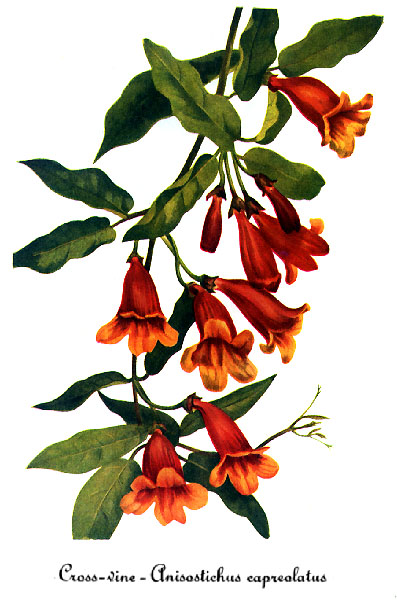
Bignonia capreolata, commonly known as Crossvine, is an elegant perennial woody vine native to the southeastern United States, belonging to the Bignoniaceae family. This vigorous climber is distinguished by its semi-evergreen foliage and striking floral displays. Its leaves are opposite and compound, typically presenting with two leaflets that often appear as four at each node, giving a characteristic 'cross' pattern when viewed from above.
The leaflets themselves are oblong to lanceolate with rounded bases, smooth, and entirely hairless. Between the leaflets, the vine develops branched tendrils, which it skillfully uses to twine and cling to various supports, enabling it to ascend trees and structures in its forest habitat. In early spring, generally from March to June, Crossvine produces a profusion of showy, trumpet-shaped flowers.
These blossoms are a vibrant combination of orange and yellow, often with a reddish exterior and a yellow throat, making them a significant early nectar source for pollinators like ruby-throated hummingbirds. Beyond its ornamental appeal, Bignonia capreolata thrives in well-drained soils rich in organic matter and prefers environments with ample sunlight, ideally receiving 6-8 hours of direct sun daily. While adaptable to diverse climates, it particularly flourishes in temperate zones, showcasing remarkable hardiness and resilience against common pests and diseases, which contributes to its suitability for ecological restoration and organic gardening practices.
Trusted Scientific References
1. Authoritative external sources for Bignonia Capreolata
1.1 Wikipedia — Bignonia Capreolata
1.2 Kew POWO (Plants of the World Online)
1.3 PubMed — peer-reviewed research
1.4 NCBI Taxonomy Browser
1.5 GBIF — Global Biodiversity
1.6Bignonia Capreolata should be interpreted through verified botanical identity, practical care, and responsible safety language. This recovery note adds the missing context needed for a complete profile: match light to the plant's habit, use well-drained soil, water according to season, and avoid unsupported medicinal or edible claims. For publishing, the plant can be presented as a source-backed garden plant with clear care guidance, common problem diagnosis, and conservative safety wording.
1.1.Bignonia Capreolata — Key Features
- ✓ <strong>Botanical Classification</strong> — Bignonia capreolata, a perennial woody vine in the Bignoniaceae family.
- ✓ <strong>Distinctive Foliage</strong> — Semi-evergreen, opposite, compound leaves with two leaflets often appearing as four per node, featuring branched tendrils.
- ✓ <strong>Showy Blooms</strong> — Produces vibrant orange and yellow trumpet-shaped flowers in early spring, attracting hummingbirds.
- ✓ <strong>Adaptogenic Properties</strong> — Traditionally revered for its ability to combat fatigue and support the body's response to stress.
- ✓ <strong>Ethnobotanical Significance</strong> — Rich history of use among Native American tribes (Cherokee, Koasati) and Appalachian folk herbalists.
- ✓ <strong>Unique Phytochemistry</strong> — Contains indole alkaloids, notably a reserpine-like compound, with ongoing research into its full spectrum of constituents.
- ✓ <strong>Ecological Value</strong> — Provides early nectar for pollinators and serves as forage for wildlife.
- ✓ <strong>Cultivation Ease</strong> — Hardy and resilient, thriving in sunny, well-drained conditions with minimal pest issues.
- ✓ <strong>Traditional Alterative</strong> — Historically used as a 'blood purifier' to support overall systemic health.
- ✓ <strong>Potential Anti</strong> — inflammatory — Traditional applications suggest properties that may help reduce inflammation and rheumatic pain.
1.2.Bignonia Capreolata — Quick Summary
- ✓ Native Southeastern US vine with striking orange and yellow trumpet flowers.
- ✓ Traditionally used as an adaptogen for fatigue and a blood purifier.
- ✓ Contains indole alkaloids similar to reserpine, contributing to its effects.
- ✓ Valued in Native American and Appalachian folk herbalism for various ailments.
- ✓ Requires well-drained soil and ample sunlight for optimal growth.
- ✓ Limited modern research, emphasizing traditional knowledge and cautious use.
2.Bignonia Capreolata — Scientific Identity
3.Bignonia Capreolata — Quick Facts
4.Bignonia Capreolata — Appearance & Identification
5.Bignonia Capreolata — Native Habitat
6.Bignonia Capreolata — Water Requirements
- ✓ Soil Preference — Thrives in well-drained soil that is rich in organic matter, ensuring proper aeration and nutrient availability.
- ✓ Sunlight Requirements — Prefers a sunny environment, requiring at least 6-8 hours of direct sunlight per day for optimal growth and flowering.
- ✓ Climatic Adaptability — Adaptable to various climates but flourishes best in temperate zones, demonstrating resilience across different environmental conditions.
- ✓ Watering Needs — Due to its shallow root system, consistent moisture is crucial, necessitating adequate irrigation, especially during dry spells.
- ✓ Support Structure — As a climbing vine, Bignonia capreolata requires a trellis, arbor, or other vertical support for its tendrils to cling and twine.
- ✓ Pest and Disease Resistance — Exhibits notable hardiness and resilience against common garden pests and diseases, making it suitable for low-maintenance and organic gardening.
- ✓ Propagation — Can be propagated from seeds, cuttings, or by layering, with cuttings generally offering a faster establishment.
- ✓ Pruning — Benefits from occasional pruning to manage its vigorous growth, encourage bushier habit, and promote abundant flowering.
Reviewed by the Flora Medical Global Botanical Review Panel
Multi-disciplinary editorial group · Botany · Ethnobotany · Herbal-medicine literature
Who reviewed this: This page was checked by the Flora Medical Global Botanical Review Panel — an in-house editorial group of botany graduates, ethnobotany researchers, and horticulture practitioners who collectively maintain our 7,000+ plant encyclopedia. Meet the team.
Our 4-step verification process
1. Taxonomic verification
Scientific names and synonyms cross-checked against Kew POWO, World Flora Online, and The Plant List.
2. Phytochemical & medicinal cross-reference
Active compounds, traditional uses, and reported activities are cross-referenced with PubMed, USDA Dr. Duke's database, and peer-reviewed ethnobotanical literature.
3. Conservation & distribution check
Distribution, ecology, and conservation status confirmed against GBIF occurrence records and the IUCN Red List.
4. Editorial & safety review
Every entry passes an editorial pass for clarity, originality, and safety notices (toxicity, contraindications, dosage caveats) before publication.
Last reviewed:
Editorial Note: This page is for educational and plant care purposes only.
Written by: Flora Medical Global Editorial Team
Reviewed by: Flora Medical Global Botanical Review Panel
Last Updated: June 15, 2026







Bignonia Capreolata — Comments & Community Reviews
Rate this plant