

Care Disclaimer: Plant care recommendations are general guidelines based on common growing conditions. Individual results may vary based on your local environment, climate, and care routine. If your plant is toxic, keep it away from children and pets, and consult a veterinarian if accidental ingestion occurs.
1.Borago Officinalis — Overview
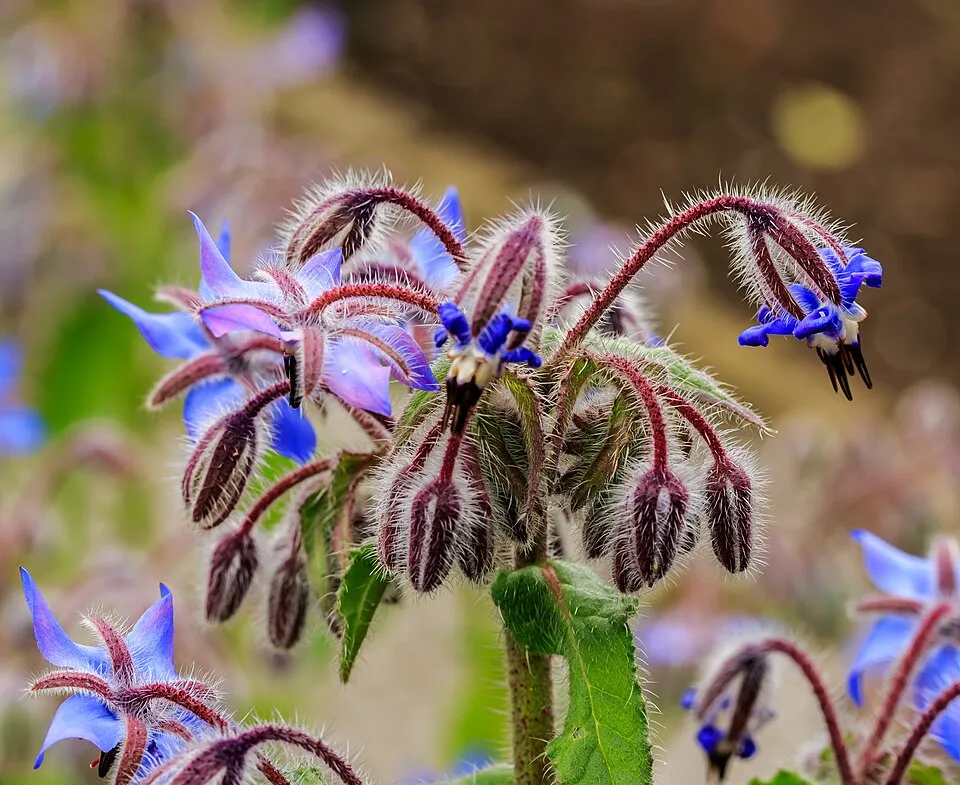
Borago officinalis, commonly known as Borage or Starflower, is a captivating annual herbaceous plant belonging to the Boraginaceae family, native to the Mediterranean region but widely naturalized across various temperate climates. It typically grows to a height of 60 to 90 cm (24 to 36 inches), characterized by its robust, hollow stems covered with stiff, bristly hairs. The leaves are ovate to lanceolate, also densely covered with coarse hairs, giving them a rough texture.
They grow alternately along the stem, often forming a basal rosette before the stem elongates. The most striking feature of Borago officinalis is its star-shaped flowers, which emerge in loose cymes. These vibrant blossoms display a unique color transformation, often starting pink and maturing into a brilliant sky-blue, though white and purple varieties also exist.
Each flower features five pointed petals and prominent black anthers forming a cone in the center, which is highly attractive to pollinators, especially bees, due to its abundant nectar production. Borago officinalis thrives in well-drained, moderately fertile soil and prefers full sun to partial shade. Its adaptability allows it to flourish in diverse habitats, from cultivated gardens and herb patches to roadsides and disturbed ground, making it a resilient and widespread species.
Trusted Scientific References
1. Authoritative external sources for Borago Officinalis
1.1 Wikipedia — Borago Officinalis
1.2 Kew POWO (Plants of the World Online)
1.3 PubMed — peer-reviewed research
1.4 NCBI Taxonomy Browser
1.5 GBIF — Global Biodiversity
1.6Borago Officinalis should be interpreted through verified botanical identity, practical care, and responsible safety language. This recovery note adds the missing context needed for a complete profile: match light to the plant's habit, use well-drained soil, water according to season, and avoid unsupported medicinal or edible claims. For publishing, the plant can be presented as a source-backed garden plant with clear care guidance, common problem diagnosis, and conservative safety wording.
1.1.Borago Officinalis — Key Features
- ✓ <strong>Star</strong> — shaped blue flowers — Distinctive, vibrant blue, star-shaped blossoms that are highly ornamental and attract pollinators.
- ✓ <strong>Bristly foliage</strong> — Leaves and stems are covered with coarse, stiff hairs, giving the plant a unique texture.
- ✓ <strong>Rich in GLA</strong> — Seeds are a primary botanical source of Gamma-Linolenic Acid, a valuable omega-6 fatty acid.
- ✓ <strong>Antioxidant powerhouse</strong> — Contains high levels of rosmarinic acid and flavonoids, offering strong antioxidant protection.
- ✓ <strong>Mediterranean origin</strong> — Native to the Mediterranean region, adapted to warm climates and well-drained soils.
- ✓ <strong>Self</strong> — seeding annual — Easily grown from seed and often self-propagates, returning year after year in suitable conditions.
- ✓ <strong>Culinary versatility</strong> — Young leaves and flowers are edible, used in salads, drinks, and cooked dishes for a mild cucumber flavor.
- ✓ <strong>Traditional medicinal uses</strong> — Long history of use in herbal medicine for inflammation, respiratory issues, and mood support.
- ✓ <strong>Pollinator magnet</strong> — Highly attractive to bees and other beneficial insects, enhancing garden biodiversity.
- ✓ <strong>Hormonal support</strong> — Utilized for supporting women's health, particularly for PMS and menopausal symptoms.
1.2.Borago Officinalis — Quick Summary
- ✓ Borage (Borago officinalis) is an annual herb known for its star-shaped blue flowers and bristly leaves.
- ✓ Rich in Gamma-Linolenic Acid (GLA) and rosmarinic acid, offering significant anti-inflammatory and antioxidant benefits.
- ✓ Traditionally used for digestive, respiratory, and skin health, and to alleviate hormonal symptoms.
- ✓ Contains pyrrolizidine alkaloids (PAs) which necessitate caution regarding liver toxicity, especially with prolonged use of the herb.
- ✓ Highly attractive to pollinators, making it valuable for ecological gardens.
- ✓ Versatile in culinary applications, from fresh salads to cooked greens and infused beverages.
2.Borago Officinalis — Scientific Identity
3.Borago Officinalis — Quick Facts
4.Borago Officinalis — Appearance & Identification
5.Borago Officinalis — Native Habitat
6.Borago Officinalis — Water Requirements
- ✓ Soil Preference — Borago officinalis thrives in well-drained, loamy soil with a pH range of 6.0 to 7.5, which mimics its native Mediterranean environment.
- ✓ Sun Exposure — Requires full sun to partial shade for optimal growth, with full sun encouraging more prolific flowering and denser foliage.
- ✓ Watering Regime — Needs regular watering, especially during dry spells, but it is crucial to avoid overwatering to prevent root rot, as the plant prefers consistently moist, not waterlogged, conditions.
- ✓ Fertilization — Benefits from a balanced, organic fertilizer applied every few months during the growing season to support its vigorous growth and flower production.
- ✓ Pruning and Deadheading — Pruning dead or wilted flowers (deadheading) encourages continuous blooming and helps maintain plant vigor, extending the harvest period for leaves and flowers.
- ✓ Propagation — Easily propagated from seed, which can be directly sown outdoors after the last frost, or started indoors for an earlier harvest. Borago often self-seeds readily.
- ✓ Pest and Disease Management — Generally robust, Borago is relatively pest-resistant. Ensure good air circulation to prevent fungal issues in humid conditions.
- ✓ Companion Planting — Excellent companion for tomatoes, strawberries, and cabbage, attracting beneficial pollinators and deterring pests.
Reviewed by the Flora Medical Global Botanical Review Panel
Multi-disciplinary editorial group · Botany · Ethnobotany · Herbal-medicine literature
Who reviewed this: This page was checked by the Flora Medical Global Botanical Review Panel — an in-house editorial group of botany graduates, ethnobotany researchers, and horticulture practitioners who collectively maintain our 7,000+ plant encyclopedia. Meet the team.
Our 4-step verification process
1. Taxonomic verification
Scientific names and synonyms cross-checked against Kew POWO, World Flora Online, and The Plant List.
2. Phytochemical & medicinal cross-reference
Active compounds, traditional uses, and reported activities are cross-referenced with PubMed, USDA Dr. Duke's database, and peer-reviewed ethnobotanical literature.
3. Conservation & distribution check
Distribution, ecology, and conservation status confirmed against GBIF occurrence records and the IUCN Red List.
4. Editorial & safety review
Every entry passes an editorial pass for clarity, originality, and safety notices (toxicity, contraindications, dosage caveats) before publication.
Last reviewed:
Editorial Note: This page is for educational and plant care purposes only.
Written by: Flora Medical Global Editorial Team
Reviewed by: Flora Medical Global Botanical Review Panel
Last Updated: June 15, 2026







Borago Officinalis — Comments & Community Reviews
Rate this plant