


Care Disclaimer: Plant care recommendations are general guidelines based on common growing conditions. Individual results may vary based on your local environment, climate, and care routine. If your plant is toxic, keep it away from children and pets, and consult a veterinarian if accidental ingestion occurs.
1.Boston Ivy — Overview
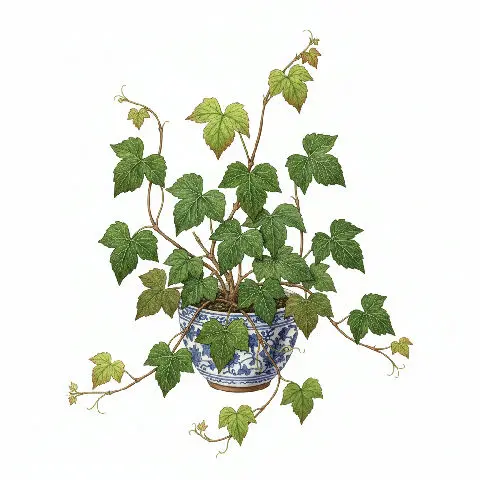
Boston Ivy, scientifically known as Parthenocissus tricuspidata, is a vigorous, deciduous woody vine belonging to the grape family, Vitaceae. Native to East Asia, specifically Japan, Korea, and northern and eastern China, this plant has gained immense popularity worldwide for its striking autumn foliage and exceptional climbing abilities. Its common name 'Boston Ivy' reflects its widespread use as an ornamental climbing plant on buildings in urban areas, particularly in Boston, Massachusetts, where it famously adorns collegiate architecture and historic homes.
It is often confused with its close relative, Virginia Creeper (Parthenocissus quinquefolia), but can be distinguished by its typically three-lobed leaves, whereas Virginia Creeper usually has five distinct leaflets. The plant's ability to cling to surfaces is facilitated by specialized adhesive pads or holdfasts that develop at the tips of its tendrils, allowing it to ascend smooth walls without the need for additional support. This characteristic makes it an ideal candidate for greening vertical surfaces, contributing to urban biodiversity and cooling effects.
From a botanical perspective, its rapid growth rate can cover large areas quickly, providing a dense canopy of foliage that transitions from vibrant green in spring and summer to fiery shades of red, orange, and purple in autumn, making it a highly desirable ornamental plant. Beyond its aesthetic appeal, Parthenocissus tricuspidata has historically been valued in traditional East Asian medicine, particularly in Traditional Chinese Medicine (TCM), for properties related to blood circulation, pain relief, and anti-inflammatory effects, with modern research beginning to explore its rich phytochemical composition.
Trusted Scientific References
1. Authoritative external sources for Parthenocissus tricuspidata
1.1 Wikipedia — Parthenocissus tricuspidata
1.2 Kew POWO (Plants of the World Online)
1.3 PubMed — peer-reviewed research
1.4 NCBI Taxonomy Browser
1.5 GBIF — Global Biodiversity
1.1.Boston Ivy — Key Features
- ✓ <strong>Deciduous woody vine</strong> — Deciduous woody vine with a highly vigorous climbing growth habit.
- ✓ <strong>Native to East</strong> — Native to East Asia, specifically regions of Japan, Korea, and China.
- ✓ <strong>Features distinctive three</strong> — lobed leaves, distinguishing it from related species like Virginia Creeper.
- ✓ <strong>Exhibits spectacular autumn</strong> — Exhibits spectacular autumn coloration, with leaves turning vibrant shades of red, orange, and purple.
- ✓ <strong>Climbs effectively via</strong> — Climbs effectively via specialized tendrils equipped with adhesive discs, allowing it to cling to smooth surfaces.
- ✓ <strong>Highly valued as</strong> — Highly valued as an ornamental plant for covering walls, buildings, and providing urban greening benefits.
- ✓ <strong>Possesses traditional medicinal</strong> — Possesses traditional medicinal applications in East Asian systems for addressing pain and inflammation.
- ✓ <strong>Phytochemically rich, containing</strong> — Phytochemically rich, containing significant amounts of flavonoids, stilbenoids, and phenolic acids.
- ✓ <strong>Produces small, dark</strong> — Produces small, dark berries that are attractive to birds but are considered mildly toxic to humans and pets.
- ✓ <strong>Demonstrates high tolerance</strong> — Demonstrates high tolerance to urban environmental stressors, including pollution, wind, and varied soil conditions.
1.2.Boston Ivy — Quick Summary
- ✓ Vigorous deciduous woody vine native to East Asia, belonging to the Vitaceae family.
- ✓ Renowned for its stunning three-lobed leaves that transform into brilliant red, orange, and purple hues in autumn.
- ✓ Traditionally utilized in East Asian medicine, particularly TCM, for its anti-inflammatory, analgesic, and blood circulation-enhancing properties.
- ✓ Rich in beneficial phytochemicals, including flavonoids and stilbenoids, which contribute to its therapeutic potential.
- ✓ Produces small, dark, mildly toxic berries; internal medicinal use requires strict expert guidance and caution.
2.Boston Ivy — Scientific Identity
3.Boston Ivy — Quick Facts
4.Boston Ivy — Appearance & Identification
5.Boston Ivy — Native Habitat
6.Boston Ivy — Water Requirements
- ✓ Site Selection — Thrives best in full sun to partial shade; full sun exposure is crucial for the development of its most vibrant and intense autumn leaf coloration.
- ✓ Soil Requirements — Adaptable to a wide array of soil types, ranging from rocky and poor soils to those rich in organic matter, and tolerates various pH levels, but consistently prefers well-drained conditions.
- ✓ Watering — Requires moderate watering, particularly during prolonged dry spells; once established, Parthenocissus tricuspidata exhibits good tolerance to drought conditions.
- ✓ Propagation — Primarily propagated through stem cuttings taken during the late spring or early summer, and can also be grown from seeds following an appropriate cold stratification period.
- ✓ Pruning — Regular and diligent pruning is essential to manage its vigorous and expansive growth, preventing it from damaging structures such as gutters, shingles, or electrical wiring.
- ✓ Pest and Disease Management — Generally robust and low-maintenance, but gardeners should monitor for occasional issues like Japanese beetles, leafhoppers, or common fungal problems such as mildew and leaf spots, which are typically not severe.
- ✓ Support Structure — Naturally adheres to vertical surfaces like masonry or brick walls using specialized tendrils equipped with adhesive discs; however, it should not be allowed to climb wooden siding or shingled roofs.
Reviewed by the Flora Medical Global Botanical Review Panel
Multi-disciplinary editorial group · Botany · Ethnobotany · Herbal-medicine literature
Who reviewed this: This page was checked by the Flora Medical Global Botanical Review Panel — an in-house editorial group of botany graduates, ethnobotany researchers, and horticulture practitioners who collectively maintain our 7,000+ plant encyclopedia. Meet the team.
Our 4-step verification process
1. Taxonomic verification
Scientific names and synonyms cross-checked against Kew POWO, World Flora Online, and The Plant List.
2. Phytochemical & medicinal cross-reference
Active compounds, traditional uses, and reported activities are cross-referenced with PubMed, USDA Dr. Duke's database, and peer-reviewed ethnobotanical literature.
3. Conservation & distribution check
Distribution, ecology, and conservation status confirmed against GBIF occurrence records and the IUCN Red List.
4. Editorial & safety review
Every entry passes an editorial pass for clarity, originality, and safety notices (toxicity, contraindications, dosage caveats) before publication.
Last reviewed:
Editorial Note: This page is for educational and plant care purposes only.
Written by: Flora Medical Global Editorial Team
Reviewed by: Flora Medical Global Botanical Review Panel
Last Updated: June 15, 2026







Boston Ivy — Comments & Community Reviews
Rate this plant