

Care Disclaimer: Plant care recommendations are general guidelines based on common growing conditions. Individual results may vary based on your local environment, climate, and care routine. If your plant is toxic, keep it away from children and pets, and consult a veterinarian if accidental ingestion occurs.
1.Bougainvillea Barbara Karst — Overview
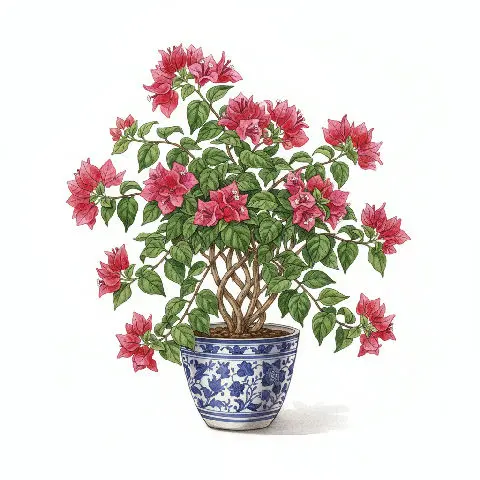
Bougainvillea 'Barbara Karst' is a captivating and exceptionally robust hybrid within the genus Bougainvillea, celebrated for its prolific display of brilliant magenta-red bracts. While its exact genetic parentage is a horticultural achievement, it is widely understood to derive its vigorous characteristics and intense coloration from foundational species such as Bougainvillea spectabilis and B. glabra. This ornamental climber originates from the warm, humid regions of South America, a lineage acknowledged by its genus name, which honors the 18th-century French explorer Louis Antoine de Bougainville.
Morphologically, 'Barbara Karst' presents as a woody vine or shrub, capable of extensive growth, featuring ovate to lanceolate green leaves and sharp thorns. The true flowers are small, inconspicuous, and typically white or yellow, nestled within the much larger, papery, and vibrantly colored bracts that give the plant its renowned visual appeal. Depending on the climate, it can exhibit a semi-deciduous habit in cooler subtropical zones or remain evergreen in consistently frost-free tropical environments. Its adaptable nature allows it to thrive in a variety of warm settings, from coastal areas to arid regions, provided it receives ample sunlight.
Globally, it has become a staple in landscaping for its long-lasting bloom cycles and ability to create dramatic cascades of color, making it a testament to both natural beauty and horticultural innovation. Beyond its widespread ornamental application, the broader Bougainvillea genus has a rich history of traditional medicinal use, particularly in regions like Mexico and Central America, a heritage that 'Barbara Karst' potentially shares through its genetic makeup.
Trusted Scientific References
1. Authoritative external sources for Bougainvillea hybrid
1.1 Wikipedia — Bougainvillea hybrid
1.2 Kew POWO (Plants of the World Online)
1.3 PubMed — peer-reviewed research
1.4 NCBI Taxonomy Browser
1.5 GBIF — Global Biodiversity
1.6Bougainvillea Barbara Karst should be interpreted through verified botanical identity, practical care, and responsible safety language. This recovery note adds the missing context needed for a complete profile: match light to the plant's habit, use well-drained soil, water according to season, and avoid unsupported medicinal or edible claims. For publishing, the plant can be presented as a source-backed garden plant with clear care guidance, common problem diagnosis, and conservative safety wording.
1.1.Bougainvillea Barbara Karst — Key Features
- ✓ <strong>Brilliant Magenta</strong> — Red Bracts — The most striking feature, offering a long-lasting and intense visual display.
- ✓ <strong>Vigorous Growth Habit</strong> — A robust climber or spreading shrub, ideal for covering large areas, walls, or trellises.
- ✓ <strong>Drought Tolerant</strong> — Highly adaptable to dry conditions once established, requiring less water than many ornamentals.
- ✓ <strong>Semi</strong> — deciduous to Evergreen — Its foliage retention varies by climate, remaining green year-round in tropical zones.
- ✓ <strong>Traditional Medicinal Uses</strong> — Carries the ethnobotanical legacy of the Bougainvillea genus for respiratory and fever remedies.
- ✓ <strong>Rich Phytochemical Profile</strong> — Contains valuable compounds like pinitol, diverse flavonoids, and antioxidant betacyanins.
- ✓ <strong>Extended Bloom Period</strong> — Offers prolific flowering over many months, especially in suitable warm climates.
- ✓ <strong>Low Maintenance</strong> — Relatively easy to care for, requiring minimal attention beyond pruning and occasional feeding.
- ✓ <strong>Ornamental Versatility</strong> — Can be grown as a specimen plant, hedge, groundcover, or in containers.
- ✓ <strong>Hybrid Vigor</strong> — Exhibiting enhanced growth, disease resistance, and floriferousness compared to some wild species.
1.2.Bougainvillea Barbara Karst — Quick Summary
- ✓ Bougainvillea 'Barbara Karst' is a vibrant, ornamental hybrid known for its magenta-red bracts and vigorous growth.
- ✓ Traditionally, the broader Bougainvillea genus has been used for respiratory ailments and fever reduction.
- ✓ The plant is rich in beneficial phytochemicals, including pinitol, flavonoids, and betacyanins.
- ✓ Research suggests potential anti-inflammatory, antioxidant, antimicrobial, and antidiabetic properties.
- ✓ Cultivation requires warm, frost-free climates and abundant sunlight for optimal flowering.
- ✓ Caution is advised due to potential skin irritation from sap and thorns, and limited specific human clinical data.
2.Bougainvillea Barbara Karst — Scientific Identity
3.Bougainvillea Barbara Karst — Quick Facts
4.Bougainvillea Barbara Karst — Appearance & Identification
5.Bougainvillea Barbara Karst — Native Habitat
6.Bougainvillea Barbara Karst — Water Requirements
- ✓ Climate Preference — Thrives in tropical and subtropical regions, ideally in USDA Hardiness Zones 9-11, requiring warm, frost-free conditions for vigorous growth and continuous blooming.
- ✓ Sunlight Requirements — Demands full sun exposure, at least 6 hours daily, to produce the most vibrant bracts and promote abundant flowering.
- ✓ Soil Conditions — Prefers well-draining soil, slightly acidic to neutral (pH 5.5-7.0), and can tolerate poor soil quality, though enriched soil will enhance growth.
- ✓ Watering Regimen — Drought-tolerant once established, but regular, deep watering is beneficial during dry periods, allowing the soil to dry out between waterings to encourage blooming.
- ✓ Pruning Techniques — Regular pruning is essential to maintain shape, control size, encourage new growth, and promote a continuous flush of flowers, especially after major bloom cycles.
- ✓ Fertilization Schedule — Apply a balanced fertilizer during the active growing season, but switch to a low-nitrogen, high-phosphorus fertilizer to encourage more bract production.
- ✓ Propagation Method — Primarily propagated through semi-hardwood stem cuttings taken in spring or early summer, which root relatively easily with rooting hormone.
- ✓ Pest and Disease Management — Generally robust, but monitor for common pests like aphids, mealybugs, and scale insects; maintain good air circulation to prevent fungal issues.
Reviewed by the Flora Medical Global Botanical Review Panel
Multi-disciplinary editorial group · Botany · Ethnobotany · Herbal-medicine literature
Who reviewed this: This page was checked by the Flora Medical Global Botanical Review Panel — an in-house editorial group of botany graduates, ethnobotany researchers, and horticulture practitioners who collectively maintain our 7,000+ plant encyclopedia. Meet the team.
Our 4-step verification process
1. Taxonomic verification
Scientific names and synonyms cross-checked against Kew POWO, World Flora Online, and The Plant List.
2. Phytochemical & medicinal cross-reference
Active compounds, traditional uses, and reported activities are cross-referenced with PubMed, USDA Dr. Duke's database, and peer-reviewed ethnobotanical literature.
3. Conservation & distribution check
Distribution, ecology, and conservation status confirmed against GBIF occurrence records and the IUCN Red List.
4. Editorial & safety review
Every entry passes an editorial pass for clarity, originality, and safety notices (toxicity, contraindications, dosage caveats) before publication.
Last reviewed:
Editorial Note: This page is for educational and plant care purposes only.
Written by: Flora Medical Global Editorial Team
Reviewed by: Flora Medical Global Botanical Review Panel
Last Updated: June 15, 2026







Bougainvillea Barbara Karst — Comments & Community Reviews
Rate this plant