
Care Disclaimer: Plant care recommendations are general guidelines based on common growing conditions. Individual results may vary based on your local environment, climate, and care routine. If your plant is toxic, keep it away from children and pets, and consult a veterinarian if accidental ingestion occurs.
1.Bowiea Volubilis — Overview
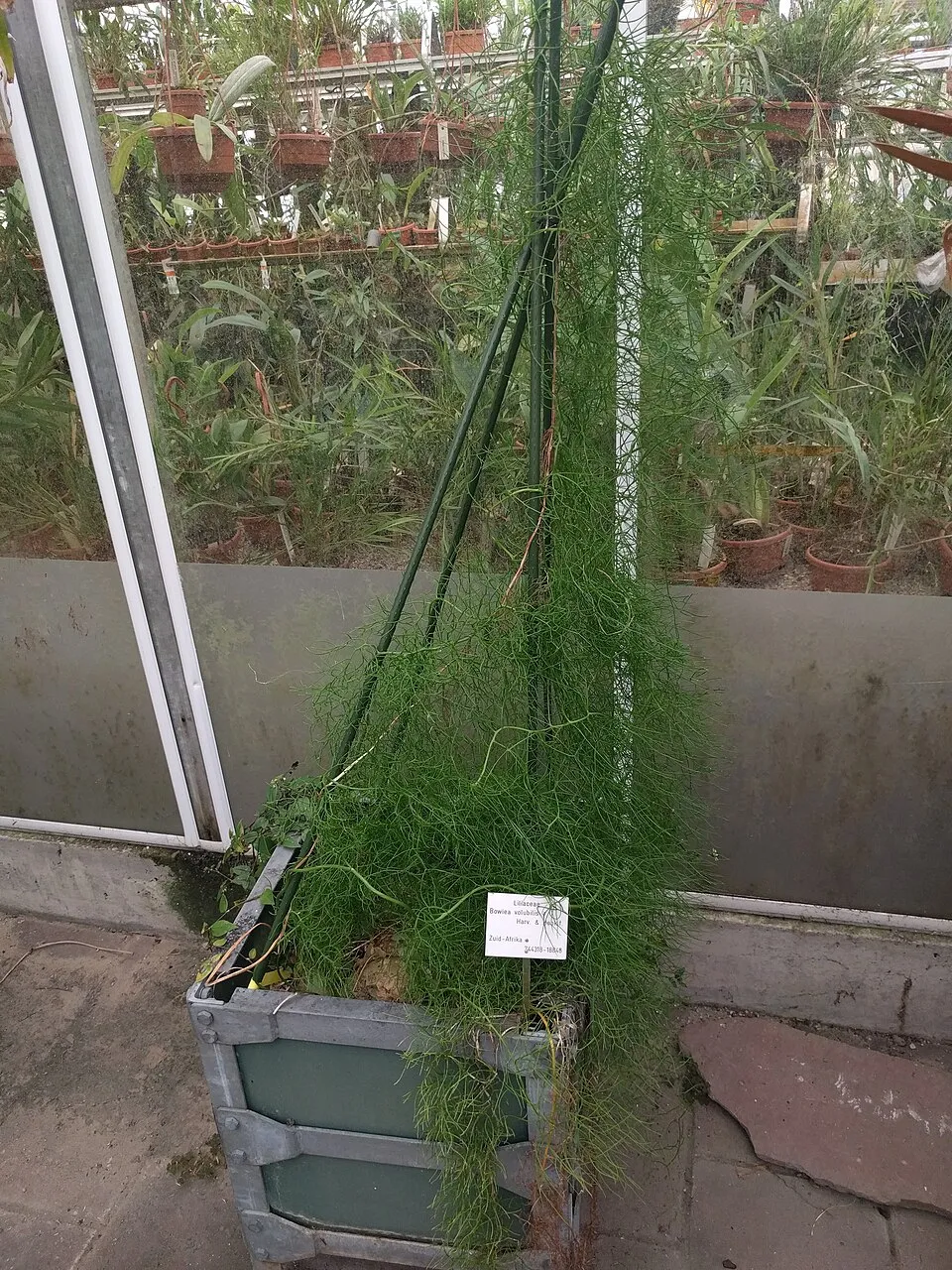
Bowiea volubilis, commonly known as the Climbing Onion or Sea Onion, is a remarkably unique perennial succulent native to southern and eastern Africa, particularly South Africa, Eswatini, and Lesotho. This distinctive plant is characterized by its large, partially exposed, greenish bulb, which can grow up to 25 cm in diameter and serves as a water and nutrient storage organ. From this bulb emerges a slender, highly branched, bright green, twining stem that can reach several meters in length, scrambling over shrubs or trellises.
The leaves are highly reduced, scale-like, and ephemeral, often only appearing briefly before withering, with the stem largely performing the photosynthetic function. During its active growth period, typically in summer, Bowiea volubilis produces numerous small, star-shaped, greenish-white flowers along its stems, followed by three-angled capsules containing black seeds. It thrives in arid to semi-arid environments, often found in rocky outcrops or scrambling through sparse vegetation, preferring well-drained soils and bright, indirect light.
Taxonomically, it belongs to the Asparagaceae family, specifically the subfamily Scilloideae, highlighting its relation to other bulbous monocots.
Trusted Scientific References
1. Authoritative external sources for Bowiea Volubilis
1.1 Wikipedia — Bowiea Volubilis
1.2 Kew POWO (Plants of the World Online)
1.3 PubMed — peer-reviewed research
1.4 NCBI Taxonomy Browser
1.5 GBIF — Global Biodiversity
1.6Bowiea Volubilis should be interpreted through verified botanical identity, practical care, and responsible safety language. This recovery note adds the missing context needed for a complete profile: match light to the plant's habit, use well-drained soil, water according to season, and avoid unsupported medicinal or edible claims. For publishing, the plant can be presented as a source-backed garden plant with clear care guidance, common problem diagnosis, and conservative safety wording.
1.1.Bowiea Volubilis — Key Features
- ✓ <strong>Prominent, partially exposed,</strong> — Prominent, partially exposed, green bulb, resembling an onion, serving as a storage organ.
- ✓ <strong>Deciduous, highly branched,</strong> — Deciduous, highly branched, twining stems that climb vigorously over supports.
- ✓ <strong>Contains powerful cardiac</strong> — Contains powerful cardiac glycosides, making it highly toxic if ingested by humans or animals.
- ✓ <strong>Traditional uses in</strong> — Traditional uses in African medicine for respiratory ailments, coughs, and colds.
- ✓ <strong>Exhibits documented antifungal,</strong> — Exhibits documented antifungal, antibacterial, and cytotoxic properties in research.
- ✓ <strong>Drought</strong> — tolerant and adapted to arid to semi-arid environments of Southern Africa.
- ✓ <strong>Valued as a</strong> — Valued as a unique ornamental succulent for its unusual growth habit and aesthetic.
- ✓ <strong>Native to Southern</strong> — Native to Southern and Eastern Africa, often found scrambling in scrubland or rocky areas.
- ✓ <strong>Produces small, star</strong> — like, greenish-white flowers during its active growing season.
1.2.Bowiea Volubilis — Quick Summary
- ✓ Common name "Climbing Onion" known for its exposed, green bulb and unique climbing stems.
- ✓ Contains highly potent and toxic cardiac glycosides, alkaloids, and saponins.
- ✓ Traditionally used for respiratory issues, coughs, colds, and as a cardiac remedy, but with extreme caution.
- ✓ Poses significant health risks if ingested; not suitable for self-medication due to high toxicity.
- ✓ Primarily cultivated as an ornamental plant due to its distinctive growth habit.
2.Bowiea Volubilis — Scientific Identity
3.Bowiea Volubilis — Quick Facts
4.Bowiea Volubilis — Appearance & Identification
5.Bowiea Volubilis — Native Habitat
6.Bowiea Volubilis — Water Requirements
- ✓ Propagation — Primarily from seeds, which should be sown in well-drained soil, or by carefully dividing offsets from the main bulb, ensuring each piece has a growth point.
- ✓ Soil Requirements — Thrives in very well-drained, gritty, or sandy potting mix, mimicking its natural arid habitat to effectively prevent bulb rot.
- ✓ Light Conditions — Prefers bright, indirect light to partial sun; direct scorching sun should be avoided, especially in hot climates, to prevent sunburn.
- ✓ Watering — Water sparingly during its active growth period, allowing the soil to dry out completely between waterings; almost no water during winter dormancy.
- ✓ Temperature & Humidity — Requires warm temperatures, ideally between 18-28°C (65-82°F), and is highly sensitive to frost, necessitating indoor protection in colder zones.
- ✓ Support Structure — As a climbing plant, Bowiea volubilis benefits from a trellis, stake, or nearby plant to support its twining stems and prevent sprawling.
- ✓ Container Growing — Excellent choice for containers, allowing for better control over soil conditions and easy relocation for winter protection or aesthetic placement.
Reviewed by the Flora Medical Global Botanical Review Panel
Multi-disciplinary editorial group · Botany · Ethnobotany · Herbal-medicine literature
Who reviewed this: This page was checked by the Flora Medical Global Botanical Review Panel — an in-house editorial group of botany graduates, ethnobotany researchers, and horticulture practitioners who collectively maintain our 7,000+ plant encyclopedia. Meet the team.
Our 4-step verification process
1. Taxonomic verification
Scientific names and synonyms cross-checked against Kew POWO, World Flora Online, and The Plant List.
2. Phytochemical & medicinal cross-reference
Active compounds, traditional uses, and reported activities are cross-referenced with PubMed, USDA Dr. Duke's database, and peer-reviewed ethnobotanical literature.
3. Conservation & distribution check
Distribution, ecology, and conservation status confirmed against GBIF occurrence records and the IUCN Red List.
4. Editorial & safety review
Every entry passes an editorial pass for clarity, originality, and safety notices (toxicity, contraindications, dosage caveats) before publication.
Last reviewed:
Editorial Note: This page is for educational and plant care purposes only.
Written by: Flora Medical Global Editorial Team
Reviewed by: Flora Medical Global Botanical Review Panel
Last Updated: June 15, 2026







Bowiea Volubilis — Comments & Community Reviews
Rate this plant