


Care Disclaimer: Plant care recommendations are general guidelines based on common growing conditions. Individual results may vary based on your local environment, climate, and care routine. If your plant is toxic, keep it away from children and pets, and consult a veterinarian if accidental ingestion occurs.
1.Broad Bean — Overview
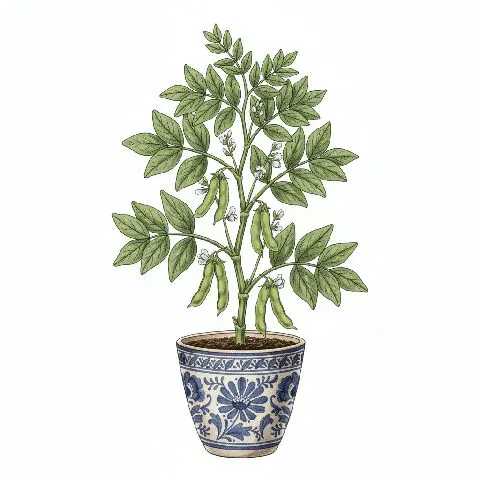
Vicia faba, commonly recognized as the broad bean, fava bean, or field bean, is an esteemed member of the Fabaceae family, encompassing peas and beans. This annual flowering plant is historically significant, tracing its origins to North Africa and Southwest Asia, with cultivation records extending back 10,000 to 8,000 years into the Neolithic era. It served as a fundamental dietary component for ancient civilizations like the Egyptians, Greeks, and Romans, who also imbued it with symbolic and ritualistic importance.
The broad bean typically grows as a robust, upright annual, reaching heights of 0.5 to 1.7 meters. Its distinguishing features include thick, hollow, square stems and large, glaucous green leaves composed of 2-6 broad, ovate leaflets, notably lacking the tendrils common in other Vicia species. Flowers, often white with characteristic black or dark purple blotches, emerge in clusters of 1 to 5 from the leaf axils.
These develop into substantial, elongated, leathery pods, generally 10-30 cm long, housing 3-8 large, flattened seeds that vary from green to brownish-purple.
Vicia faba thrives in cool, moist climates and demonstrates remarkable frost-hardiness, making it an excellent early spring crop in temperate zones. Nutritionally, its seeds are a powerhouse, abundant in protein, dietary fiber, complex carbohydrates, and a rich array of micronutrients, including folate, manganese, copper, phosphorus, and various B vitamins.
Modern scientific inquiry has elucidated its intricate phytochemical profile, revealing beneficial compounds such as L-DOPA (levodopa), a precursor to dopamine, and other active constituents like vicine, convicine, and condensed tannins, contributing to its diverse health applications.
Trusted Scientific References
1. Authoritative external sources for Vicia faba
1.1 Wikipedia — Vicia faba
1.2 Kew POWO (Plants of the World Online)
1.3 PubMed — peer-reviewed research
1.4 NCBI Taxonomy Browser
1.5 GBIF — Global Biodiversity
1.6Broad Bean should be interpreted through verified botanical identity, practical care, and responsible safety language. This recovery note adds the missing context needed for a complete profile: match light to the plant's habit, use well-drained soil, water according to season, and avoid unsupported medicinal or edible claims. For publishing, the plant can be presented as a source-backed garden plant with clear care guidance, common problem diagnosis, and conservative safety wording.
1.1.Broad Bean — Key Features
- ✓ <strong>High L</strong> — Dopa Content — Natural source of dopamine precursor, supporting neurological function.
- ✓ <strong>Rich in Dietary Fiber</strong> — Promotes digestive health, bowel regularity, and cardiovascular wellness.
- ✓ <strong>Protein Powerhouse</strong> — Provides a complete plant-based protein, essential for muscle and tissue repair.
- ✓ <strong>Micronutrient Dense</strong> — Abundant in folate, iron, manganese, copper, phosphorus, and B vitamins.
- ✓ <strong>Ancient Cultivation History</strong> — A dietary staple and medicinal plant across diverse cultures for millennia.
- ✓ <strong>Frost</strong> — Hardy Crop — Ideal for cultivation in cool, temperate climates and early spring planting.
- ✓ <strong>Nitrogen</strong> — Fixing Legume — Enhances soil fertility naturally through symbiotic nitrogen fixation.
- ✓ <strong>Distinct Morphology</strong> — Characterized by its lack of tendrils, differentiating it from many Vicia species.
- ✓ <strong>Favism Risk</strong> — Critical safety consideration for individuals with G6PD deficiency.
- ✓ <strong>Versatile Culinary Use</strong> — Enjoyed fresh, dried, sprouted, or processed into flour for various dishes.
1.2.Broad Bean — Quick Summary
- ✓ Broad Bean (Vicia faba) is a highly nutritious legume with a rich history in global diets and traditional medicine.
- ✓ Celebrated for its L-Dopa content, offering potential neurological benefits, particularly for Parkinsonism.
- ✓ Excellent source of protein, dietary fiber, and essential micronutrients supporting overall health.
- ✓ Traditional uses span digestive health, anemia, and immune support across Ayurvedic and ancient practices.
- ✓ Important contraindication for individuals with G6PD deficiency due to the risk of favism.
- ✓ Versatile in culinary applications and available in various medicinal forms, from whole beans to standardized extracts.
2.Broad Bean — Scientific Identity
3.Broad Bean — Quick Facts
4.Broad Bean — Appearance & Identification
5.Broad Bean — Native Habitat
6.Broad Bean — Water Requirements
- ✓ Climate Preference — Thrives in cool, moist temperate climates, demonstrating excellent frost tolerance, ideal for early spring or late autumn sowing.
- ✓ Soil Requirements — Prefers fertile, well-drained loamy soils with a neutral to slightly acidic pH (6.0-7.0), but can adapt to heavier clay soils.
- ✓ Sowing — Plant seeds 5-10 cm deep and 10-20 cm apart in rows, ensuring good soil contact for optimal germination and robust growth.
- ✓ Watering — Requires consistent moisture, particularly during critical growth stages like flowering and pod development, to prevent stress and maximize yield.
- ✓ Fertilization — As a legume, Vicia faba fixes atmospheric nitrogen, reducing the need for nitrogen fertilizers; however, it benefits from adequate phosphorus and potassium.
- ✓ Pest and Disease Management — Monitor for common pests such as black bean aphid and diseases like chocolate spot and rust; employ crop rotation and resistant varieties.
- ✓ Harvesting — Pods are typically ready for harvest when they are plump and bright green, usually 15-20 weeks after planting, before seeds become too starchy.
- ✓ Crop Rotation — An excellent choice for crop rotation systems, enhancing soil fertility and breaking disease cycles for subsequent crops.
Reviewed by the Flora Medical Global Botanical Review Panel
Multi-disciplinary editorial group · Botany · Ethnobotany · Herbal-medicine literature
Who reviewed this: This page was checked by the Flora Medical Global Botanical Review Panel — an in-house editorial group of botany graduates, ethnobotany researchers, and horticulture practitioners who collectively maintain our 7,000+ plant encyclopedia. Meet the team.
Our 4-step verification process
1. Taxonomic verification
Scientific names and synonyms cross-checked against Kew POWO, World Flora Online, and The Plant List.
2. Phytochemical & medicinal cross-reference
Active compounds, traditional uses, and reported activities are cross-referenced with PubMed, USDA Dr. Duke's database, and peer-reviewed ethnobotanical literature.
3. Conservation & distribution check
Distribution, ecology, and conservation status confirmed against GBIF occurrence records and the IUCN Red List.
4. Editorial & safety review
Every entry passes an editorial pass for clarity, originality, and safety notices (toxicity, contraindications, dosage caveats) before publication.
Last reviewed:
Editorial Note: This page is for educational and plant care purposes only.
Written by: Flora Medical Global Editorial Team
Reviewed by: Flora Medical Global Botanical Review Panel
Last Updated: June 15, 2026







Broad Bean — Comments & Community Reviews
Rate this plant