
Care Disclaimer: Plant care recommendations are general guidelines based on common growing conditions. Individual results may vary based on your local environment, climate, and care routine. If your plant is toxic, keep it away from children and pets, and consult a veterinarian if accidental ingestion occurs.
1.Brunnera — Overview
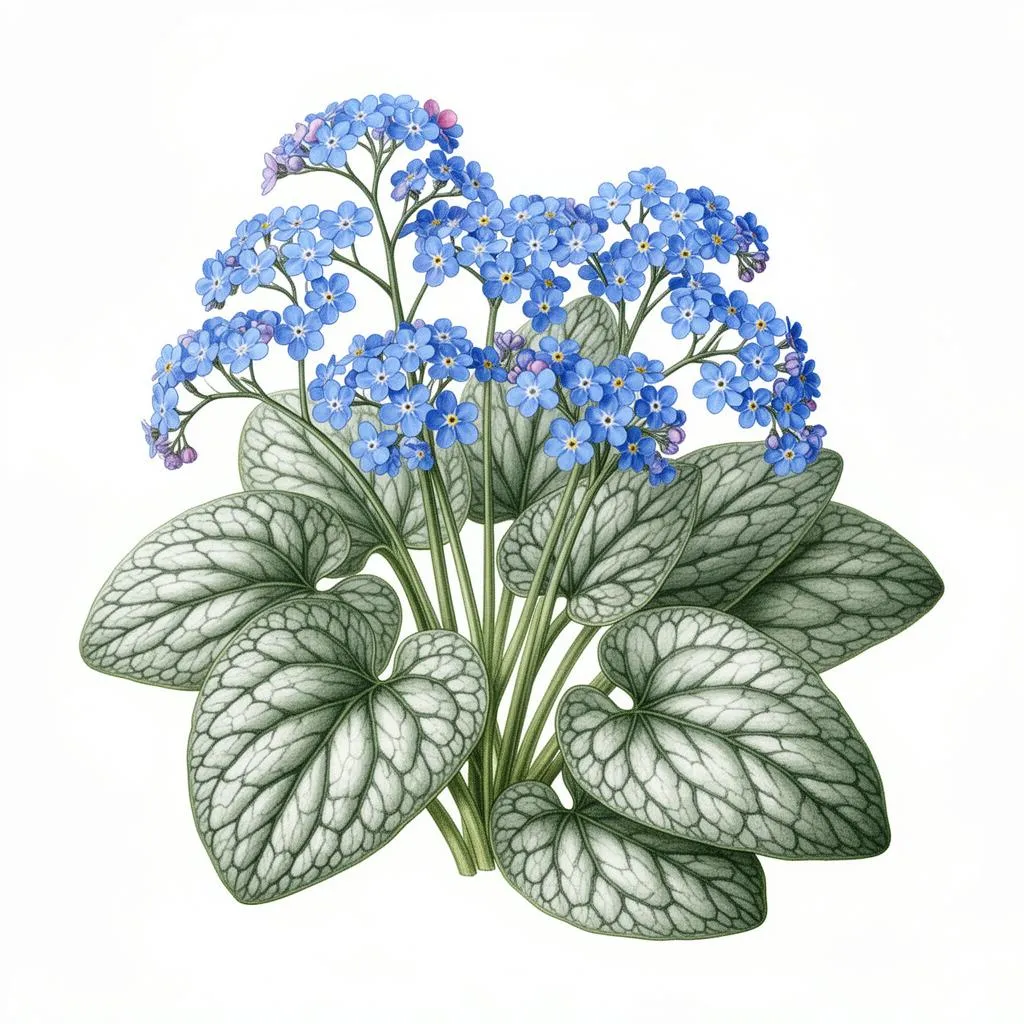
Brunnera macrophylla, widely recognized as Siberian Bugloss or Great Forget-me-not, is an enchanting herbaceous perennial belonging to the Boraginaceae family. Native to the cool, moist woodlands of the Caucasus region, spanning from Eastern Europe through Turkey and into Siberia, this plant thrives in dappled shade, reflecting its natural understory habitat. Its botanical lineage traces back to the early 19th century, with the genus named in tribute to Swiss botanist Samuel Brunner, and the specific epithet 'macrophylla' aptly describes its large leaves. Characterized by a rhizomatous, clumping growth habit, Brunnera macrophylla typically forms a mound of striking, heart-shaped basal leaves that emerge in early spring, often before its delicate flowers.
These leaves, which can reach up to 6 inches in width, possess a distinctive rough and hairy texture, making them notably resistant to deer and rabbits. While the foliage is often a rich dark green, numerous cultivars showcase intricate silver or creamy white variegation, adding luminous appeal to shaded garden areas. In mid-to-late spring, airy sprays of small, sky-blue, five-petaled flowers, reminiscent of forget-me-nots, rise above the foliage, typically featuring a contrasting white or yellow eye. These blossoms create an ethereal blue haze, offering a beautiful counterpoint to the plant's robust leaves.
Ecologically, Brunnera macrophylla plays a role in its native ecosystem by stabilizing soil and providing early season nectar for various pollinators. Although primarily cultivated for its ornamental value in modern horticulture, historical accounts suggest its limited application in regional folk medicine traditions, hinting at an understanding of its properties by local populations, albeit without widespread codified recognition in major herbal systems.
Trusted Scientific References
1. Authoritative external sources for Brunnera macrophylla
1.1 Wikipedia — Brunnera macrophylla
1.2 Kew POWO (Plants of the World Online)
1.3 PubMed — peer-reviewed research
1.4 NCBI Taxonomy Browser
1.5 GBIF — Global Biodiversity
1.1.Brunnera — Key Features
- ✓ <strong>Botanical Name</strong> — Brunnera macrophylla
- ✓ <strong>Common Names</strong> — Siberian Bugloss, Great Forget-me-not, Heartleaf Brunnera, False Forget-me-not
- ✓ <strong>Family</strong> — Boraginaceae
- ✓ <strong>Native Region</strong> — Caucasus region (Eastern Europe to Siberia)
- ✓ <strong>Growth Habit</strong> — Rhizomatous, clumping herbaceous perennial, forming a mounding habit.
- ✓ <strong>Foliage</strong> — Large, heart-shaped, often variegated, rough-textured basal leaves.
- ✓ <strong>Flowers</strong> — Delicate, sky-blue, five-petaled, forget-me-not-like blooms in airy sprays during spring.
- ✓ <strong>Preferred Conditions</strong> — Partial to full shade, consistently moist, fertile, well-drained soil.
- ✓ <strong>Landscape Use</strong> — Excellent as a groundcover, shade garden specimen, or border plant.
- ✓ <strong>Special Qualities</strong> — Highly resistant to deer and rabbits due to leaf texture; intolerant of excessive heat and humidity.
1.2.Brunnera — Quick Summary
- ✓ Ornamental shade perennial with distinctive heart-shaped leaves and delicate blue flowers.
- ✓ Native to the Caucasus region, thriving in cool, moist, shaded woodland environments.
- ✓ Historically noted for limited regional folk medicine applications, but scientific evidence is scarce.
- ✓ May contain hepatotoxic pyrrolizidine alkaloids (PAs), necessitating strict avoidance of internal consumption.
- ✓ Primarily valued in modern horticulture for its aesthetic appeal as a groundcover or specimen plant.
- ✓ Generally deer and rabbit resistant, and relatively low maintenance in suitable temperate climates.
2.Brunnera — Scientific Identity
3.Brunnera — Quick Facts
4.Brunnera — Appearance & Identification
5.Brunnera — Native Habitat
6.Brunnera — Water Requirements
- ✓ Soil Preference — Thrives best in fertile, consistently moist, and well-drained soils that are rich in organic matter, ideally maintaining a slightly acidic to neutral pH.
- ✓ Light Requirements — Prefers partial to full shade, necessitating protection from intense afternoon sun to prevent leaf scorch and preserve the vibrancy of its foliage.
- ✓ Watering — Requires regular and consistent moisture; dry soil conditions, especially during warmer periods, must be avoided through supplemental irrigation.
- ✓ Climate Adaptation — Best suited for temperate regions with cooler nights, as it demonstrates intolerance to the hot, humid climates prevalent in areas like the southeastern United States.
- ✓ Propagation — Easily propagated by dividing its rhizomatous clumps in early spring or fall, or via self-seeding, although cultivars may not reproduce true to type from seed.
- ✓ Pest and Disease Management — Generally robust with minimal significant insect or disease problems, though slugs and snails can occasionally become an issue in damp environments.
- ✓ Mulching — Applying a generous layer of organic mulch around the base helps retain soil moisture, keeps the root zone cool, and effectively suppresses weed growth.
- ✓ Winter Hardiness — Fully hardy in USDA Zones 3-8, reliably returning each spring, with its basal foliage often emerging well before the last frost.
Reviewed by the Flora Medical Global Botanical Review Panel
Multi-disciplinary editorial group · Botany · Ethnobotany · Herbal-medicine literature
Who reviewed this: This page was checked by the Flora Medical Global Botanical Review Panel — an in-house editorial group of botany graduates, ethnobotany researchers, and horticulture practitioners who collectively maintain our 7,000+ plant encyclopedia. Meet the team.
Our 4-step verification process
1. Taxonomic verification
Scientific names and synonyms cross-checked against Kew POWO, World Flora Online, and The Plant List.
2. Phytochemical & medicinal cross-reference
Active compounds, traditional uses, and reported activities are cross-referenced with PubMed, USDA Dr. Duke's database, and peer-reviewed ethnobotanical literature.
3. Conservation & distribution check
Distribution, ecology, and conservation status confirmed against GBIF occurrence records and the IUCN Red List.
4. Editorial & safety review
Every entry passes an editorial pass for clarity, originality, and safety notices (toxicity, contraindications, dosage caveats) before publication.
Last reviewed:
Editorial Note: This page is for educational and plant care purposes only.
Written by: Flora Medical Global Editorial Team
Reviewed by: Flora Medical Global Botanical Review Panel
Last Updated: June 15, 2026







Brunnera — Comments & Community Reviews
Rate this plant