


Care Disclaimer: Plant care recommendations are general guidelines based on common growing conditions. Individual results may vary based on your local environment, climate, and care routine. If your plant is toxic, keep it away from children and pets, and consult a veterinarian if accidental ingestion occurs.
1.Brussels Sprouts — Overview
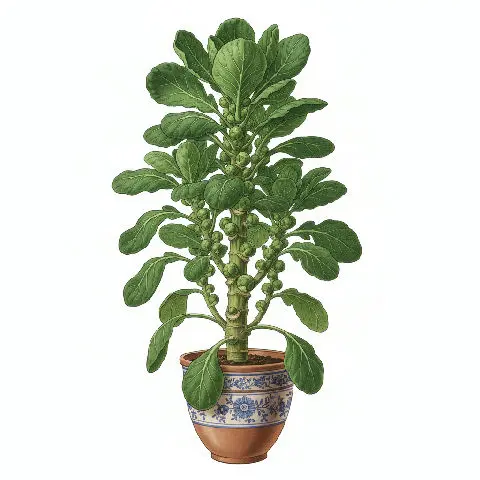
Brussels sprouts, scientifically known as Brassica oleracea gemmifera, represent a distinctive cultivar group derived from the wild cabbage, Brassica oleracea. These unique miniature, cabbage-like heads, typically measuring between 1.5 to 4 cm in diameter, are highly valued for their edible buds. They grow in a characteristic spiral arrangement along the length of a thick, upright central stem, which can reach an impressive height of 60 to 120 cm. The plant bears large, ovate leaves, with the sprouts forming in their axils.
Originating in Northern Europe, Brussels sprouts are believed to have been cultivated extensively near Brussels, Belgium, as early as the 13th century, gaining widespread popularity by the 16th century. They are biennial plants, though commonly grown as annuals for their edible sprouts, and if left to mature, would produce yellow flowers and silique fruits. The flavor profile is often described as earthy, nutty, and notably bitter, a characteristic largely attributed to the presence of glucosinolates. However, this bitterness can be significantly mellowed and even transformed into a sweet, savory note through various cooking methods, such as roasting, which caramelizes their natural sugars.
Nutritionally, Brussels sprouts are a powerhouse, brimming with essential vitamins, particularly Vitamin K and Vitamin C, and providing a substantial amount of dietary fiber. Their rich array of phytochemicals, especially glucosinolates like sinigrin and their breakdown products such as sulforaphane, continues to be a focal point of scientific research for their potential health-promoting properties.
Trusted Scientific References
1. Authoritative external sources for Brassica oleracea gemmifera
1.1 Wikipedia — Brassica oleracea gemmifera
1.2 Kew POWO (Plants of the World Online)
1.3 PubMed — peer-reviewed research
1.4 NCBI Taxonomy Browser
1.5 GBIF — Global Biodiversity
1.6Brussels Sprouts should be interpreted through verified botanical identity, practical care, and responsible safety language. This recovery note adds the missing context needed for a complete profile: match light to the plant's habit, use well-drained soil, water according to season, and avoid unsupported medicinal or edible claims. For publishing, the plant can be presented as a source-backed garden plant with clear care guidance, common problem diagnosis, and conservative safety wording.
1.1.Brussels Sprouts — Key Features
- ✓ <strong>Miniature Cabbage</strong> — Like Buds — Distinctive small, dense heads that grow along a central stem.
- ✓ <strong>Rich in Glucosinolates</strong> — Key phytochemicals responsible for many of its health-promoting properties and characteristic flavor.
- ✓ <strong>Excellent Source of Vitamin K</strong> — Crucial for healthy blood clotting and maintaining strong bones.
- ✓ <strong>High in Vitamin C</strong> — A powerful antioxidant essential for immune system function and collagen synthesis.
- ✓ <strong>Significant Dietary Fiber</strong> — Contributes to digestive health, satiety, and blood sugar management.
- ✓ <strong>Member of the Brassicaceae Family</strong> — A cruciferous vegetable related to broccoli, cabbage, and kale.
- ✓ <strong>Cool Season Vegetable</strong> — Thrives in cooler climates and is sensitive to heat stress.
- ✓ <strong>Potential Anti</strong> — inflammatory Effects — Attributed to compounds like sulforaphane.
- ✓ <strong>Versatile Culinary Ingredient</strong> — Can be prepared in numerous ways, from roasting to stir-frying.
- ✓ <strong>Biennial Plant Grown as Annual</strong> — Typically harvested for its sprouts in its first growing season.
1.2.Brussels Sprouts — Quick Summary
- ✓ Nutrient Powerhouse — Rich in essential vitamins K and C, dietary fiber, and potent antioxidants.
- ✓ Cancer-Fighting Potential — Contains glucosinolates and sulforaphane, extensively studied for their chemopreventive effects.
- ✓ Digestive & Heart Health — High fiber content supports gut regularity and contributes to cardiovascular well-being.
- ✓ European Origin — First extensively cultivated in Belgium as early as the 13th century.
- ✓ Bitter-Sweet Flavor — Earthy, nutty, and slightly bitter taste that can be mellowed and sweetened through proper cooking.
- ✓ Caution with Medications — Vitamin K content necessitates consistent intake for individuals on blood-thinning medications.
2.Brussels Sprouts — Scientific Identity
3.Brussels Sprouts — Quick Facts
4.Brussels Sprouts — Appearance & Identification
5.Brussels Sprouts — Native Habitat
6.Brussels Sprouts — Water Requirements
- ✓ Climate Preference — Thrives in cool, consistent temperatures, ideally between 7-24°C (45-75°F); intolerant of hot weather which can cause bitterness and bolting.
- ✓ Soil Requirements — Prefers fertile, well-drained loamy soil with a pH range of 6.0-7.0, enriched with ample organic matter for optimal growth.
- ✓ Planting — Typically initiated indoors 4-6 weeks before the last expected frost, then transplanted outdoors when seedlings are robust.
- ✓ Spacing — Plants should be spaced approximately 45-60 cm (18-24 inches) apart in rows that are 75-90 cm (30-36 inches) apart to allow for proper development.
- ✓ Watering — Requires consistent moisture, especially critical during the period of sprout development; avoid both drought stress and waterlogging.
- ✓ Fertilization — Benefits from a balanced fertilizer application, particularly with adequate nitrogen, phosphorus, and potassium, and sometimes supplemented with boron.
- ✓ Pest and Disease Management — Susceptible to common Brassica pests like cabbage worms and aphids, and diseases such as clubroot; organic pest control and crop rotation are recommended strategies.
- ✓ Harvesting — Sprouts mature progressively from the bottom of the stem upwards, ready for harvest when firm and 2.5-4 cm (1-1.6 inches) in diameter, usually 90-110 days after planting.
Reviewed by the Flora Medical Global Botanical Review Panel
Multi-disciplinary editorial group · Botany · Ethnobotany · Herbal-medicine literature
Who reviewed this: This page was checked by the Flora Medical Global Botanical Review Panel — an in-house editorial group of botany graduates, ethnobotany researchers, and horticulture practitioners who collectively maintain our 7,000+ plant encyclopedia. Meet the team.
Our 4-step verification process
1. Taxonomic verification
Scientific names and synonyms cross-checked against Kew POWO, World Flora Online, and The Plant List.
2. Phytochemical & medicinal cross-reference
Active compounds, traditional uses, and reported activities are cross-referenced with PubMed, USDA Dr. Duke's database, and peer-reviewed ethnobotanical literature.
3. Conservation & distribution check
Distribution, ecology, and conservation status confirmed against GBIF occurrence records and the IUCN Red List.
4. Editorial & safety review
Every entry passes an editorial pass for clarity, originality, and safety notices (toxicity, contraindications, dosage caveats) before publication.
Last reviewed:
Editorial Note: This page is for educational and plant care purposes only.
Written by: Flora Medical Global Editorial Team
Reviewed by: Flora Medical Global Botanical Review Panel
Last Updated: June 15, 2026







Brussels Sprouts — Comments & Community Reviews
Rate this plant