


Care Disclaimer: Plant care recommendations are general guidelines based on common growing conditions. Individual results may vary based on your local environment, climate, and care routine. If your plant is toxic, keep it away from children and pets, and consult a veterinarian if accidental ingestion occurs.
1.Butia — Overview
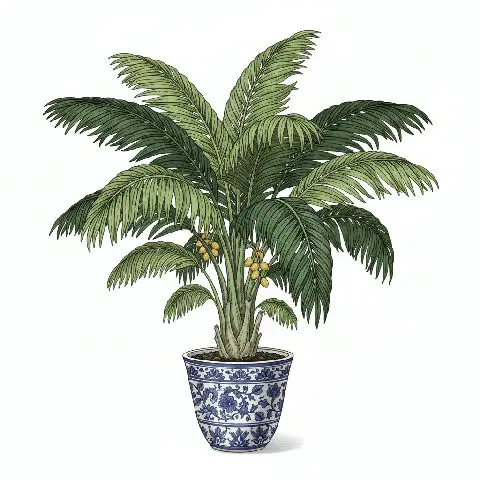
Butia capitata, commonly recognized as the Jelly Palm, Pindo Palm, or Wine Palm, is an esteemed member of the Arecaceae family, indigenous to the subtropical landscapes of South America, particularly thriving across Brazil, Uruguay, and Argentina. This captivating palm species is characterized by its robust, solitary trunk, typically attaining heights of 3 to 6 meters, though some mature specimens can reach over 8 meters.
The trunk often retains persistent leaf bases, creating a distinctive, textured pattern. Its striking arching, pinnate leaves display a beautiful blue-green to grayish-green hue, extending up to 2-3 meters in length and forming an elegant, feather-like canopy.
Ecologically, Butia capitata flourishes in open grasslands (campos) and savannas, demonstrating a remarkable adaptability to well-drained, sandy, or gravelly soils and impressive drought tolerance once established. Historically, its significance is deeply rooted in the culinary traditions of indigenous populations and early settlers, who have long gathered and utilized its highly prized fruit. The common name 'Jelly Palm' directly alludes to the fruit's popular and enduring use in crafting exquisite jellies, jams, and wines, a practice that highlights its historical and ongoing cultural relevance.
The fruit itself is a small, round to oval drupe, measuring 2-4 cm in diameter, borne in large, pendulous clusters that ripen from green to a vibrant orangish-yellow. Its complex flavor profile, often likened to a unique fusion of pineapple, apricot, and banana, makes it a highly sought-after ingredient in various culinary applications.
Trusted Scientific References
1. Authoritative external sources for Butia capitata
1.1 Wikipedia — Butia capitata
1.2 Kew POWO (Plants of the World Online)
1.3 PubMed — peer-reviewed research
1.4 NCBI Taxonomy Browser
1.5 GBIF — Global Biodiversity
1.6Butia should be interpreted through verified botanical identity, practical care, and responsible safety language. This recovery note adds the missing context needed for a complete profile: match light to the plant's habit, use well-drained soil, water according to season, and avoid unsupported medicinal or edible claims. For publishing, the plant can be presented as a source-backed garden plant with clear care guidance, common problem diagnosis, and conservative safety wording.
1.1.Butia — Key Features
- ✓ <strong>Edible Fruit</strong> — Produces delicious, aromatic fruit with a blend of pineapple, apricot, and banana flavors.
- ✓ <strong>Culinary Versatility</strong> — Primarily used for jellies, jams, wines, juices, and fresh consumption.
- ✓ <strong>High in Antioxidants</strong> — Rich source of carotenoids, flavonoids, and phenolic acids.
- ✓ <strong>Drought Tolerant</strong> — Highly adaptable to dry conditions once established, making it resilient.
- ✓ <strong>Ornamental Value</strong> — Attractive blue-green, arching pinnate leaves and distinctive trunk.
- ✓ <strong>Subtropical Adaptation</strong> — Thrives in warm climates, tolerating light frosts.
- ✓ <strong>Distinctive Trunk</strong> — Stout, solitary trunk often covered with persistent leaf bases.
- ✓ <strong>Native to South America</strong> — Historically and culturally significant in its native regions.
- ✓ <strong>Arecaceae Family</strong> — A prominent member of the palm family.
1.2.Butia — Quick Summary
- ✓ Butia capitata, or Jelly Palm, is a South American palm prized for its edible, flavorful fruit.
- ✓ Fruit boasts a unique taste profile, used extensively in jellies, jams, and wines.
- ✓ Rich in antioxidants, carotenoids, and dietary fiber, offering nutritional benefits.
- ✓ Supports digestive health, immune function, and provides antioxidant protection.
- ✓ Generally safe for consumption, with rare potential for allergic reactions or digestive upset.
- ✓ Valued for both its ornamental beauty and culinary versatility in subtropical regions.
2.Butia — Scientific Identity
3.Butia — Quick Facts
4.Butia — Appearance & Identification
5.Butia — Native Habitat
6.Butia — Water Requirements
- ✓ Soil Preference — Thrives in well-drained, sandy, or gravelly soils, but adaptable to various soil types provided drainage is good.
- ✓ Sun Exposure — Requires full sun exposure for optimal growth and fruit production, tolerating partial shade but with reduced vigor.
- ✓ Water Requirements — Drought-tolerant once established, but benefits from moderate watering, especially during dry periods and fruit development.
- ✓ Temperature Tolerance — Prefers subtropical climates; mature plants can tolerate brief periods of light frost, down to approximately -10°C (14°F).
- ✓ Propagation — Primarily propagated by seed, which can have a slow and erratic germination rate, often requiring warm temperatures and scarification.
- ✓ Fertilization — Benefits from a balanced palm-specific fertilizer applied during the growing season to support healthy foliage and fruit development.
- ✓ Pruning — Minimal pruning is needed, mainly to remove dead or damaged fronds to maintain aesthetic appeal and plant health.
- ✓ Pest and Disease Management — Generally robust, but occasional issues with scale insects or nutrient deficiencies can occur, requiring appropriate treatment.
Reviewed by the Flora Medical Global Botanical Review Panel
Multi-disciplinary editorial group · Botany · Ethnobotany · Herbal-medicine literature
Who reviewed this: This page was checked by the Flora Medical Global Botanical Review Panel — an in-house editorial group of botany graduates, ethnobotany researchers, and horticulture practitioners who collectively maintain our 7,000+ plant encyclopedia. Meet the team.
Our 4-step verification process
1. Taxonomic verification
Scientific names and synonyms cross-checked against Kew POWO, World Flora Online, and The Plant List.
2. Phytochemical & medicinal cross-reference
Active compounds, traditional uses, and reported activities are cross-referenced with PubMed, USDA Dr. Duke's database, and peer-reviewed ethnobotanical literature.
3. Conservation & distribution check
Distribution, ecology, and conservation status confirmed against GBIF occurrence records and the IUCN Red List.
4. Editorial & safety review
Every entry passes an editorial pass for clarity, originality, and safety notices (toxicity, contraindications, dosage caveats) before publication.
Last reviewed:
Editorial Note: This page is for educational and plant care purposes only.
Written by: Flora Medical Global Editorial Team
Reviewed by: Flora Medical Global Botanical Review Panel
Last Updated: June 15, 2026







Butia — Comments & Community Reviews
Rate this plant