


Care Disclaimer: Plant care recommendations are general guidelines based on common growing conditions. Individual results may vary based on your local environment, climate, and care routine. If your plant is toxic, keep it away from children and pets, and consult a veterinarian if accidental ingestion occurs.
1.Cabbage — Overview
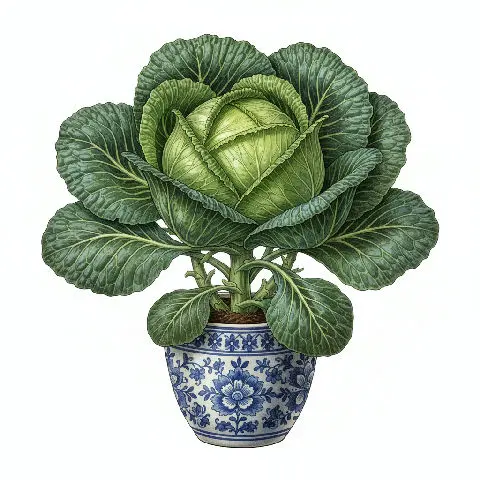
Cabbage, botanically designated Brassica oleracea capitata, is a highly adaptable and extensively cultivated biennial plant, typically grown as an annual for its distinctive, dense, leafy heads. As a prominent member of the Brassicaceae, or mustard family, it shares a common lineage with other widely consumed cruciferous vegetables such as broccoli, cauliflower, and kale, all descended from the wild Brassica oleracea. The cultivar epithet 'capitata' precisely refers to its characteristic head-forming morphology. Its rich history of cultivation spans over 4,000 years, with origins traced back to Western Europe and the Mediterranean basin, where ancient civilizations like the Greeks and Romans revered it for both its nutritional value and perceived medicinal properties. Historical accounts, including those from Cato the Elder, highlight its traditional use for ailments ranging from digestive discomfort to the prevention of inebriation.
Morphologically, Cabbage is distinguished by its thick, waxy, overlapping leaves that coalesce to form a compact, globose, or conical head. The foliage exhibits a broad spectrum of colors, from pale green to deep green, red, or vibrant purple, influenced by the specific cultivar. The leaves are frequently glaucous, possessing a whitish, powdery bloom on their surface, which aids in water retention. The plant develops a generally shallow, fibrous root system. If allowed to mature beyond its primary growing season, typically in its second year, it will 'bolt,' producing an erect stalk adorned with small, bright yellow, cruciform flowers arranged in racemes.
These flowers are primarily insect-pollinated, eventually giving way to siliques that contain small, dark seeds. Modern Cabbage cultivation is globally widespread, thriving in temperate to subtropical zones, with numerous varieties developed for diverse climates and culinary applications. It is optimally grown as a cool-season crop, preferring temperatures between 15-20°C. Nutritionally, Cabbage is celebrated for its abundance of essential vitamins, particularly C and K, dietary fiber, and a complex array of phytonutrients, most notably glucosinolates, which contribute to its characteristic flavor and significant health benefits. Trusted Scientific References Authoritative external sources for Brassica oleracea capitata : Wikipedia — Brassica oleracea capitata Kew POWO (Plants of the World Online) PubMed — peer-reviewed research NCBI Taxonomy Browser GBIF — Global Biodiversit ...[CURRENT TEXT EXISTS: 2501 chars]
1.1.Cabbage — Key Features
- ✓ <strong>Dense, globose leafy</strong> — Dense, globose leafy heads
- ✓ <strong>Member of the</strong> — Member of the Brassicaceae (mustard) family
- ✓ <strong>Rich in Vitamin</strong> — Rich in Vitamin C and Vitamin K
- ✓ <strong>Contains health</strong> — promoting glucosinolates
- ✓ <strong>Wide range of</strong> — Wide range of cultivars (green, red, Savoy)
- ✓ <strong>Ancient history of</strong> — Ancient history of cultivation and medicinal use
- ✓ <strong>Cool</strong> — season crop thriving in temperate climates
- ✓ <strong>Versatile culinary applications</strong> — Versatile culinary applications (raw, cooked, fermented)
- ✓ <strong>Known for antioxidant and anti</strong> — inflammatory properties
- ✓ <strong>Supports digestive and</strong> — Supports digestive and cardiovascular health
1.2.Cabbage — Quick Summary
- ✓ Brassica oleracea capitata: A globally cultivated, head-forming biennial vegetable.
- ✓ Rich in vitamins C, K, fiber, and glucosinolates.
- ✓ Supports digestive health, immunity, and possesses anti-inflammatory properties.
- ✓ Traditional uses include wound healing and breast engorgement relief.
- ✓ Potential anti-cancer properties due to sulforaphane and indoles.
- ✓ May cause gas; interacts with blood thinners due to Vitamin K.
2.Cabbage — Scientific Identity
3.Cabbage — Quick Facts
4.Cabbage — Appearance & Identification
5.Cabbage — Native Habitat
6.Cabbage — Water Requirements
- ✓ Soil Preparation — Cabbage thrives in fertile, well-drained soil with a pH between 6.0 and 7.0, enriched with organic matter for optimal growth.
- ✓ Planting Time — As a cool-season crop, plant Cabbage seeds indoors 6-8 weeks before the last frost, or sow directly outdoors in early spring or late summer.
- ✓ Watering Requirements — Consistent moisture is crucial; water deeply and regularly, especially during head formation, to prevent splitting and ensure tender leaves.
- ✓ Sunlight Exposure — Cabbage needs full sun, at least 6 hours of direct sunlight daily, to develop large, healthy heads.
- ✓ Fertilization — Incorporate a balanced fertilizer at planting and side-dress with nitrogen-rich fertilizer once heads begin to form to support leafy growth.
- ✓ Pest and Disease Management — Monitor for common pests like cabbage worms and aphids; utilize row covers, organic pesticides, or companion planting to deter infestations. Rotate crops annually to prevent soil-borne diseases.
- ✓ Harvesting — Harvest Cabbage heads when they are firm and solid. Cut the head at the base, leaving outer leaves on the stem, which may produce smaller secondary heads.
Reviewed by the Flora Medical Global Botanical Review Panel
Multi-disciplinary editorial group · Botany · Ethnobotany · Herbal-medicine literature
Who reviewed this: This page was checked by the Flora Medical Global Botanical Review Panel — an in-house editorial group of botany graduates, ethnobotany researchers, and horticulture practitioners who collectively maintain our 7,000+ plant encyclopedia. Meet the team.
Our 4-step verification process
1. Taxonomic verification
Scientific names and synonyms cross-checked against Kew POWO, World Flora Online, and The Plant List.
2. Phytochemical & medicinal cross-reference
Active compounds, traditional uses, and reported activities are cross-referenced with PubMed, USDA Dr. Duke's database, and peer-reviewed ethnobotanical literature.
3. Conservation & distribution check
Distribution, ecology, and conservation status confirmed against GBIF occurrence records and the IUCN Red List.
4. Editorial & safety review
Every entry passes an editorial pass for clarity, originality, and safety notices (toxicity, contraindications, dosage caveats) before publication.
Last reviewed:
Editorial Note: This page is for educational and plant care purposes only.
Written by: Flora Medical Global Editorial Team
Reviewed by: Flora Medical Global Botanical Review Panel
Last Updated: June 15, 2026







Cabbage — Comments & Community Reviews
Rate this plant