

Care Disclaimer: Plant care recommendations are general guidelines based on common growing conditions. Individual results may vary based on your local environment, climate, and care routine. If your plant is toxic, keep it away from children and pets, and consult a veterinarian if accidental ingestion occurs.
1.Callicarpa Americana — Overview
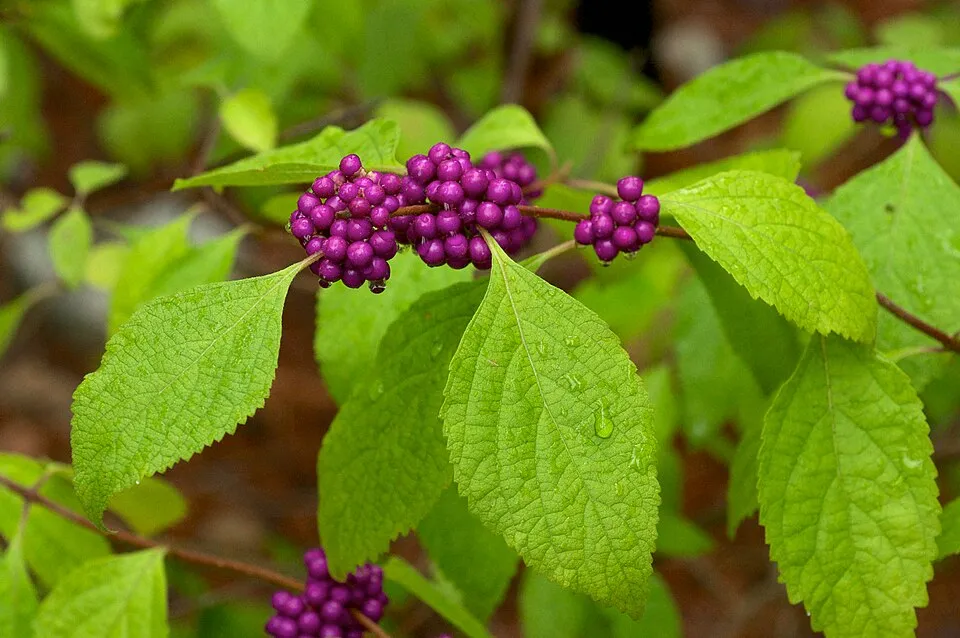
Callicarpa americana, commonly known as American beautyberry, is a captivating native perennial shrub belonging to the Lamiaceae family, widely distributed across the southeastern United States, extending from Texas and Oklahoma eastward to Maryland, and also found in the Caribbean and northern Mexico. This fast-growing deciduous shrub typically reaches a height of five to eight feet and spreads almost as wide, characterized by its gracefully arching, drooping branches.
Its leaves are elliptical to ovate in shape, arranged oppositely along the stems, and feature distinct saw-toothed margins. The underside of the leaves may exhibit a soft, woolly texture due to fine hairs.
In late spring to early summer, American beautyberry produces inconspicuous, small flowers that range in color from blue and violet to pink or white. These modest blooms are arranged in clusters at the leaf axils along the stems. However, the plant's true ornamental appeal shines in late summer and fall, specifically from August to September, when it develops striking clusters of small, iridescent purple to blue berries, known as drupes.
These vibrant fruit clusters encircle the woody stems, creating a dramatic visual display. Each small berry contains two to four tiny seeds, approximately 1/16 inch in length. Callicarpa americana thrives in a variety of conditions, often found in open woodlands, particularly under pine canopies, as well as in thickets, along rights-of-way, and in fence rows.
It adapts well to moist, loam, sandy, or shallow upland sites and tolerates a wide range of soil pH. As a pioneer species, it is indicative of mid-stages of plant succession and exhibits remarkable tolerance to fire, although it is intolerant of deep shade, which can lead to a decline in its population.
Trusted Scientific References
1. Authoritative external sources for Callicarpa americana
1.1 Wikipedia — Callicarpa americana
1.2 Kew POWO (Plants of the World Online)
1.3 PubMed — peer-reviewed research
1.4 NCBI Taxonomy Browser
1.5 GBIF — Global Biodiversity
1.1.Callicarpa Americana — Key Features
- ✓ <strong>Distinctive Purple Berries</strong> — Clusters of bright, iridescent purple berries that encircle the stems in fall and winter, providing significant ornamental value.
- ✓ <strong>Natural Insect Repellent</strong> — Leaves contain scientifically identified compounds, callicarpenal and intermedeol, effective against mosquitoes and biting insects.
- ✓ <strong>Ethnobotanical Significance</strong> — Rich history of use by various Native American tribes for a wide range of medicinal applications.
- ✓ <strong>Wildlife Food Source</strong> — Berries are a crucial food source for over forty species of songbirds and various mammals, especially in fall and winter.
- ✓ <strong>Adaptable and Hardy</strong> — Tolerates various soil types, light conditions (full sun to partial shade), and is fire-tolerant, making it resilient in diverse environments.
- ✓ <strong>Deciduous Shrub</strong> — Loses its leaves in winter, highlighting the striking berry clusters against bare branches.
- ✓ <strong>Fast</strong> — Growing Pioneer Species — Establishes quickly in disturbed areas, characteristic of early to mid-successional habitats.
- ✓ <strong>Anti</strong> — inflammatory & Antioxidant — Contains phytochemicals that contribute to its traditional uses for pain and cellular protection.
- ✓ <strong>Easy Propagation</strong> — Can be propagated from seeds, softwood cuttings, or by transplanting volunteer plants.
- ✓ <strong>Versatile Landscaping</strong> — Valued for its aesthetic appeal in mass plantings, borders, and as a specimen shrub.
1.2.Callicarpa Americana — Quick Summary
- ✓ American beautyberry is a native shrub known for its vibrant purple berries.
- ✓ Traditionally used by Native Americans for various medicinal purposes, including fevers and digestive issues.
- ✓ Leaves contain compounds (callicarpenal, intermedeol) effective as natural insect repellents.
- ✓ Exhibits anti-inflammatory, antioxidant, and potential immune-boosting properties.
- ✓ Cultivated for its ornamental value and adaptability to various soil and light conditions.
- ✓ Primarily used topically or as a decoction; internal consumption of raw berries is generally discouraged.
2.Callicarpa Americana — Scientific Identity
3.Callicarpa Americana — Quick Facts
4.Callicarpa Americana — Appearance & Identification
5.Callicarpa Americana — Native Habitat
6.Callicarpa Americana — Water Requirements
- ✓ Soil Preference — Thrives in well-drained soil rich in organic matter, adaptable to loam, sandy, or shallow upland sites.
- ✓ Light Requirements — Prefers full sun to partial shade for optimal growth and fruit production, though intolerant of deep shade.
- ✓ Watering — Requires moderate watering to maintain consistently moist but not soggy soil, especially during establishment.
- ✓ Fertilization — Apply organic compost or a balanced slow-release fertilizer in spring to promote vigorous growth and berry development.
- ✓ Propagation — Easily propagated from seeds (requiring stratification), softwood stem cuttings (4-6 inches long with rooting hormone), or by transplanting hardy volunteer plants.
- ✓ Pruning — Prune in late winter or early spring to maintain shape, encourage bushier growth, and promote new wood, as berries form on new growth.
- ✓ Pest Management — Generally robust, but monitor for leaf spots and black mold; natural deterrents like neem oil can address aphids or spider mites if they become an issue.
- ✓ Spacing — Allow adequate space for growth, as plants can reach 5-8 feet tall and wide; useful in mass plantings, borders, or as specimen shrubs.
Reviewed by the Flora Medical Global Botanical Review Panel
Multi-disciplinary editorial group · Botany · Ethnobotany · Herbal-medicine literature
Who reviewed this: This page was checked by the Flora Medical Global Botanical Review Panel — an in-house editorial group of botany graduates, ethnobotany researchers, and horticulture practitioners who collectively maintain our 7,000+ plant encyclopedia. Meet the team.
Our 4-step verification process
1. Taxonomic verification
Scientific names and synonyms cross-checked against Kew POWO, World Flora Online, and The Plant List.
2. Phytochemical & medicinal cross-reference
Active compounds, traditional uses, and reported activities are cross-referenced with PubMed, USDA Dr. Duke's database, and peer-reviewed ethnobotanical literature.
3. Conservation & distribution check
Distribution, ecology, and conservation status confirmed against GBIF occurrence records and the IUCN Red List.
4. Editorial & safety review
Every entry passes an editorial pass for clarity, originality, and safety notices (toxicity, contraindications, dosage caveats) before publication.
Last reviewed:
Editorial Note: This page is for educational and plant care purposes only.
Written by: Flora Medical Global Editorial Team
Reviewed by: Flora Medical Global Botanical Review Panel
Last Updated: June 15, 2026







Callicarpa Americana — Comments & Community Reviews
Rate this plant