
Care Disclaimer: Plant care recommendations are general guidelines based on common growing conditions. Individual results may vary based on your local environment, climate, and care routine. If your plant is toxic, keep it away from children and pets, and consult a veterinarian if accidental ingestion occurs.
1.Calydorea Xiphioides — Overview
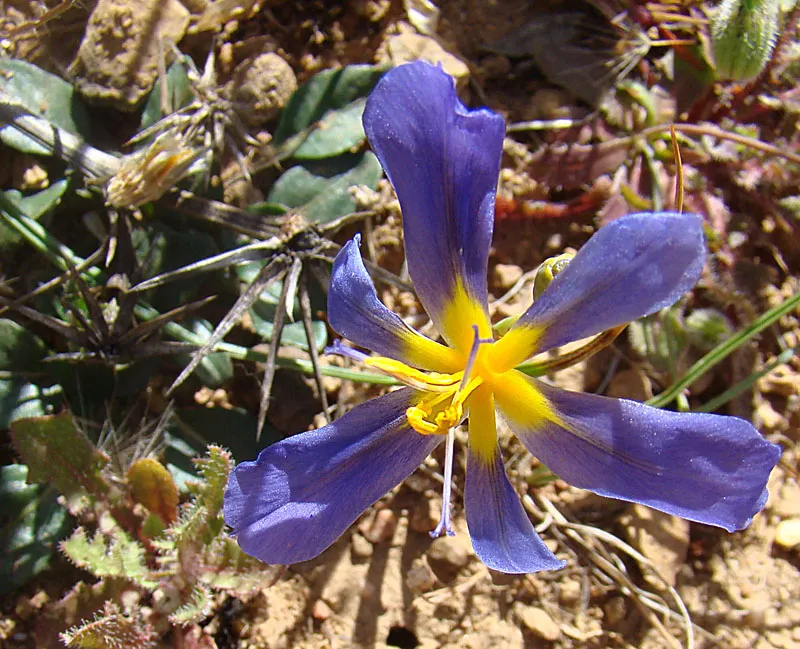
Calydorea xiphioides, commonly known as the Chilean Sword Lily or Blue-Eyed Grass (though not a true grass), is a captivating perennial herb belonging to the Iridaceae family, specifically within the tribe Tigridieae. This geophyte originates from the dry regions of central Chile, where it thrives in neutral to alkaline soils. Morphologically, Calydorea xiphioides is a relatively diminutive plant, typically reaching a height of approximately 10 centimeters.
It emerges from a corm, producing slender, sword-shaped leaves (hence 'xiphioides') that are characteristic of many Iridaceae members. The plant is renowned for its delicate, ephemeral flowers, which are typically a striking pale blue or violet hue. These flowers feature subequal tepals that spread gracefully from the base, free stamens, and distinctive short, slender style branches.
Each bloom is often short-lived, lasting only a single day, but the plant can produce a succession of flowers over its blooming period, especially under favorable conditions. In its natural habitat, Calydorea xiphioides exhibits a summer dormancy, an adaptation to the arid conditions of its native Chilean environment. Its distribution is localized to central Chile, distinguishing it within the broader Calydorea genus, which spans temperate South America, Mexico, and parts of southern North America.
Trusted Scientific References
1. Authoritative external sources for Calydorea Xiphioides
1.1 Wikipedia — Calydorea Xiphioides
1.2 Kew POWO (Plants of the World Online)
1.3 PubMed — peer-reviewed research
1.4 NCBI Taxonomy Browser
1.5 GBIF — Global Biodiversity
1.6Calydorea Xiphioides should be interpreted through verified botanical identity, practical care, and responsible safety language. This recovery note adds the missing context needed for a complete profile: match light to the plant's habit, use well-drained soil, water according to season, and avoid unsupported medicinal or edible claims. For publishing, the plant can be presented as a source-backed garden plant with clear care guidance, common problem diagnosis, and conservative safety wording.
1.1.Calydorea Xiphioides — Key Features
- ✓ <strong>Botanical Family</strong> — Member of the Iridaceae family, known for its elegant flowering plants.
- ✓ <strong>Native Origin</strong> — Endemic to the dry regions of central Chile, adapted to specific environmental conditions.
- ✓ <strong>Growth Habit</strong> — A geophyte growing from a corm, producing slender, sword-shaped foliage.
- ✓ <strong>Flower Characteristics</strong> — Produces ephemeral, pale blue or violet flowers with unique tepal and style structures.
- ✓ <strong>Habitat Adaptation</strong> — Exhibits summer dormancy, a key adaptation to arid conditions.
- ✓ <strong>Potential Medicinal Properties</strong> — Hypothesized to offer anti-inflammatory, antioxidant, and digestive support.
- ✓ <strong>Key Phytochemicals</strong> — Contains flavonoids, terpenoids, and phenolic acids that contribute to its bioactivity.
- ✓ <strong>Ornamental Value</strong> — Valued for its delicate beauty in rock gardens or specialized bulb collections.
- ✓ <strong>Cultivation Requirements</strong> — Prefers well-drained, alkaline soils and ample sunlight for optimal growth.
- ✓ <strong>Taxonomic Significance</strong> — Part of the Tigridieae tribe, with historical reclassifications within the genus Calydorea.
1.2.Calydorea Xiphioides — Quick Summary
- ✓ Calydorea xiphioides is a Chilean bulbous perennial from the Iridaceae family.
- ✓ Features delicate pale blue/violet flowers and sword-shaped leaves.
- ✓ Thrives in dry, neutral to alkaline soils with summer dormancy in the wild.
- ✓ Possesses potential anti-inflammatory, antioxidant, and digestive benefits.
- ✓ Rich in flavonoids, terpenoids, and phenolic acids.
- ✓ Requires well-draining soil, good sun, and careful watering in cultivation.
2.Calydorea Xiphioides — Scientific Identity
3.Calydorea Xiphioides — Quick Facts
4.Calydorea Xiphioides — Appearance & Identification
5.Calydorea Xiphioides — Native Habitat
6.Calydorea Xiphioides — Water Requirements
- ✓ Soil Preference — Prefers well-draining, neutral to alkaline soils, mimicking its native Chilean habitat.
- ✓ Light Requirements — Thrives in good sun exposure, requiring ample sunlight for robust growth and flowering.
- ✓ Watering Schedule — During its active growth phase, it appreciates consistent moisture but requires excellent drainage to prevent bulb rot.
- ✓ Dormancy Management — In cultivation, its natural summer dormancy can be adjusted; it can be grown as a summer grower if regularly watered during this period.
- ✓ Fertilization — Benefits from a balanced, mild fertilizer application during its growth cycle to support flowering and overall vigor.
- ✓ Propagation — Primarily propagated by corms or seeds, with corms being the more common and faster method for gardeners.
- ✓ Pest and Disease Control — Generally hardy, but ensure good air circulation to prevent fungal issues and monitor for common garden pests.
- ✓ Climate Adaptability — Can adapt to different climates, but protection from extreme cold or excessive moisture during dormancy is crucial.
Reviewed by the Flora Medical Global Botanical Review Panel
Multi-disciplinary editorial group · Botany · Ethnobotany · Herbal-medicine literature
Who reviewed this: This page was checked by the Flora Medical Global Botanical Review Panel — an in-house editorial group of botany graduates, ethnobotany researchers, and horticulture practitioners who collectively maintain our 7,000+ plant encyclopedia. Meet the team.
Our 4-step verification process
1. Taxonomic verification
Scientific names and synonyms cross-checked against Kew POWO, World Flora Online, and The Plant List.
2. Phytochemical & medicinal cross-reference
Active compounds, traditional uses, and reported activities are cross-referenced with PubMed, USDA Dr. Duke's database, and peer-reviewed ethnobotanical literature.
3. Conservation & distribution check
Distribution, ecology, and conservation status confirmed against GBIF occurrence records and the IUCN Red List.
4. Editorial & safety review
Every entry passes an editorial pass for clarity, originality, and safety notices (toxicity, contraindications, dosage caveats) before publication.
Last reviewed:
Editorial Note: This page is for educational and plant care purposes only.
Written by: Flora Medical Global Editorial Team
Reviewed by: Flora Medical Global Botanical Review Panel
Last Updated: June 15, 2026







Calydorea Xiphioides — Comments & Community Reviews
Rate this plant