

Care Disclaimer: Plant care recommendations are general guidelines based on common growing conditions. Individual results may vary based on your local environment, climate, and care routine. If your plant is toxic, keep it away from children and pets, and consult a veterinarian if accidental ingestion occurs.
1.Camassia Leichtlinii — Overview
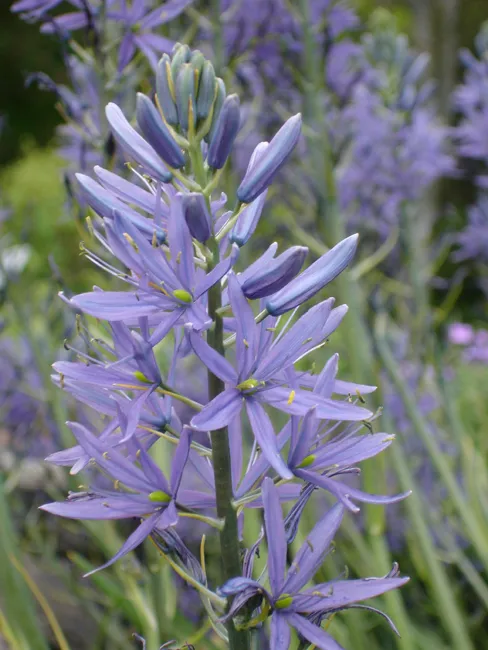
Camassia leichtlinii, commonly known as Great Camas or Leichtlin's Camas, is a striking perennial herb belonging to the Asparagaceae family, a classification that places it among other well-known bulbous plants. Native to the moist meadows, open woodlands, and prairies of western North America, its natural distribution extends from British Columbia down to California and eastward into states like Montana and Utah. Morphologically, the plant emerges from a large, edible bulb, which is a significant traditional food source for indigenous peoples, particularly after careful preparation to break down starches and neutralize certain compounds.
Its basal leaves are linear, grass-like, and typically grow in a dense clump. In late spring to early summer, a tall, sturdy flower stalk rises, often reaching heights of 2 to 4 feet, bearing a magnificent raceme of star-shaped flowers. These flowers are usually a vibrant blue or purple, though white or cream varieties exist, each with six tepals that spread widely.
After flowering, the plant produces a three-lobed capsule containing numerous small, black seeds, completing its annual life cycle. Its robust nature and ornamental beauty make it a favored choice in native plant gardens, while its historical role as a sustenance plant underscores its ecological and cultural significance. The genus Camassia is distinguished by its distinct floral structure and specific bulb characteristics, setting it apart from other similar-looking plants in its native range.
Trusted Scientific References
1. Authoritative external sources for Camassia leichtlinii
1.1 Wikipedia — Camassia leichtlinii
1.2 Kew POWO (Plants of the World Online)
1.3 PubMed — peer-reviewed research
1.4 NCBI Taxonomy Browser
1.5 GBIF — Global Biodiversity
1.6Camassia Leichtlinii should be interpreted through verified botanical identity, practical care, and responsible safety language. This recovery note adds the missing context needed for a complete profile: match light to the plant's habit, use well-drained soil, water according to season, and avoid unsupported medicinal or edible claims. For publishing, the plant can be presented as a source-backed garden plant with clear care guidance, common problem diagnosis, and conservative safety wording.
1.1.Camassia Leichtlinii — Key Features
- ✓ <strong>Native to Western</strong> — Native to Western North America, from British Columbia to California.
- ✓ <strong>Belongs to the</strong> — Belongs to the Asparagaceae family.
- ✓ <strong>Produces striking blue, purple, or white star</strong> — shaped flowers on tall stalks.
- ✓ <strong>Bulbs were a</strong> — Bulbs were a significant traditional food source for indigenous peoples.
- ✓ <strong>Contains complex carbohydrates</strong> — Contains complex carbohydrates (fructans) in its edible bulbs.
- ✓ <strong>Historically used for anti</strong> — inflammatory, analgesic, and digestive support.
- ✓ <strong>Requires careful identification</strong> — Requires careful identification to distinguish from toxic look-alike plants.
- ✓ <strong>Prefers moist, well</strong> — drained soils and full sun to partial shade.
- ✓ <strong>Offers ornamental value</strong> — Offers ornamental value in native plant and perennial gardens.
- ✓ <strong>Rich in various</strong> — Rich in various phytochemicals including flavonoids and alkaloids.
1.2.Camassia Leichtlinii — Quick Summary
- ✓ Camassia leichtlinii is a native North American bulbous perennial, traditionally used as a food source after extensive cooking.
- ✓ Valued in traditional medicine for potential anti-inflammatory, analgesic, and digestive support.
- ✓ Contains flavonoids, alkaloids, terpenoids, and saponins, contributing to its complex properties.
- ✓ Crucial to differentiate from highly toxic 'Death Camas' to avoid severe poisoning.
- ✓ Requires thorough cooking before consumption; raw bulbs are considered toxic.
- ✓ Further scientific research is needed to fully substantiate its medicinal efficacy and safety.
2.Camassia Leichtlinii — Scientific Identity
3.Camassia Leichtlinii — Quick Facts
4.Camassia Leichtlinii — Appearance & Identification
5.Camassia Leichtlinii — Native Habitat
6.Camassia Leichtlinii — Water Requirements
- ✓ Soil Preference — Thrives in well-drained, fertile, loamy soil rich in organic matter, mimicking its native habitat conditions.
- ✓ Sun Exposure — Prefers full sun to partial shade, with flowering being most prolific in locations receiving ample sunlight.
- ✓ Watering Needs — Requires regular watering, especially during its active growth period in spring and early summer, but tolerates drier conditions once dormant.
- ✓ Fertilization — A balanced, slow-release organic fertilizer can be applied in early spring to support vigorous growth and abundant flowering.
- ✓ Propagation — Primarily propagated by bulb offsets or by sowing seeds, which typically require a cold stratification period for successful germination.
- ✓ Pest and Disease — Generally resistant to most common pests and diseases, though proper drainage is crucial to prevent bulb rot.
- ✓ Hardiness Zones — Best suited for USDA hardiness zones 4-8, tolerating cold winters and warm summers.
- ✓ Maintenance — Deadheading spent flowers can encourage the plant to put energy into bulb development rather than seed production, enhancing future blooms.
Reviewed by the Flora Medical Global Botanical Review Panel
Multi-disciplinary editorial group · Botany · Ethnobotany · Herbal-medicine literature
Who reviewed this: This page was checked by the Flora Medical Global Botanical Review Panel — an in-house editorial group of botany graduates, ethnobotany researchers, and horticulture practitioners who collectively maintain our 7,000+ plant encyclopedia. Meet the team.
Our 4-step verification process
1. Taxonomic verification
Scientific names and synonyms cross-checked against Kew POWO, World Flora Online, and The Plant List.
2. Phytochemical & medicinal cross-reference
Active compounds, traditional uses, and reported activities are cross-referenced with PubMed, USDA Dr. Duke's database, and peer-reviewed ethnobotanical literature.
3. Conservation & distribution check
Distribution, ecology, and conservation status confirmed against GBIF occurrence records and the IUCN Red List.
4. Editorial & safety review
Every entry passes an editorial pass for clarity, originality, and safety notices (toxicity, contraindications, dosage caveats) before publication.
Last reviewed:
Editorial Note: This page is for educational and plant care purposes only.
Written by: Flora Medical Global Editorial Team
Reviewed by: Flora Medical Global Botanical Review Panel
Last Updated: June 15, 2026







Camassia Leichtlinii — Comments & Community Reviews
Rate this plant