
Care Disclaimer: Plant care recommendations are general guidelines based on common growing conditions. Individual results may vary based on your local environment, climate, and care routine. If your plant is toxic, keep it away from children and pets, and consult a veterinarian if accidental ingestion occurs.
1.Camassia Quamash — Overview
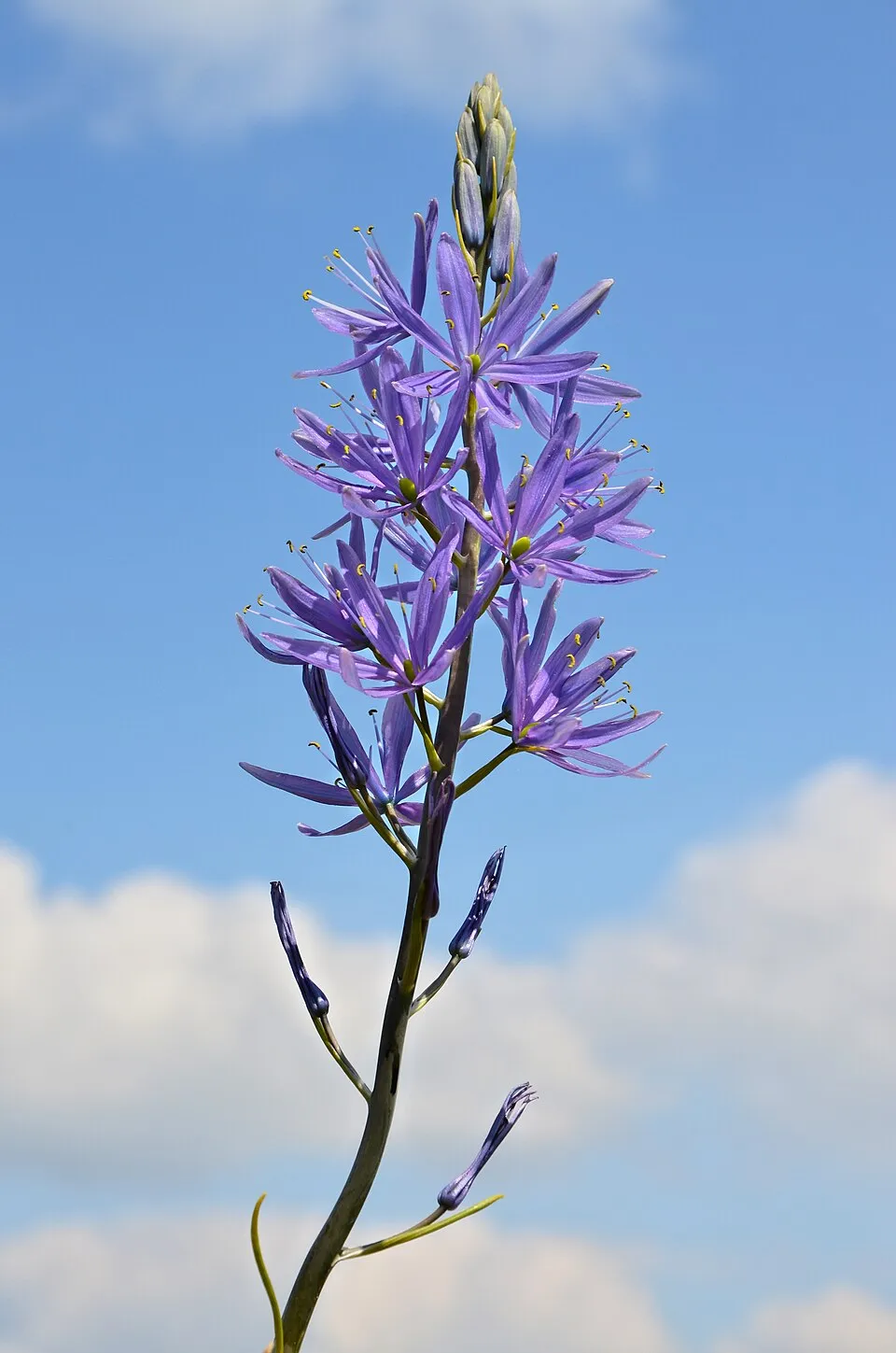
Camassia quamash, commonly known as Small Camas, Common Camass, or Swamp Sego, is a resilient perennial herb belonging to the Liliaceae (Lily) family. This bulbous plant is characterized by its basal clusters of narrow, grass-like, bright green leaves, which emerge from the ground before the flowering stalk.
The plant typically reaches a height of 1 to 3 feet (0.3 to 0.9 meters), culminating in striking racemes that bear dozens of showy, star-like flowers. These blossoms typically display a spectrum of sky- to deep-blue or blue-violet hues, often so abundant as to paint entire meadows with their vibrant color during peak bloom.
Each flower is composed of three sepals and three petals, all sharing the characteristic blue coloration, contributing to its distinctive appearance. Camassia quamash is native to western North America, with a natural distribution spanning from British Columbia south to California, and east into southwestern Alberta, Montana, Wyoming, and Utah.
It thrives in moist habitats, particularly areas that receive ample moisture in winter and spring but may dry out by late spring or early summer, reflecting its adaptation to heavy, seasonally moist soils. Its ability to flourish in full sun and tolerate a range of soil types, from heavy clay to loamy, underscores its robust nature, making it a significant component of native plant ecosystems in its range.
Trusted Scientific References
1. Authoritative external sources for Camassia Quamash
1.1 Wikipedia — Camassia Quamash
1.2 Kew POWO (Plants of the World Online)
1.3 PubMed — peer-reviewed research
1.4 NCBI Taxonomy Browser
1.5 GBIF — Global Biodiversity
1.6Camassia Quamash should be interpreted through verified botanical identity, practical care, and responsible safety language. This recovery note adds the missing context needed for a complete profile: match light to the plant's habit, use well-drained soil, water according to season, and avoid unsupported medicinal or edible claims. For publishing, the plant can be presented as a source-backed garden plant with clear care guidance, common problem diagnosis, and conservative safety wording.
1.1.Camassia Quamash — Key Features
- ✓ <strong>Native North American Plant</strong> — Indigenous to western regions of the continent.
- ✓ <strong>Striking Blue Flowers</strong> — Produces showy racemes of sky- to deep-blue blossoms.
- ✓ <strong>Edible Bulb</strong> — Historically a crucial starchy food for indigenous populations.
- ✓ <strong>Rich in Fructans</strong> — Bulbs contain complex carbohydrates, offering prebiotic benefits.
- ✓ <strong>Traditional Medicinal Uses</strong> — Believed to possess anti-inflammatory and antioxidant properties.
- ✓ <strong>Perennial Herb</strong> — Returns year after year from an underground bulb.
- ✓ <strong>Adaptable to Moist Soils</strong> — Thrives in heavy, winter- and spring-moist conditions.
- ✓ <strong>Attracts Pollinators</strong> — Its vibrant flowers are a magnet for bees and other beneficial insects.
- ✓ <strong>Distinctive Foliage</strong> — Features narrow, grass-like basal leaves.
- ✓ <strong>Cultural Significance</strong> — Holds deep historical and cultural importance for indigenous communities.
1.2.Camassia Quamash — Quick Summary
- ✓ Camassia quamash is a native North American perennial lily with striking blue flowers.
- ✓ Its bulbs were a vital traditional food source for indigenous peoples, rich in fructans.
- ✓ Believed to offer anti-inflammatory, antioxidant, and digestive support.
- ✓ Cultivation requires moist soil and full sun, but careful identification is paramount.
- ✓ Critical safety warning: Easily confused with the highly toxic 'Death Camas'.
- ✓ Primarily used as a cooked food, offering nutritional and potential prebiotic benefits.
2.Camassia Quamash — Scientific Identity
3.Camassia Quamash — Quick Facts
4.Camassia Quamash — Appearance & Identification
5.Camassia Quamash — Native Habitat
6.Camassia Quamash — Water Requirements
- ✓ Site Selection — Choose a location with full sun exposure, receiving at least 6-8 hours of direct sunlight daily for optimal growth and flowering.
- ✓ Soil Preparation — Camassia quamash thrives in heavy, winter- and spring-moist soils rich in organic matter, with a slightly acidic to neutral pH (6.0-7.0).
- ✓ Planting Bulbs — Plant bulbs in the fall, about 4-6 inches deep and 4-6 inches apart, ensuring good drainage to prevent rot during dormancy.
- ✓ Watering Regimen — Maintain consistently moist soil during the active growing season (winter and spring); reduce watering as the plant goes dormant in late spring/early summer, but avoid completely dry soil.
- ✓ Fertilization — Apply a balanced organic fertilizer in early spring to support robust growth and abundant flowering, following product instructions for application rates.
- ✓ Dormancy Care — Allow foliage to die back naturally after flowering, as this energy returns to the bulb. Do not cut back leaves prematurely.
- ✓ Pest and Disease Management — Camassia is relatively pest-free, but ensure good air circulation and proper soil drainage to prevent fungal issues.
- ✓ Propagation — Propagate primarily by offsets from the main bulb in late summer or early fall, or by seed, though seed propagation is a slower process.
Reviewed by the Flora Medical Global Botanical Review Panel
Multi-disciplinary editorial group · Botany · Ethnobotany · Herbal-medicine literature
Who reviewed this: This page was checked by the Flora Medical Global Botanical Review Panel — an in-house editorial group of botany graduates, ethnobotany researchers, and horticulture practitioners who collectively maintain our 7,000+ plant encyclopedia. Meet the team.
Our 4-step verification process
1. Taxonomic verification
Scientific names and synonyms cross-checked against Kew POWO, World Flora Online, and The Plant List.
2. Phytochemical & medicinal cross-reference
Active compounds, traditional uses, and reported activities are cross-referenced with PubMed, USDA Dr. Duke's database, and peer-reviewed ethnobotanical literature.
3. Conservation & distribution check
Distribution, ecology, and conservation status confirmed against GBIF occurrence records and the IUCN Red List.
4. Editorial & safety review
Every entry passes an editorial pass for clarity, originality, and safety notices (toxicity, contraindications, dosage caveats) before publication.
Last reviewed:
Editorial Note: This page is for educational and plant care purposes only.
Written by: Flora Medical Global Editorial Team
Reviewed by: Flora Medical Global Botanical Review Panel
Last Updated: June 15, 2026







Camassia Quamash — Comments & Community Reviews
Rate this plant