

Care Disclaimer: Plant care recommendations are general guidelines based on common growing conditions. Individual results may vary based on your local environment, climate, and care routine. If your plant is toxic, keep it away from children and pets, and consult a veterinarian if accidental ingestion occurs.
1.Campanula Rotundifolia — Overview
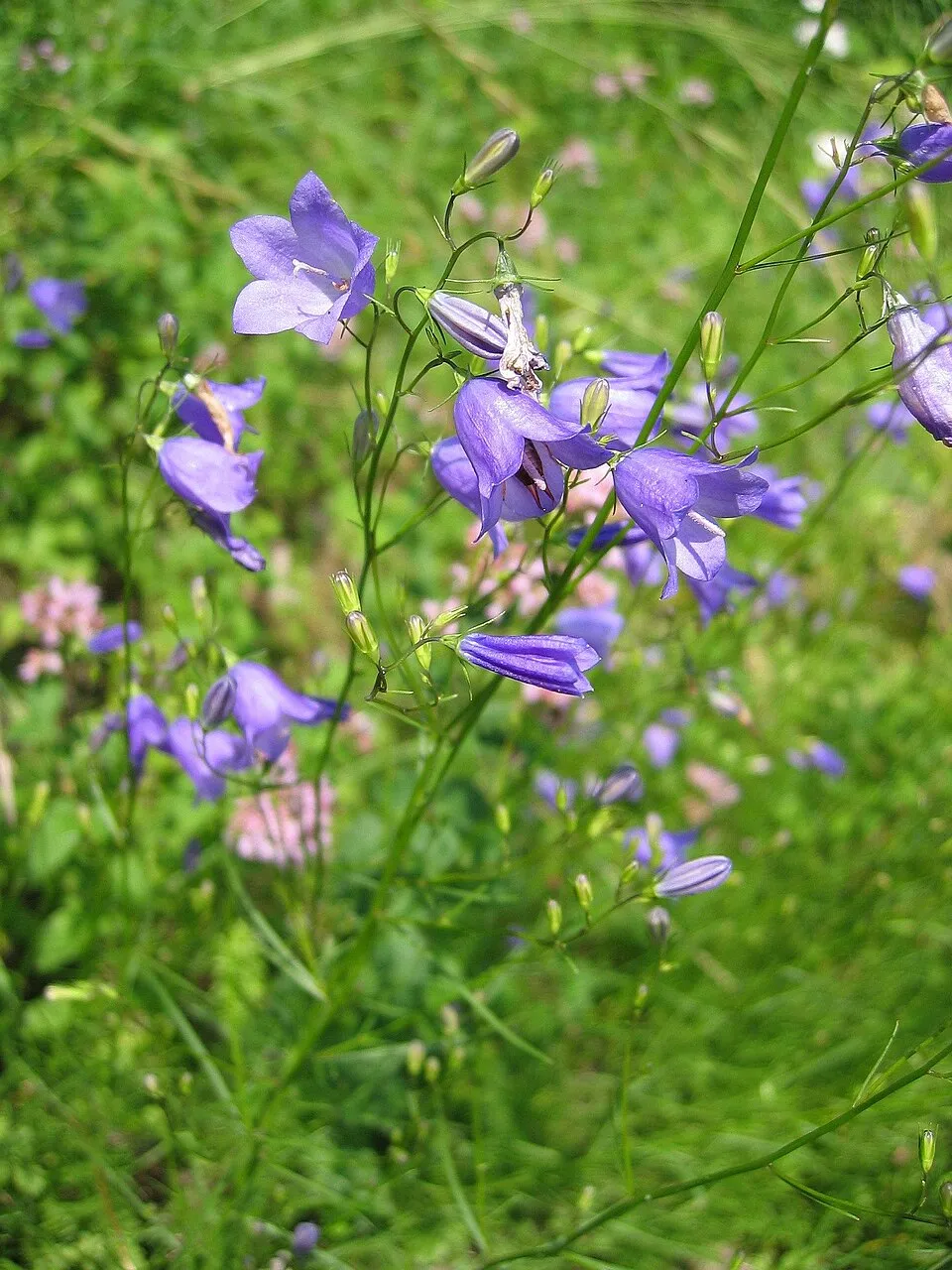
Campanula rotundifolia, commonly known as Harebell or Scottish Bluebell, is a graceful herbaceous perennial belonging to the Campanulaceae family. This resilient species thrives across the Northern Hemisphere, adapting to an impressive array of habitats from sun-drenched meadows and dry cliffs to shaded woodlands and coastal beaches, often found at elevations reaching up to 12,000 feet. Its distinctive morphology includes a slender, wiry stem typically growing 30 to 60 cm tall.
The plant exhibits dimorphic foliage: the basal leaves are notably rounded to heart-shaped, often with a slightly serrated margin, and may wither early, which gave rise to its specific epithet 'rotundifolia'. In contrast, the stem leaves are much narrower, linear, and grass-like. The delicate, bell-shaped flowers, usually 12-30 mm long, bloom in late summer and autumn, displaying shades of violet-blue, though pale pink or white variants can occur.
These elegant blossoms are borne on slender pedicels in a panicle or raceme and are primarily pollinated by bees, though self-fertilization is possible. A characteristic milky latex is exuded when the stem or leaves are broken, a common feature among many Campanula species. Despite its delicate appearance, Harebell is remarkably hardy, spreading through both seed dispersal and rhizomes, making it a persistent and cherished component of diverse ecosystems.
Trusted Scientific References
1. Authoritative external sources for Campanula Rotundifolia
1.1 Wikipedia — Campanula Rotundifolia
1.2 Kew POWO (Plants of the World Online)
1.3 PubMed — peer-reviewed research
1.4 NCBI Taxonomy Browser
1.5 GBIF — Global Biodiversity
1.6Campanula Rotundifolia should be interpreted through verified botanical identity, practical care, and responsible safety language. This recovery note adds the missing context needed for a complete profile: match light to the plant's habit, use well-drained soil, water according to season, and avoid unsupported medicinal or edible claims. For publishing, the plant can be presented as a source-backed garden plant with clear care guidance, common problem diagnosis, and conservative safety wording.
1.1.Campanula Rotundifolia — Key Features
- ✓ <strong>Perennial herbaceous plant</strong> — Perennial herbaceous plant with a delicate appearance yet robust hardiness.
- ✓ <strong>Distinctive dimorphic foliage</strong> — rounded basal leaves and linear stem leaves.
- ✓ <strong>Produces charming violet</strong> — blue, bell-shaped flowers in late summer and autumn.
- ✓ <strong>Widely distributed across</strong> — Widely distributed across a variety of habitats throughout the Northern Hemisphere.
- ✓ <strong>Exudes a characteristic</strong> — Exudes a characteristic milky latex sap when plant parts are broken.
- ✓ <strong>Primarily pollinated by bees, but capable of self</strong> — fertilization for propagation.
- ✓ <strong>Historically significant as</strong> — Historically significant as a source of blue dye and a symbol for clans/nations.
- ✓ <strong>Contains a range</strong> — Contains a range of phytochemicals including flavonoids, alkaloids, and phenolic acids.
- ✓ <strong>Traditionally used in folk medicine for its anti</strong> — inflammatory and digestive properties.
- ✓ <strong>Propagates effectively by</strong> — Propagates effectively by both seeds and rhizome division.
1.2.Campanula Rotundifolia — Quick Summary
- ✓ Harebell is a graceful perennial wildflower found across the Northern Hemisphere.
- ✓ Characterized by its unique round basal leaves and delicate violet-blue bell-shaped flowers.
- ✓ Traditionally valued for its minor medicinal qualities, particularly for digestive and respiratory support.
- ✓ Contains beneficial phytochemicals such as flavonoids, alkaloids, and essential oils.
- ✓ Adaptable and hardy, thriving in diverse habitats from sun to partial shade.
- ✓ A symbol of Scotland and Sweden, also historically used for dye and in folk beliefs.
2.Campanula Rotundifolia — Scientific Identity
3.Campanula Rotundifolia — Quick Facts
4.Campanula Rotundifolia — Appearance & Identification
5.Campanula Rotundifolia — Native Habitat
6.Campanula Rotundifolia — Water Requirements
- ✓ Soil Preference — Thrives in well-drained, fertile soil rich in organic matter, but is also highly adaptable to sandy, gravelly, or even rocky substrates.
- ✓ Light Requirements — Prefers full sun to partial shade, demonstrating considerable tolerance for varying light conditions across its natural range.
- ✓ Watering Regime — Requires regular watering during dry periods to establish, but mature plants prefer moderate moisture and are intolerant of waterlogged conditions.
- ✓ Propagation by Seed — Seeds are extremely small and can be collected, then sown directly onto the soil surface in spring for germination.
- ✓ Division of Clumps — Established clumps of Harebell can be successfully divided in either spring or fall to create new plants.
- ✓ Hardiness and Resilience — Remarkably hardy, *Campanula rotundifolia* is much more robust than its delicate appearance suggests, tolerating a wide range of temperatures.
- ✓ Maintenance — Generally low-maintenance once established, requiring minimal intervention beyond ensuring appropriate light and moisture conditions.
- ✓ Habitat Mimicry — For optimal growth, replicate its natural diverse habitats, from open meadows to the edges of woodlands.
Reviewed by the Flora Medical Global Botanical Review Panel
Multi-disciplinary editorial group · Botany · Ethnobotany · Herbal-medicine literature
Who reviewed this: This page was checked by the Flora Medical Global Botanical Review Panel — an in-house editorial group of botany graduates, ethnobotany researchers, and horticulture practitioners who collectively maintain our 7,000+ plant encyclopedia. Meet the team.
Our 4-step verification process
1. Taxonomic verification
Scientific names and synonyms cross-checked against Kew POWO, World Flora Online, and The Plant List.
2. Phytochemical & medicinal cross-reference
Active compounds, traditional uses, and reported activities are cross-referenced with PubMed, USDA Dr. Duke's database, and peer-reviewed ethnobotanical literature.
3. Conservation & distribution check
Distribution, ecology, and conservation status confirmed against GBIF occurrence records and the IUCN Red List.
4. Editorial & safety review
Every entry passes an editorial pass for clarity, originality, and safety notices (toxicity, contraindications, dosage caveats) before publication.
Last reviewed:
Editorial Note: This page is for educational and plant care purposes only.
Written by: Flora Medical Global Editorial Team
Reviewed by: Flora Medical Global Botanical Review Panel
Last Updated: June 15, 2026







Campanula Rotundifolia — Comments & Community Reviews
Rate this plant