
Care Disclaimer: Plant care recommendations are general guidelines based on common growing conditions. Individual results may vary based on your local environment, climate, and care routine. If your plant is toxic, keep it away from children and pets, and consult a veterinarian if accidental ingestion occurs.
1.Campsis Radicans — Overview
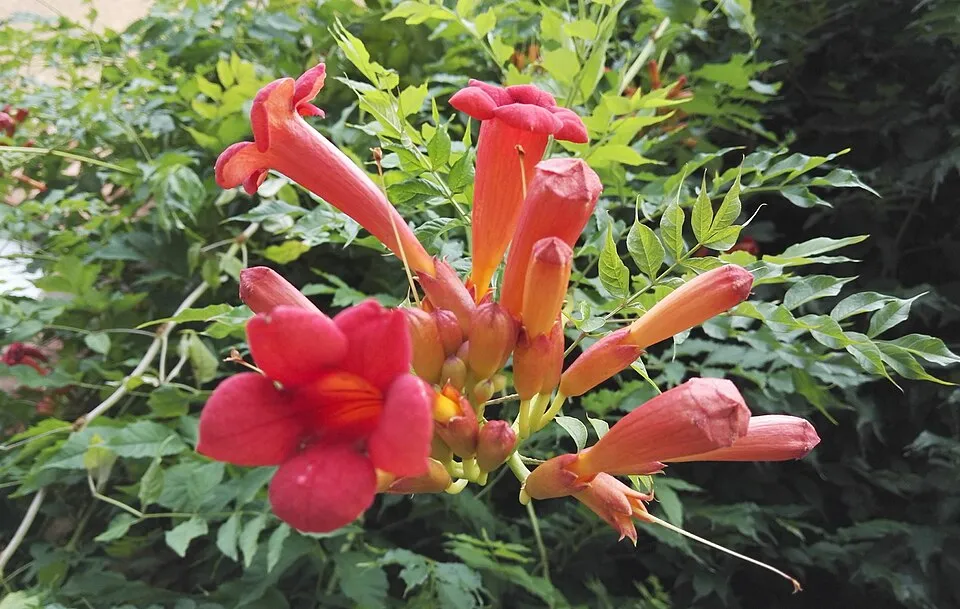
Campsis radicans, commonly known as Trumpet Creeper or Trumpet Vine, is a robust, deciduous perennial vine belonging to the Bignoniaceae family. Native to the central and eastern United States, this vigorous plant is characterized by its woody stems and ability to climb aggressively using aerial rootlets that cling to various surfaces. Its foliage consists of pinnately compound leaves, each bearing numerous serrated leaflets, providing a dense green cover.
The most striking feature of Campsis radicans is its profusion of large, showy, trumpet-shaped flowers, typically vibrant orange-red, but also occurring in shades of yellow or apricot, which bloom throughout the summer and attract hummingbirds. Following flowering, the plant produces elongated, bean-like seed pods that mature in the fall, releasing numerous winged seeds. Found naturally in diverse habitats such as swamps, forests, thickets, and along roadsides, Trumpet Creeper is highly adaptable to various soil conditions and demonstrates considerable drought tolerance once established.
Its genus name, 'Campsis,' derives from the Greek word 'kampe' meaning 'bent,' referring to the curved stamens of its flowers, while 'radicans' is Latin for 'producing roots,' aptly describing its climbing mechanism. Despite its ornamental appeal, the plant is known for its aggressive growth habit, readily spreading through underground runners and prolific self-seeding, often forming extensive colonies that can outcompete other vegetation.
Trusted Scientific References
1. Authoritative external sources for Campsis radicans
1.1 Wikipedia — Campsis radicans
1.2 Kew POWO (Plants of the World Online)
1.3 PubMed — peer-reviewed research
1.4 NCBI Taxonomy Browser
1.5 GBIF — Global Biodiversity
1.6Campsis Radicans should be interpreted through verified botanical identity, practical care, and responsible safety language. This recovery note adds the missing context needed for a complete profile: match light to the plant's habit, use well-drained soil, water according to season, and avoid unsupported medicinal or edible claims. For publishing, the plant can be presented as a source-backed garden plant with clear care guidance, common problem diagnosis, and conservative safety wording.
1.1.Campsis Radicans — Key Features
- ✓ <strong>Botanical Name</strong> — Campsis radicans
- ✓ <strong>Common Names</strong> — Trumpet Creeper, Trumpet Vine, Cow-itch, Hellvine, Foxglove Vine
- ✓ <strong>Family</strong> — Bignoniaceae
- ✓ <strong>Growth Habit</strong> — Vigorous, deciduous, woody perennial vine with aerial rootlets
- ✓ <strong>Flower Characteristics</strong> — Large, showy, trumpet-shaped flowers, typically orange-red to yellow
- ✓ <strong>Native Range</strong> — Central and Eastern United States
- ✓ <strong>Ecological Role</strong> — Larval host for the plebeian sphinx moth, attracts hummingbirds and pollinators
- ✓ <strong>Known Toxicity</strong> — Classified as a low severity poison; causes contact dermatitis upon contact
- ✓ <strong>Invasive Potential</strong> — Aggressive spreader via underground suckers and abundant self-seeding
- ✓ <strong>Preferred Conditions</strong> — Thrives in full sun to partial shade, adaptable to various soil types, drought-tolerant once established
1.2.Campsis Radicans — Quick Summary
- ✓ Campsis radicans, or Trumpet Creeper, is an aggressive, woody vine native to the Eastern US, known for its showy, trumpet-shaped flowers.
- ✓ Historically, it was noted for folk anti-inflammatory and digestive uses, but modern medicinal application is not recommended due to toxicity.
- ✓ Contains flavonoids, phenolics, and terpenoids, yet specific medicinal efficacy is unproven and overshadowed by significant safety concerns.
- ✓ The plant is a known low-severity poison and commonly causes contact dermatitis upon skin exposure.
- ✓ Requires sturdy support for cultivation and diligent management to control its invasive spread in garden settings.
- ✓ Not suitable for internal medicinal use; extreme caution is advised for any external applications or handling.
2.Campsis Radicans — Scientific Identity
3.Campsis Radicans — Quick Facts
4.Campsis Radicans — Appearance & Identification
5.Campsis Radicans — Native Habitat
6.Campsis Radicans — Water Requirements
- ✓ Soil Requirements — Campsis radicans thrives in a wide range of soil types, preferring lean to average fertility, but tolerating rich, well-draining conditions with a pH between 6.0 and 7.0.
- ✓ Light Exposure — Optimal flowering occurs in full sun, ensuring the most vibrant blooms; however, the foliage can tolerate partial shade, though flowering may be reduced.
- ✓ Watering Practices — Requires regular moisture, especially during dry periods, to establish robust growth, but demonstrates good drought tolerance once the vine is fully established in the landscape.
- ✓ Nutritional Needs — Benefits from moderate application of a balanced fertilizer during its active growing season to support vigorous development and abundant flower production.
- ✓ Pruning and Maintenance — Pruning spent flowers encourages further blooming, and early spring pruning is recommended as the plant flowers on new growth, allowing for shaping and size management.
- ✓ Support and Containment — Due to its dense, woody nature and considerable weight, provide sturdy structures like arbors or pergolas for climbing; manage its aggressive spreading via suckers and self-seeding by planting near mowable areas or concrete barriers to control its invasive tendencies.
Reviewed by the Flora Medical Global Botanical Review Panel
Multi-disciplinary editorial group · Botany · Ethnobotany · Herbal-medicine literature
Who reviewed this: This page was checked by the Flora Medical Global Botanical Review Panel — an in-house editorial group of botany graduates, ethnobotany researchers, and horticulture practitioners who collectively maintain our 7,000+ plant encyclopedia. Meet the team.
Our 4-step verification process
1. Taxonomic verification
Scientific names and synonyms cross-checked against Kew POWO, World Flora Online, and The Plant List.
2. Phytochemical & medicinal cross-reference
Active compounds, traditional uses, and reported activities are cross-referenced with PubMed, USDA Dr. Duke's database, and peer-reviewed ethnobotanical literature.
3. Conservation & distribution check
Distribution, ecology, and conservation status confirmed against GBIF occurrence records and the IUCN Red List.
4. Editorial & safety review
Every entry passes an editorial pass for clarity, originality, and safety notices (toxicity, contraindications, dosage caveats) before publication.
Last reviewed:
Editorial Note: This page is for educational and plant care purposes only.
Written by: Flora Medical Global Editorial Team
Reviewed by: Flora Medical Global Botanical Review Panel
Last Updated: June 15, 2026







Campsis Radicans — Comments & Community Reviews
Rate this plant