

Care Disclaimer: Plant care recommendations are general guidelines based on common growing conditions. Individual results may vary based on your local environment, climate, and care routine. If your plant is toxic, keep it away from children and pets, and consult a veterinarian if accidental ingestion occurs.
1.Caragana Arborescens — Overview
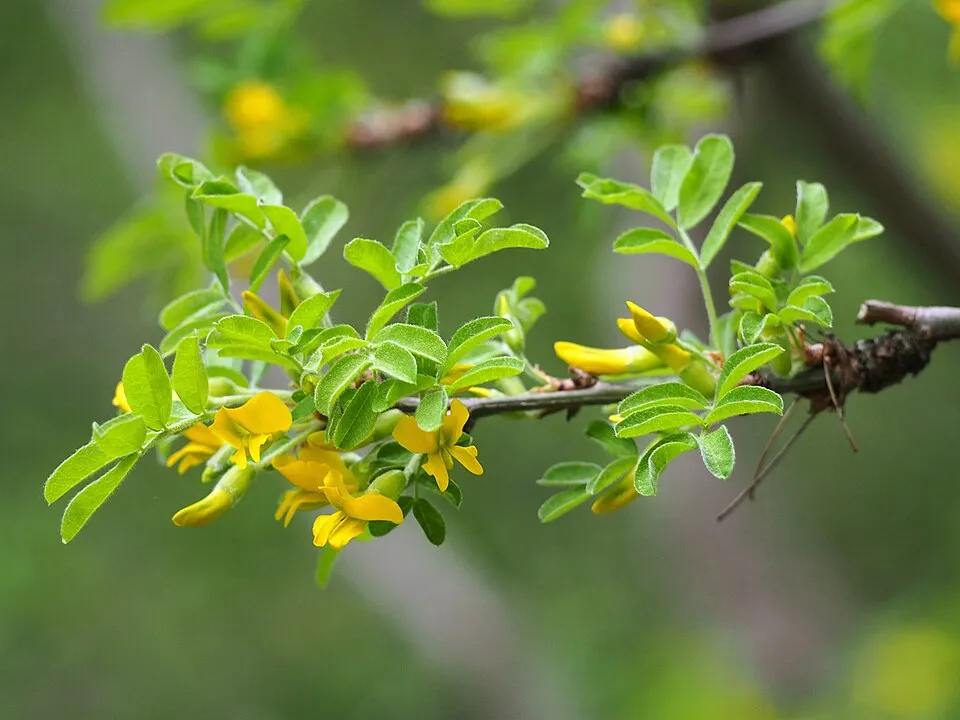
Caragana arborescens, commonly known as the Siberian Pea Tree or Siberian Peashrub, is a robust, deciduous shrub or small tree belonging to the Fabaceae family. Native to Eastern Asia, specifically Siberia and Mongolia, it has also become naturalized in parts of Europe, including France, thriving in diverse environments such as river banks, rocky slopes, open forests, and forest edges. This resilient plant typically grows to a height of 6 meters (19 feet) with a spread of 4 meters (13 feet), exhibiting a fast growth rate.
Its foliage consists of alternate, pinnately compound leaves with numerous small, oval leaflets that range from light to dark green. In late spring to early summer, Caragana arborescens produces an abundance of small, bright yellow, pea-like flowers that are often fragrant and highly attractive to pollinators. These blossoms are followed by slender, elongated pods that ripen in mid-summer, containing several small, edible seeds.
The plant's deep and extensive root system not only anchors it firmly in various soil types but also contributes to its ecological value as a nitrogen-fixer, enhancing soil fertility in its native and cultivated habitats. It is highly tolerant of cold, drought, and strong winds, making it a valuable species for challenging climates and soil stabilization efforts.
Trusted Scientific References
1. Authoritative external sources for Caragana arborescens
1.1 Wikipedia — Caragana arborescens
1.2 Kew POWO (Plants of the World Online)
1.3 PubMed — peer-reviewed research
1.4 NCBI Taxonomy Browser
1.5 GBIF — Global Biodiversity
1.6Caragana Arborescens should be interpreted through verified botanical identity, practical care, and responsible safety language. This recovery note adds the missing context needed for a complete profile: match light to the plant's habit, use well-drained soil, water according to season, and avoid unsupported medicinal or edible claims. For publishing, the plant can be presented as a source-backed garden plant with clear care guidance, common problem diagnosis, and conservative safety wording.
1.1.Caragana Arborescens — Key Features
- ✓ <strong>Nitrogen</strong> — Fixing Legume — Enhances soil fertility.
- ✓ <strong>Extreme Hardiness</strong> — Tolerates USDA zones 2-7.
- ✓ <strong>Edible Seeds and Pods</strong> — High in protein and oil.
- ✓ <strong>Attractive Yellow Flowers</strong> — Significant pollinator plant.
- ✓ <strong>Traditional Medicinal Uses</strong> — Anti-inflammatory, digestive aid, gynecological support.
- ✓ <strong>Drought and Wind Tolerant</strong> — Ideal for challenging environments.
- ✓ <strong>Erosion Control Plant</strong> — Extensive root system stabilizes soil.
- ✓ <strong>Source of Fibre and Dye</strong> — Bark for cordage, leaves for blue dye.
- ✓ <strong>Fast</strong> — Growing Deciduous Shrub — Quick establishment for hedges or shelterbelts.
- ✓ <strong>Rich in Bioactive Compounds</strong> — Flavonoids, saponins, alkaloids.
1.2.Caragana Arborescens — Quick Summary
- ✓ Siberian Pea Tree is a hardy, nitrogen-fixing shrub from Eastern Asia.
- ✓ Valued for traditional medicinal uses, including anti-inflammatory and digestive support.
- ✓ Rich in flavonoids, saponins, and proteins, especially in its edible seeds.
- ✓ Easy to cultivate, tolerating cold, drought, and poor soils.
- ✓ Used in infusions, poultices, and as a cooked vegetable.
- ✓ Contraindicated in pregnancy due to emmenagogue effects; professional advice recommended.
2.Caragana Arborescens — Scientific Identity
3.Caragana Arborescens — Quick Facts
4.Caragana Arborescens — Appearance & Identification
5.Caragana Arborescens — Native Habitat
6.Caragana Arborescens — Water Requirements
- ✓ Soil Preference — Thrives in well-drained, loamy soils, adaptable to nutritionally poor conditions, and tolerates a wide pH range from mildly acidic to very alkaline.
- ✓ Light Requirements — Requires full sun exposure, ideally at least six hours daily; cannot tolerate full shade conditions.
- ✓ Watering Regime — Needs regular watering, especially during dry spells, but is highly drought-tolerant once established; avoid waterlogging.
- ✓ Fertilization — Benefits from a balanced fertilizer application during the active growing season to enhance growth and flowering.
- ✓ Hardiness Zones — Exceptionally hardy, suitable for USDA zones 2-7 and UK zone 2, demonstrating strong frost resistance.
- ✓ Nitrogen Fixation — As a legume, it naturally fixes atmospheric nitrogen, improving soil fertility for itself and neighboring plants.
- ✓ Wind and Erosion Control — Highly wind-resistant and its extensive root system makes it excellent for shelterbelts and soil stabilization.
Reviewed by the Flora Medical Global Botanical Review Panel
Multi-disciplinary editorial group · Botany · Ethnobotany · Herbal-medicine literature
Who reviewed this: This page was checked by the Flora Medical Global Botanical Review Panel — an in-house editorial group of botany graduates, ethnobotany researchers, and horticulture practitioners who collectively maintain our 7,000+ plant encyclopedia. Meet the team.
Our 4-step verification process
1. Taxonomic verification
Scientific names and synonyms cross-checked against Kew POWO, World Flora Online, and The Plant List.
2. Phytochemical & medicinal cross-reference
Active compounds, traditional uses, and reported activities are cross-referenced with PubMed, USDA Dr. Duke's database, and peer-reviewed ethnobotanical literature.
3. Conservation & distribution check
Distribution, ecology, and conservation status confirmed against GBIF occurrence records and the IUCN Red List.
4. Editorial & safety review
Every entry passes an editorial pass for clarity, originality, and safety notices (toxicity, contraindications, dosage caveats) before publication.
Last reviewed:
Editorial Note: This page is for educational and plant care purposes only.
Written by: Flora Medical Global Editorial Team
Reviewed by: Flora Medical Global Botanical Review Panel
Last Updated: June 15, 2026







Caragana Arborescens — Comments & Community Reviews
Rate this plant