


Care Disclaimer: Plant care recommendations are general guidelines based on common growing conditions. Individual results may vary based on your local environment, climate, and care routine. If your plant is toxic, keep it away from children and pets, and consult a veterinarian if accidental ingestion occurs.
1.Catalpa Bignonioides — Overview
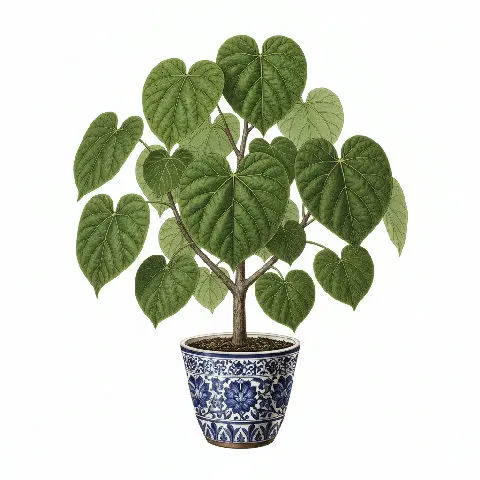
Catalpa bignonioides, widely recognized as the Southern Catalpa, Indian Bean Tree, or Cigar Tree, is a striking deciduous tree native to the diverse ecosystems of the southeastern United States. This fast-growing species typically achieves heights of 10 to 20 meters, with some mature specimens reaching over 30 meters, establishing a broad, impressive crown that can extend 12 to 18 meters in width. Its aesthetic appeal is rooted in several distinctive morphological characteristics.
The foliage consists of remarkably large, heart-shaped (cordate) to ovate leaves, often growing up to 30 centimeters long and 20 centimeters wide, arranged in whorls of three or opposite pairs. These leaves feature a vibrant, smooth green upper surface and a finely hairy underside, providing dense, cooling shade throughout the warmer seasons. The bark of young Catalpa bignonioides trees is initially smooth and grayish-brown, gradually developing a textured appearance with age, characterized by shallow furrows and scaly ridges that enhance its winter profile.
One of the most captivating aspects of the Southern Catalpa is its abundant and spectacular floral display, which occurs from late spring to early summer. It produces large, showy, bell-shaped flowers, predominantly white or creamy-white, intricately marked with purple or brownish-purple spots and streaks, along with prominent yellow stripes in their throats. These fragrant blossoms are borne in upright, pyramidal panicles, often 15-25 cm in length, making them highly attractive to a wide range of pollinators, including various bee species, hummingbirds, and other insects.
Following this impressive bloom, the tree develops its eponymous fruit: long, slender, cylindrical seed pods that strikingly resemble green beans or cigars, giving rise to one of its common names. These distinctive pods can grow to lengths of 20 to 40 centimeters, often remaining on the tree through autumn and winter before eventually splitting open to release numerous flat, winged seeds that are efficiently dispersed by wind, contributing to the tree's ecological role.
Trusted Scientific References
1. Authoritative external sources for Catalpa bignonioides
1.1 Wikipedia — Catalpa bignonioides
1.2 Kew POWO (Plants of the World Online)
1.3 PubMed — peer-reviewed research
1.4 NCBI Taxonomy Browser
1.5 GBIF — Global Biodiversity
1.1.Catalpa Bignonioides — Key Features
- ✓ <strong>Rapid Growth Rate</strong> — A fast-growing shade tree reaching significant heights and canopy spread.
- ✓ <strong>Distinctive Foliage</strong> — Large, heart-shaped leaves provide dense shade and ornamental value.
- ✓ <strong>Showy Flowers</strong> — Large, bell-shaped white flowers with purple and yellow markings appear in late spring/early summer.
- ✓ <strong>Unique Seed Pods</strong> — Long, slender, cigar-like pods persist through winter, giving it the 'Cigar Tree' moniker.
- ✓ <strong>Native to Southeastern US</strong> — Well-adapted to its indigenous climate and soil conditions.
- ✓ <strong>Antidiabetic Potential</strong> — Scientifically studied for its α-glucosidase inhibitory and insulin-secreting activities.
- ✓ <strong>Rich in Iridoids and Flavonoids</strong> — Key chemical constituents with various therapeutic actions.
- ✓ <strong>Traditional Medicinal History</strong> — Used in South American folk medicine for a range of ailments including diabetes and skin conditions.
- ✓ <strong>Attracts Pollinators</strong> — Flowers are highly attractive to bees, hummingbirds, and other insects.
- ✓ <strong>Urban Tolerance</strong> — Exhibits good tolerance to urban pollution and various environmental stresses.
1.2.Catalpa Bignonioides — Quick Summary
- ✓ Southern Catalpa, or Indian Bean Tree, is a fast-growing deciduous tree native to the southeastern US.
- ✓ Known for large heart-shaped leaves, showy white flowers, and distinctive long, cigar-like seed pods.
- ✓ Traditionally used in South America for diabetes, gastric issues, and skin ailments.
- ✓ Modern research highlights its antidiabetic potential through α-glucosidase inhibition and insulin secretion.
- ✓ Rich in iridoids (like catalpol) and flavonoids, which contribute to its medicinal properties.
- ✓ Caution is advised for use, especially in pregnant individuals, children, and those on antidiabetic medications.
2.Catalpa Bignonioides — Scientific Identity
3.Catalpa Bignonioides — Quick Facts
4.Catalpa Bignonioides — Appearance & Identification
5.Catalpa Bignonioides — Native Habitat
6.Catalpa Bignonioides — Water Requirements
- ✓ Site Selection — Plant in a location with full sun exposure for optimal growth and flowering, though it can tolerate partial shade.
- ✓ Soil Requirements — Thrives in deep, moist, well-drained loamy soils but is tolerant of a wide range of soil types, including clay and sandy soils.
- ✓ Watering — Requires regular watering, especially during dry periods and in its establishment phase; mature trees are moderately drought-tolerant.
- ✓ Propagation — Primarily propagated by seeds, which require stratification, or by softwood cuttings taken in late spring to early summer.
- ✓ Pruning — Prune in late winter or early spring to remove dead or diseased branches and to shape the tree, promoting a strong structure.
- ✓ Pest and Disease Management — Generally a robust tree, but can be susceptible to Catalpa sphinx moth larvae and occasional leaf spot diseases; minimal intervention is usually required.
- ✓ Hardiness — Hardy in USDA zones 4-9, demonstrating good cold tolerance once established.
- ✓ Spacing — Allow ample space for its broad, spreading crown, typically planting at least 10-15 meters away from structures or other large trees.
Reviewed by the Flora Medical Global Botanical Review Panel
Multi-disciplinary editorial group · Botany · Ethnobotany · Herbal-medicine literature
Who reviewed this: This page was checked by the Flora Medical Global Botanical Review Panel — an in-house editorial group of botany graduates, ethnobotany researchers, and horticulture practitioners who collectively maintain our 7,000+ plant encyclopedia. Meet the team.
Our 4-step verification process
1. Taxonomic verification
Scientific names and synonyms cross-checked against Kew POWO, World Flora Online, and The Plant List.
2. Phytochemical & medicinal cross-reference
Active compounds, traditional uses, and reported activities are cross-referenced with PubMed, USDA Dr. Duke's database, and peer-reviewed ethnobotanical literature.
3. Conservation & distribution check
Distribution, ecology, and conservation status confirmed against GBIF occurrence records and the IUCN Red List.
4. Editorial & safety review
Every entry passes an editorial pass for clarity, originality, and safety notices (toxicity, contraindications, dosage caveats) before publication.
Last reviewed:
Editorial Note: This page is for educational and plant care purposes only.
Written by: Flora Medical Global Editorial Team
Reviewed by: Flora Medical Global Botanical Review Panel
Last Updated: June 15, 2026







Catalpa Bignonioides — Comments & Community Reviews
Rate this plant