


Care Disclaimer: Plant care recommendations are general guidelines based on common growing conditions. Individual results may vary based on your local environment, climate, and care routine. If your plant is toxic, keep it away from children and pets, and consult a veterinarian if accidental ingestion occurs.
1.Ceanothus — Overview
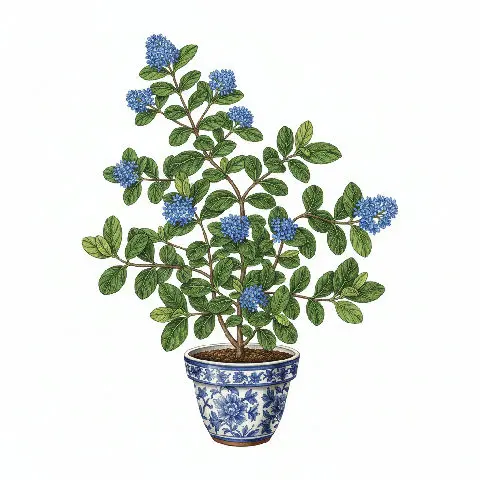
Ceanothus thyrsiflorus, commonly known as California lilac, Blueblossom, or Blue Mountain Lilac, is a versatile and visually striking broadleaf evergreen shrub belonging to the Rhamnaceae family. This resilient plant typically grows 3 to 10 feet (0.9 to 3 meters) tall, though in ideal native conditions, it can mature into a large, tree-like specimen reaching up to 20 feet (6 meters) in height and width with a short trunk and spreading branches. Its dense, glossy, dark green leaves are alternate, measuring 1 to 3 inches (2.5 to 7.6 cm) long with smooth margins, providing a lush, year-round verdant backdrop.
In spring, Ceanothus thyrsiflorus is famed for its profusion of small, tubular flowers, predominantly in shades of true blue to purple, which form magnificent spike-like clusters (thyrses) that can completely envelop the plant. These showy blooms are a significant nectar source, attracting a diverse array of pollinators, including hummingbirds, honey bees, and butterflies.
Native to the coastal shrublands, wooded slopes, canyons, and evergreen forests of California and Oregon, this hardy species thrives in regions with a Mediterranean climate. It prefers well-drained soils, ranging from acidic to alkaline, and flourishes in full sun to partial shade. Once established, Ceanothus thyrsiflorus exhibits remarkable drought tolerance, making it an excellent choice for xeriscaping, erosion control on slopes, and sustainable landscaping.
Its dense foliage also provides valuable cover for songbirds, enhancing its ecological role. The genus name 'Ceanothus' derives from an ancient Greek term for certain buckthorn plants, while 'thyrsiflorus' aptly describes its thyrse-shaped inflorescences.
Trusted Scientific References
1. Authoritative external sources for Ceanothus thyrsiflorus
1.1 Wikipedia — Ceanothus thyrsiflorus
1.2 Kew POWO (Plants of the World Online)
1.3 PubMed — peer-reviewed research
1.4 NCBI Taxonomy Browser
1.5 GBIF — Global Biodiversity
1.6Ceanothus should be interpreted through verified botanical identity, practical care, and responsible safety language. This recovery note adds the missing context needed for a complete profile: match light to the plant's habit, use well-drained soil, water according to season, and avoid unsupported medicinal or edible claims. For publishing, the plant can be presented as a source-backed garden plant with clear care guidance, common problem diagnosis, and conservative safety wording.
1.1.Ceanothus — Key Features
- ✓ <strong>Striking Blue Flowers</strong> — Known for its abundant clusters of true blue to purple flowers that blanket the shrub in spring.
- ✓ <strong>Evergreen Foliage</strong> — Maintains glossy, dark green leaves year-round, providing continuous aesthetic appeal and winter cover.
- ✓ <strong>Drought Tolerant</strong> — Highly adapted to dry conditions once established, making it ideal for water-wise landscaping.
- ✓ <strong>Pollinator Magnet</strong> — Attracts bees, butterflies, and hummingbirds, supporting local biodiversity.
- ✓ <strong>Native Plant</strong> — Indigenous to California and Oregon, thriving in Mediterranean climates.
- ✓ <strong>Lymphatic Herb</strong> — Renowned in herbalism for its benefits to the lymphatic system and immune support.
- ✓ <strong>Astringent Properties</strong> — Possesses strong astringent qualities, useful for toning tissues and reducing inflammation.
- ✓ <strong>Erosion Control</strong> — Its dense root system and spreading habit make it effective for stabilizing slopes.
- ✓ <strong>Low Maintenance</strong> — Requires minimal care once established, making it a gardener-friendly choice.
- ✓ <strong>Traditional Uses</strong> — Historically utilized by Native Americans for medicinal purposes and as a natural soap.
1.2.Ceanothus — Quick Summary
- ✓ Botanical Identity — Ceanothus thyrsiflorus, California lilac, an evergreen shrub native to California and Oregon.
- ✓ Medicinal Focus — Valued for lymphatic, respiratory, and skin support, with strong astringent and anti-inflammatory properties.
- ✓ Key Compounds — Rich in triterpenoid saponins (like ceanothic acid), flavonoids, and tannins.
- ✓ Traditional Uses — Employed by indigenous peoples for coughs, respiratory issues, and skin healing; also used for natural soap.
- ✓ Cultivation — Low maintenance, drought-tolerant, prefers full sun and well-drained soil, excellent for xeriscaping.
- ✓ Safety Note — Generally safe with traditional use, but caution advised for pregnancy, lactation, and with certain medications; consult a professional.
2.Ceanothus — Scientific Identity
3.Ceanothus — Quick Facts
4.Ceanothus — Appearance & Identification
5.Ceanothus — Native Habitat
6.Ceanothus — Water Requirements
- ✓ Site Selection — Plant Ceanothus thyrsiflorus in its permanent location, as it dislikes root disturbance once established.
- ✓ Light Requirements — Provide full sun (6+ hours direct sunlight) to partial shade (2-6 hours direct sunlight) for optimal growth and flowering.
- ✓ Soil Conditions — Ensure well-drained soil; it tolerates a wide range of soil textures including loam and sand, and pH from acidic to alkaline.
- ✓ Watering — Water regularly during establishment; once mature, it is highly drought-tolerant and requires minimal supplemental irrigation.
- ✓ Pruning — Prune immediately after flowering to shape the plant and remove spent blooms, avoiding heavy pruning or cutting wood thicker than a pencil to maintain plant vigor.
- ✓ Propagation — Can be propagated from seed, which ripens from August to October, or via stem cuttings for cultivar consistency.
- ✓ Winter Hardiness — Hardy in USDA Zones 5a-9b, though colder winters may cause some dieback; provides excellent winter cover for wildlife.
- ✓ Erosion Control — Ideal for planting on slopes due to its spreading habit and dense root system, effectively preventing soil erosion.
Reviewed by the Flora Medical Global Botanical Review Panel
Multi-disciplinary editorial group · Botany · Ethnobotany · Herbal-medicine literature
Who reviewed this: This page was checked by the Flora Medical Global Botanical Review Panel — an in-house editorial group of botany graduates, ethnobotany researchers, and horticulture practitioners who collectively maintain our 7,000+ plant encyclopedia. Meet the team.
Our 4-step verification process
1. Taxonomic verification
Scientific names and synonyms cross-checked against Kew POWO, World Flora Online, and The Plant List.
2. Phytochemical & medicinal cross-reference
Active compounds, traditional uses, and reported activities are cross-referenced with PubMed, USDA Dr. Duke's database, and peer-reviewed ethnobotanical literature.
3. Conservation & distribution check
Distribution, ecology, and conservation status confirmed against GBIF occurrence records and the IUCN Red List.
4. Editorial & safety review
Every entry passes an editorial pass for clarity, originality, and safety notices (toxicity, contraindications, dosage caveats) before publication.
Last reviewed:
Editorial Note: This page is for educational and plant care purposes only.
Written by: Flora Medical Global Editorial Team
Reviewed by: Flora Medical Global Botanical Review Panel
Last Updated: June 15, 2026







Ceanothus — Comments & Community Reviews
Rate this plant