
Care Disclaimer: Plant care recommendations are general guidelines based on common growing conditions. Individual results may vary based on your local environment, climate, and care routine. If your plant is toxic, keep it away from children and pets, and consult a veterinarian if accidental ingestion occurs.
1.Ceanothus Americanus — Overview
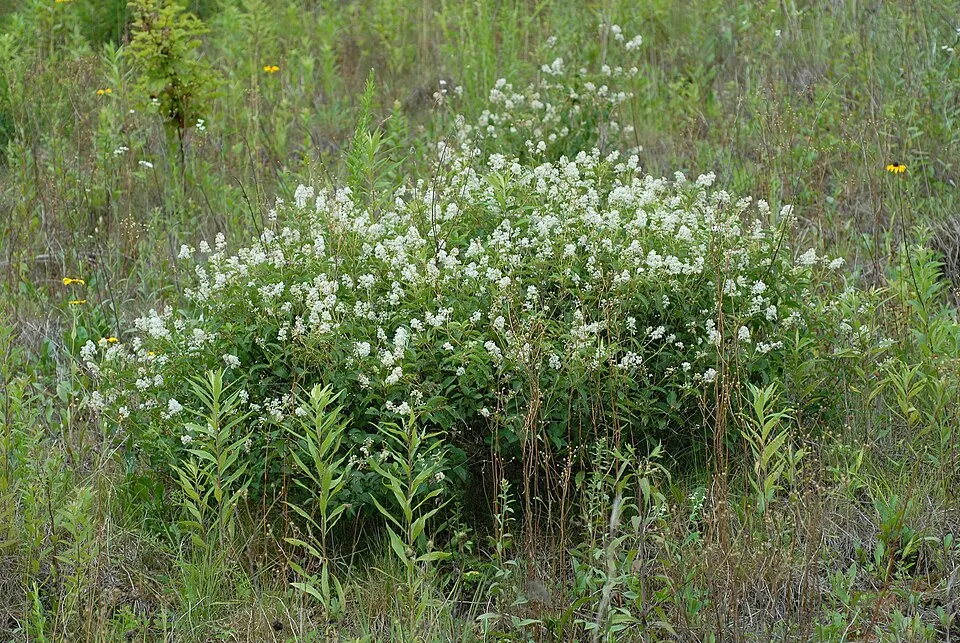
Ceanothus americanus, commonly known as Red Root or New Jersey Tea, is a resilient deciduous shrub native to eastern and central North America, typically reaching heights of 1 to 1.5 meters. It belongs to the Rhamnaceae family, distinguishing it from the 'Various' family designation often mistakenly attributed. The plant features alternate, ovate to elliptic leaves, finely serrated along the margins, with prominent veins that give them a somewhat crinkled appearance.
In late spring to early summer, Ceanothus americanus produces abundant clusters of delicate, fragrant white flowers arranged in elongated panicles, attracting a variety of pollinators. Its common name, New Jersey Tea, stems from its historical use during the American Revolutionary War as a substitute for imported black tea. The plant's most notable characteristic, and the source of its other common name, Red Root, is its deep, thick, reddish-brown root system.
These roots are woody and robust, enabling the plant to thrive in diverse habitats, from dry, open woodlands and prairies to forest edges and rocky slopes. It demonstrates remarkable adaptability to various soil types, preferring well-drained conditions, and is known for its ability to resprout vigorously after wildfires, playing an important ecological role in successional landscapes across its native range.
Trusted Scientific References
1. Authoritative external sources for Ceanothus americanus
1.1 Wikipedia — Ceanothus americanus
1.2 Kew POWO (Plants of the World Online)
1.3 PubMed — peer-reviewed research
1.4 NCBI Taxonomy Browser
1.5 GBIF — Global Biodiversity
1.6Ceanothus Americanus should be interpreted through verified botanical identity, practical care, and responsible safety language. This recovery note adds the missing context needed for a complete profile: match light to the plant's habit, use well-drained soil, water according to season, and avoid unsupported medicinal or edible claims. For publishing, the plant can be presented as a source-backed garden plant with clear care guidance, common problem diagnosis, and conservative safety wording.
1.1.Ceanothus Americanus — Key Features
- ✓ <strong>Native North American Shrub</strong> — Indigenous to eastern and central regions, known for its ecological resilience.
- ✓ <strong>Lymphatic System Tonic</strong> — Highly regarded for stimulating and decongesting the lymphatic system.
- ✓ <strong>Splenic Support Herb</strong> — Traditionally used to enhance spleen function and address enlargement.
- ✓ <strong>Anti</strong> — inflammatory Action — Contains compounds that help reduce inflammation throughout the body.
- ✓ <strong>Respiratory Expectorant</strong> — Aids in clearing mucus and soothing respiratory tract irritations.
- ✓ <strong>Rich in Bioactive Compounds</strong> — Features triterpenoid saponins, alkaloids, flavonoids, and tannins.
- ✓ <strong>Drought</strong> — Tolerant and Hardy — Adaptable to various environments and relatively easy to cultivate.
- ✓ <strong>Historical 'New Jersey Tea'</strong> — Used as a tea substitute during the American Revolution.
- ✓ <strong>Astringent Properties</strong> — Beneficial for topical applications on skin irritations and wounds.
- ✓ <strong>Immune Modulator</strong> — Contributes to overall immune health by supporting key immune organs.
1.2.Ceanothus Americanus — Quick Summary
- ✓ Red Root (Ceanothus americanus) is a native North American shrub renowned for its medicinal properties.
- ✓ It is a primary lymphatic system herb, crucial for detoxification and immune support.
- ✓ Key compounds include ceanothic acid, ceanothine alkaloids, flavonoids, and tannins.
- ✓ Traditionally used for lymphatic congestion, enlarged spleen, and respiratory issues.
- ✓ Available as decoctions, tinctures, and topical preparations for various applications.
- ✓ Generally safe when used appropriately, but caution is advised for pregnant individuals and those on certain medications.
2.Ceanothus Americanus — Scientific Identity
3.Ceanothus Americanus — Quick Facts
4.Ceanothus Americanus — Appearance & Identification
5.Ceanothus Americanus — Native Habitat
6.Ceanothus Americanus — Water Requirements
- ✓ Site Selection — Choose a location with full sun to partial shade, ensuring at least 4-6 hours of direct sunlight daily for optimal growth of Ceanothus americanus.
- ✓ Soil Requirements — Red Root thrives in well-draining soil; amend heavy clay soils with sand or gravel to improve drainage and prevent root rot.
- ✓ Watering Regimen — Water regularly during the first growing season to establish the plant, then it becomes quite drought-tolerant, requiring less frequent watering.
- ✓ Mulching — Apply a layer of organic mulch around the base to conserve soil moisture, regulate soil temperature, and suppress weed growth.
- ✓ Fertilization — Fertilize sparingly with a balanced, slow-release granular fertilizer in early spring, or use compost to enrich the soil naturally.
- ✓ Pruning Techniques — Prune in late winter or early spring to remove dead or damaged branches and to maintain its desired shape and encourage bushier growth.
- ✓ Propagation — Ceanothus americanus can be propagated from seeds, which often require stratification, or from semi-hardwood cuttings taken in summer.
- ✓ Pest and Disease Management — This plant is generally resistant to most pests and diseases, making it a low-maintenance addition to many gardens.
Reviewed by the Flora Medical Global Botanical Review Panel
Multi-disciplinary editorial group · Botany · Ethnobotany · Herbal-medicine literature
Who reviewed this: This page was checked by the Flora Medical Global Botanical Review Panel — an in-house editorial group of botany graduates, ethnobotany researchers, and horticulture practitioners who collectively maintain our 7,000+ plant encyclopedia. Meet the team.
Our 4-step verification process
1. Taxonomic verification
Scientific names and synonyms cross-checked against Kew POWO, World Flora Online, and The Plant List.
2. Phytochemical & medicinal cross-reference
Active compounds, traditional uses, and reported activities are cross-referenced with PubMed, USDA Dr. Duke's database, and peer-reviewed ethnobotanical literature.
3. Conservation & distribution check
Distribution, ecology, and conservation status confirmed against GBIF occurrence records and the IUCN Red List.
4. Editorial & safety review
Every entry passes an editorial pass for clarity, originality, and safety notices (toxicity, contraindications, dosage caveats) before publication.
Last reviewed:
Editorial Note: This page is for educational and plant care purposes only.
Written by: Flora Medical Global Editorial Team
Reviewed by: Flora Medical Global Botanical Review Panel
Last Updated: June 15, 2026







Ceanothus Americanus — Comments & Community Reviews
Rate this plant