

Care Disclaimer: Plant care recommendations are general guidelines based on common growing conditions. Individual results may vary based on your local environment, climate, and care routine. If your plant is toxic, keep it away from children and pets, and consult a veterinarian if accidental ingestion occurs.
1.Ceanothus Thyrsiflorus — Overview
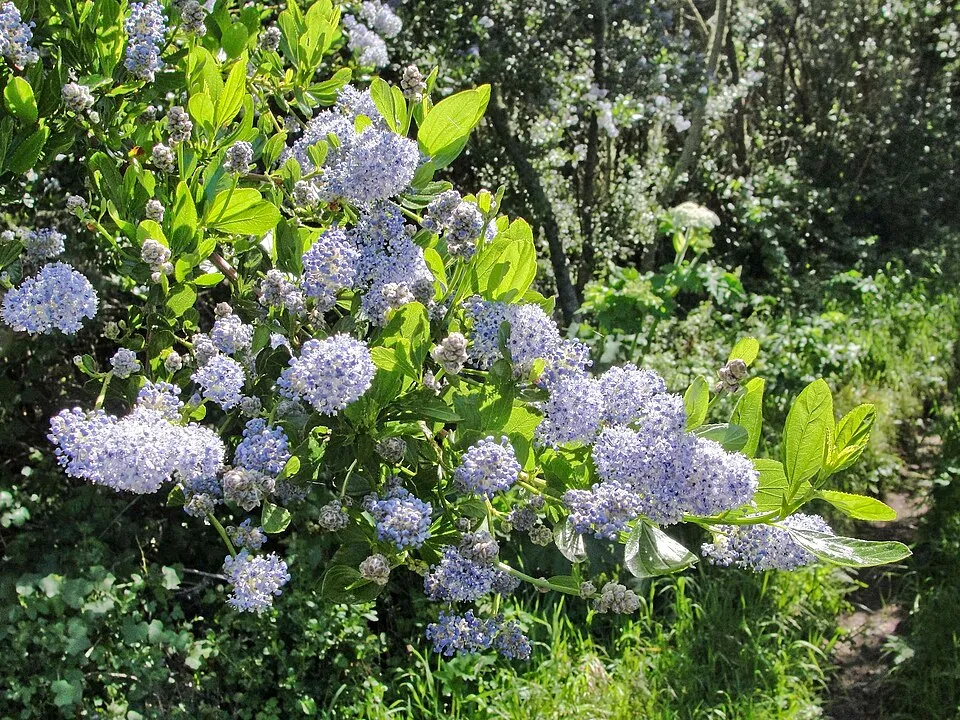
Ceanothus thyrsiflorus, commonly known as Blueblossom, Blue Blossom, Blue Brush, or Blue Mountain Lilac, is a resilient broadleaf evergreen shrub belonging to the Rhamnaceae, or buckthorn family. Native to the diverse landscapes of southwestern North America, its natural habitat spans from Oregon down to Mexico, where it thrives on wooded slopes, within canyons, alongside streams, and integrated into evergreen forests. This adaptable plant typically grows as a dense, spreading shrub, though it can reach impressive heights of up to 20 feet if left unpruned, developing a short trunk and wide branches.
Its most striking feature is the profusion of truly blue flowers, a color notoriously difficult to find in the plant kingdom, which bloom in spike-like clusters, known as thyrses, from mid-May to mid-June. Before fully opening, the flower buds often display a delicate pinky-lavender hue. The leaves are glossy, evergreen, and provide consistent cover year-round.
Following flowering, the plant produces small, glandular-sticky, and slightly lobed capsule fruits that ripen from August to October, often displaying brown, copper, or purple tones. The genus name 'Ceanothus' derives from 'keanothos,' an ancient Greek term for certain plants in the buckthorn family, while 'thyrsiflorus' aptly describes its thyrse-shaped inflorescence.
Trusted Scientific References
1. Authoritative external sources for Ceanothus thyrsiflorus
1.1 Wikipedia — Ceanothus thyrsiflorus
1.2 Kew POWO (Plants of the World Online)
1.3 PubMed — peer-reviewed research
1.4 NCBI Taxonomy Browser
1.5 GBIF — Global Biodiversity
1.6Ceanothus Thyrsiflorus should be interpreted through verified botanical identity, practical care, and responsible safety language. This recovery note adds the missing context needed for a complete profile: match light to the plant's habit, use well-drained soil, water according to season, and avoid unsupported medicinal or edible claims. For publishing, the plant can be presented as a source-backed garden plant with clear care guidance, common problem diagnosis, and conservative safety wording.
1.1.Ceanothus Thyrsiflorus — Key Features
- ✓ <strong>Botanical Name</strong> — Ceanothus thyrsiflorus (Blueblossom).
- ✓ <strong>Family</strong> — Rhamnaceae (Buckthorn Family).
- ✓ <strong>Native Range</strong> — Southwestern North America, from Oregon to Mexico.
- ✓ <strong>Key Constituents</strong> — Flavonoids, Tannins, Phenolic Acids, Saponins.
- ✓ <strong>Primary Actions</strong> — Anti-inflammatory, Antioxidant, Diuretic, Astringent, Expectorant.
- ✓ <strong>Traditional Uses</strong> — Digestive aid, respiratory support, topical cleanser, anti-inflammatory.
- ✓ <strong>Growth Habit</strong> — Broadleaf evergreen shrub, can grow up to 20 feet tall and wide.
- ✓ <strong>Distinctive Feature</strong> — Abundant clusters of vibrant, truly blue flowers in spring.
- ✓ <strong>Cultivation</strong> — Low maintenance, prefers well-drained soil and dislikes root disturbance.
- ✓ <strong>Wildlife Value</strong> — Attracts hummingbirds, bees, and butterflies, providing nectar and cover.
1.2.Ceanothus Thyrsiflorus — Quick Summary
- ✓ Ceanothus thyrsiflorus, or Blueblossom, is a North American evergreen shrub of the Rhamnaceae family.
- ✓ Traditionally valued for digestive, respiratory, anti-inflammatory, and diuretic support.
- ✓ Rich in beneficial phytochemicals including flavonoids, tannins, and saponins.
- ✓ Exhibits potent antioxidant and astringent properties, contributing to overall wellness.
- ✓ Cultivation requires well-drained soil, full sun to partial shade, and minimal pruning.
- ✓ Consult a healthcare professional before use, especially during pregnancy or with medications.
2.Ceanothus Thyrsiflorus — Scientific Identity
3.Ceanothus Thyrsiflorus — Quick Facts
4.Ceanothus Thyrsiflorus — Appearance & Identification
5.Ceanothus Thyrsiflorus — Native Habitat
6.Ceanothus Thyrsiflorus — Water Requirements
- ✓ Soil Preference — Thrives in well-drained, loamy soil that is moderately enriched with organic matter, avoiding heavy clay.
- ✓ Sunlight Requirements — Prefers full sun (at least 6 hours direct sunlight daily) to partial shade for optimal growth and flowering.
- ✓ Watering Regimen — Water moderately, allowing the topsoil to dry completely between watering sessions; established plants are drought-tolerant.
- ✓ Planting Technique — Due to its dislike for root disturbance, plant Ceanothus thyrsiflorus in its permanent site when young.
- ✓ Pruning Strategy — Perform light pruning immediately after flowering to maintain shape and remove dead or damaged foliage; avoid heavy cutting, especially wood thicker than a pencil, as it flowers on previous year's growth.
- ✓ Fertilization — Apply a balanced, slow-release fertilizer during the active growing season to promote vigorous health and abundant blooms.
- ✓ Hardiness and Protection — Generally hardy, but in colder winters, provide protection to prevent potential freeze damage to foliage and branches.
- ✓ Pest and Disease Management — Highly resistant to most common diseases and insect pests; however, be mindful of browsing by deer and elk.
Reviewed by the Flora Medical Global Botanical Review Panel
Multi-disciplinary editorial group · Botany · Ethnobotany · Herbal-medicine literature
Who reviewed this: This page was checked by the Flora Medical Global Botanical Review Panel — an in-house editorial group of botany graduates, ethnobotany researchers, and horticulture practitioners who collectively maintain our 7,000+ plant encyclopedia. Meet the team.
Our 4-step verification process
1. Taxonomic verification
Scientific names and synonyms cross-checked against Kew POWO, World Flora Online, and The Plant List.
2. Phytochemical & medicinal cross-reference
Active compounds, traditional uses, and reported activities are cross-referenced with PubMed, USDA Dr. Duke's database, and peer-reviewed ethnobotanical literature.
3. Conservation & distribution check
Distribution, ecology, and conservation status confirmed against GBIF occurrence records and the IUCN Red List.
4. Editorial & safety review
Every entry passes an editorial pass for clarity, originality, and safety notices (toxicity, contraindications, dosage caveats) before publication.
Last reviewed:
Editorial Note: This page is for educational and plant care purposes only.
Written by: Flora Medical Global Editorial Team
Reviewed by: Flora Medical Global Botanical Review Panel
Last Updated: June 15, 2026







Ceanothus Thyrsiflorus — Comments & Community Reviews
Rate this plant