


Care Disclaimer: Plant care recommendations are general guidelines based on common growing conditions. Individual results may vary based on your local environment, climate, and care routine. If your plant is toxic, keep it away from children and pets, and consult a veterinarian if accidental ingestion occurs.
1.Celeriac — Overview
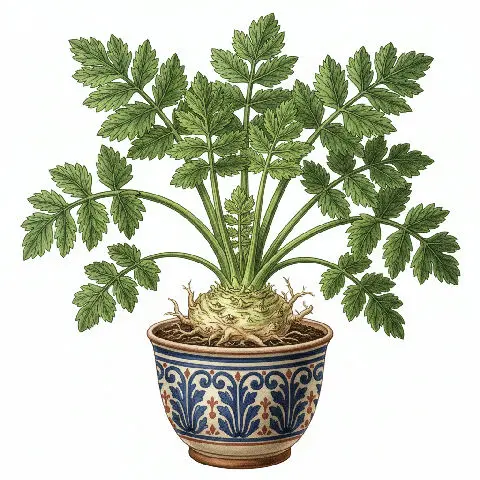
Celeriac, scientifically known as Apium graveolens rapaceum, is a distinctive biennial plant cultivated primarily for its edible, swollen hypocotyl, commonly referred to as a root. This unique cultivar of wild celery typically reaches heights of 60 to 90 cm. Its robust foliage consists of deeply lobed leaves, measuring 20 to 30 cm long, displaying a vibrant dark green hue that sets it apart from common celery varieties.
The plant's most striking feature is its tuberous root, which can grow up to 15 cm in diameter, characterized by a knobby, irregular, and rough exterior ranging in color from light brown to pale beige. In its second year, celeriac produces flowering stems topped with small, delicate, white, umbrella-shaped clusters known as umbels, which bloom in late summer and are attractive to pollinators. Native to the Mediterranean basin, Apium graveolens rapaceum thrives in cool, temperate climates and belongs to the Apiaceae family, a botanical group renowned for its aromatic and culinary members such as carrots, parsley, and parsnips.
Its adaptability and unique, earthy flavor profile make it a valued vegetable in both traditional and modern cuisine, increasingly recognized for its nutritional density.
Trusted Scientific References
1. Authoritative external sources for Apium graveolens rapaceum
1.1 Wikipedia — Apium graveolens rapaceum
1.2 Kew POWO (Plants of the World Online)
1.3 PubMed — peer-reviewed research
1.4 NCBI Taxonomy Browser
1.5 GBIF — Global Biodiversity
1.6Celeriac should be interpreted through verified botanical identity, practical care, and responsible safety language. This recovery note adds the missing context needed for a complete profile: match light to the plant's habit, use well-drained soil, water according to season, and avoid unsupported medicinal or edible claims. For publishing, the plant can be presented as a source-backed garden plant with clear care guidance, common problem diagnosis, and conservative safety wording.
1.1.Celeriac — Key Features
- ✓ <strong>Edible Tuberous Root</strong> — The primary culinary part, known for its distinct earthy and nutty flavor.
- ✓ <strong>Rich Phytochemical Profile</strong> — Contains a diverse array of bioactive compounds, including flavonoids, furanocoumarins, and phthalides.
- ✓ <strong>Anti</strong> — inflammatory Properties — Demonstrated through modern research, with significant activity found in both root and aerial extracts.
- ✓ <strong>High Nutritional Value</strong> — An excellent source of Vitamins C, K, and B6, along with vital minerals like potassium and iron.
- ✓ <strong>Digestive Aid</strong> — High fiber content supports gastrointestinal health and regularity.
- ✓ <strong>Mediterranean Origin</strong> — Native to the region, it thrives in cool, temperate climates, making it adaptable to various growing conditions.
- ✓ <strong>Apiaceae Family Member</strong> — Closely related to common celery, carrots, and parsley, sharing some botanical characteristics.
- ✓ <strong>Versatile Culinary Use</strong> — Can be consumed raw, cooked, juiced, or incorporated into a wide range of dishes.
- ✓ <strong>Potential for Waste Reduction</strong> — Studies highlight the significant health benefits of the often-discarded aerial parts, promoting whole-plant utilization.
- ✓ <strong>Traditional Medicinal Uses</strong> — Incorporated into Ayurvedic and Traditional Chinese Medicine practices for various ailments.
1.2.Celeriac — Quick Summary
- ✓ Celeriac is a unique root vegetable, a cultivar of wild celery, prized for its knobby, edible tuber.
- ✓ It is nutritionally dense, rich in vitamins (C, K, B6) and essential minerals (potassium, iron).
- ✓ Both the root and aerial parts contain potent anti-inflammatory and antioxidant phytochemicals, including apigenin and furanocoumarins.
- ✓ Traditionally used in Ayurveda and TCM to support digestion, liver/kidney function, and address inflammatory skin conditions.
- ✓ Modern research confirms its anti-inflammatory potential, particularly highlighting the underutilized aerial parts.
- ✓ While generally safe as food, caution is advised for individuals with allergies or those on certain medications, and due to potential phototoxicity.
2.Celeriac — Scientific Identity
3.Celeriac — Quick Facts
4.Celeriac — Appearance & Identification
5.Celeriac — Native Habitat
6.Celeriac — Water Requirements
- ✓ Soil Preparation — Requires a fertile, deep, loamy, and well-draining soil with a pH between 6.0 and 7.0, enriched with plenty of organic matter.
- ✓ Climate Requirements — Thrives in cool, temperate climates; consistent moisture and moderate temperatures are crucial, as it is sensitive to both extreme heat and frost.
- ✓ Sowing and Spacing — Seeds are typically started indoors 8-10 weeks before the last expected frost; transplant seedlings outdoors 20-30 cm apart in rows 30-45 cm apart.
- ✓ Watering — Consistent and ample watering is essential, particularly during the root development phase, to ensure proper swelling and prevent cracking; avoid waterlogging.
- ✓ Fertilization — Benefits from regular applications of a balanced fertilizer throughout the growing season to support robust leaf and root development.
- ✓ Harvesting — The tuberous roots are ready for harvest in late autumn, usually 90-120 days after transplanting, when they reach a diameter of 7-10 cm.
- ✓ Pest and Disease Management — Monitor for common Apiaceae pests like celery leaf miners and diseases such as early blight, employing appropriate organic or conventional controls.
Reviewed by the Flora Medical Global Botanical Review Panel
Multi-disciplinary editorial group · Botany · Ethnobotany · Herbal-medicine literature
Who reviewed this: This page was checked by the Flora Medical Global Botanical Review Panel — an in-house editorial group of botany graduates, ethnobotany researchers, and horticulture practitioners who collectively maintain our 7,000+ plant encyclopedia. Meet the team.
Our 4-step verification process
1. Taxonomic verification
Scientific names and synonyms cross-checked against Kew POWO, World Flora Online, and The Plant List.
2. Phytochemical & medicinal cross-reference
Active compounds, traditional uses, and reported activities are cross-referenced with PubMed, USDA Dr. Duke's database, and peer-reviewed ethnobotanical literature.
3. Conservation & distribution check
Distribution, ecology, and conservation status confirmed against GBIF occurrence records and the IUCN Red List.
4. Editorial & safety review
Every entry passes an editorial pass for clarity, originality, and safety notices (toxicity, contraindications, dosage caveats) before publication.
Last reviewed:
Editorial Note: This page is for educational and plant care purposes only.
Written by: Flora Medical Global Editorial Team
Reviewed by: Flora Medical Global Botanical Review Panel
Last Updated: June 15, 2026







Celeriac — Comments & Community Reviews
Rate this plant