

Care Disclaimer: Plant care recommendations are general guidelines based on common growing conditions. Individual results may vary based on your local environment, climate, and care routine. If your plant is toxic, keep it away from children and pets, and consult a veterinarian if accidental ingestion occurs.
1.Cephalanthus Occidentalis — Overview
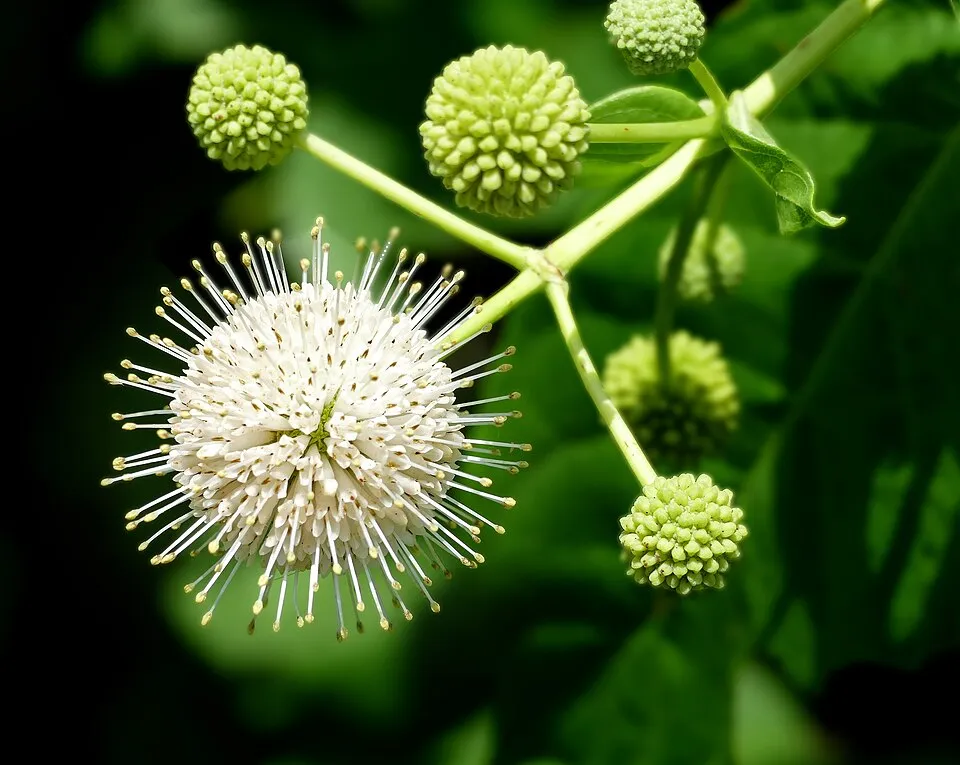
Cephalanthus occidentalis, commonly known as buttonbush, is a captivating deciduous shrub belonging to the diverse Rubiaceae family, which also includes coffee and gardenia. This riparian species is intrinsically linked to the wetland ecosystems across North America, ranging from eastern Canada through the United States and extending into Mexico and Cuba. Its preferred habitats include swamps, marshes, floodplains, and the margins of ponds, lakes, and slow-moving streams, where it often thrives in saturated or even standing water. The shrub typically grows to a height of 1 to 4 meters (3 to 12 feet), occasionally reaching small tree-like proportions, and exhibits a rounded, bushy growth habit. Its bark is generally smooth and grayish-brown on younger stems, becoming somewhat furrowed with age. The root system is fibrous and extensive, well-adapted to anaerobic conditions and capable of stabilizing wetland soils.
The foliage of Cephalanthus occidentalis is characterized by its glossy, dark green leaves, which are typically arranged in opposite or whorled patterns of three along the stems. Each leaf is lanceolate to ovate, measuring between 5 to 15 cm (2 to 6 inches) long, with an entire margin and a prominent midrib. In autumn, the leaves transform into an attractive yellow hue before abscission. The most striking feature of the buttonbush is its distinctive spherical flower heads, which emerge from mid-summer to early fall. These globose inflorescences, approximately 2.5-4 cm (1-1.5 inches) in diameter, are composed of hundreds of tiny, tubular, creamy-white to pale yellow flowers. Each individual flower possesses a long, slender style that protrudes conspicuously, giving the flower head a pincushion-like or sputnik appearance.
These fragrant blooms are a significant attractant for a wide array of pollinators, including various species of bees, butterflies (such as the monarch), and hummingbirds. Following successful pollination, the buttonbush develops unique spherical fruit clusters, which mature into hard, button-like aggregates of reddish-brown nutlets. These persistent fruit heads remain on the shrub throughout winter, providing visual interest and a food source for waterfowl and other wildlife. The resilience and ecological importance of Cephalanthus occidentalis in wetland restoration efforts underscore its significance beyond its ornamental value. Trusted Scientific References Authoritative external sources for Cephalanthus occidentalis : Wikipedia ...[CURRENT TEXT EXISTS: 2647 chars]
1.1.Cephalanthus Occidentalis — Key Features
- ✓ <strong>Distinctive spherical white</strong> — Distinctive spherical white flower heads resembling pincushions.
- ✓ <strong>Native to North</strong> — Native to North American wetlands, thriving in moist to wet soils.
- ✓ <strong>Deciduous shrub with</strong> — Deciduous shrub with glossy green leaves and attractive yellow fall color.
- ✓ <strong>Produces unique button</strong> — like fruit clusters that persist through winter.
- ✓ <strong>Traditionally used in</strong> — Traditionally used in Indigenous medicine for various ailments.
- ✓ <strong>Contains toxic indole</strong> — Contains toxic indole alkaloids, particularly cephalanthine, in its bark.
- ✓ <strong>Important pollinator plant,</strong> — Important pollinator plant, attracting bees, butterflies, and hummingbirds.
- ✓ <strong>Adaptable to challenging</strong> — Adaptable to challenging soil conditions, including anoxic environments.
- ✓ <strong>Exhibits astringent, anti</strong> — inflammatory, and antipyretic properties (traditional).
- ✓ <strong>Essential for wetland</strong> — Essential for wetland restoration and stabilization projects.
1.2.Cephalanthus Occidentalis — Quick Summary
- ✓ Cephalanthus occidentalis is a North American wetland shrub known for its distinctive spherical flowers and fruits.
- ✓ Traditionally used by Indigenous peoples for fevers, inflammation, wounds, and as an astringent.
- ✓ Contains potent indole alkaloids like cephalanthine and cephaline, along with tannins and saponins.
- ✓ All parts, especially the root bark, are considered toxic if ingested, primarily causing gastrointestinal and neurological symptoms.
- ✓ Primarily recommended for external use or highly diluted internal applications under expert guidance.
- ✓ Valued for its ecological role as a pollinator and wildlife plant in riparian habitats.
2.Cephalanthus Occidentalis — Scientific Identity
3.Cephalanthus Occidentalis — Quick Facts
4.Cephalanthus Occidentalis — Appearance & Identification
5.Cephalanthus Occidentalis — Native Habitat
6.Cephalanthus Occidentalis — Water Requirements
- ✓ Site Selection — Choose a location with full sun to partial shade and consistently moist to wet soil, ideally mimicking its native riparian habitats.
- ✓ Soil Requirements — Thrives in heavy, clayey soils or loamy soils with good organic content, tolerating both acidic and alkaline pH levels.
- ✓ Watering — Requires ample water, especially during dry periods; it can tolerate standing water and is an excellent choice for rain gardens or pond margins.
- ✓ Propagation — Can be propagated from seeds (requiring cold stratification) or softwood cuttings taken in late spring to early summer.
- ✓ Pruning — Prune in late winter or early spring to maintain shape, remove dead wood, and encourage denser growth and more prolific flowering.
- ✓ Fertilization — Generally not required in rich soils; if growth is poor, a balanced, slow-release fertilizer can be applied in early spring.
- ✓ Pest and Disease Resistance — Buttonbush is relatively resistant to most pests and diseases, making it a low-maintenance landscape plant.
- ✓ Winter Hardiness — Fully hardy in USDA zones 4-9, tolerating cold winters and late frosts without significant damage.
Reviewed by the Flora Medical Global Botanical Review Panel
Multi-disciplinary editorial group · Botany · Ethnobotany · Herbal-medicine literature
Who reviewed this: This page was checked by the Flora Medical Global Botanical Review Panel — an in-house editorial group of botany graduates, ethnobotany researchers, and horticulture practitioners who collectively maintain our 7,000+ plant encyclopedia. Meet the team.
Our 4-step verification process
1. Taxonomic verification
Scientific names and synonyms cross-checked against Kew POWO, World Flora Online, and The Plant List.
2. Phytochemical & medicinal cross-reference
Active compounds, traditional uses, and reported activities are cross-referenced with PubMed, USDA Dr. Duke's database, and peer-reviewed ethnobotanical literature.
3. Conservation & distribution check
Distribution, ecology, and conservation status confirmed against GBIF occurrence records and the IUCN Red List.
4. Editorial & safety review
Every entry passes an editorial pass for clarity, originality, and safety notices (toxicity, contraindications, dosage caveats) before publication.
Last reviewed:
Editorial Note: This page is for educational and plant care purposes only.
Written by: Flora Medical Global Editorial Team
Reviewed by: Flora Medical Global Botanical Review Panel
Last Updated: June 15, 2026







Cephalanthus Occidentalis — Comments & Community Reviews
Rate this plant