

Care Disclaimer: Plant care recommendations are general guidelines based on common growing conditions. Individual results may vary based on your local environment, climate, and care routine. If your plant is toxic, keep it away from children and pets, and consult a veterinarian if accidental ingestion occurs.
1.Chimonanthus Praecox — Overview
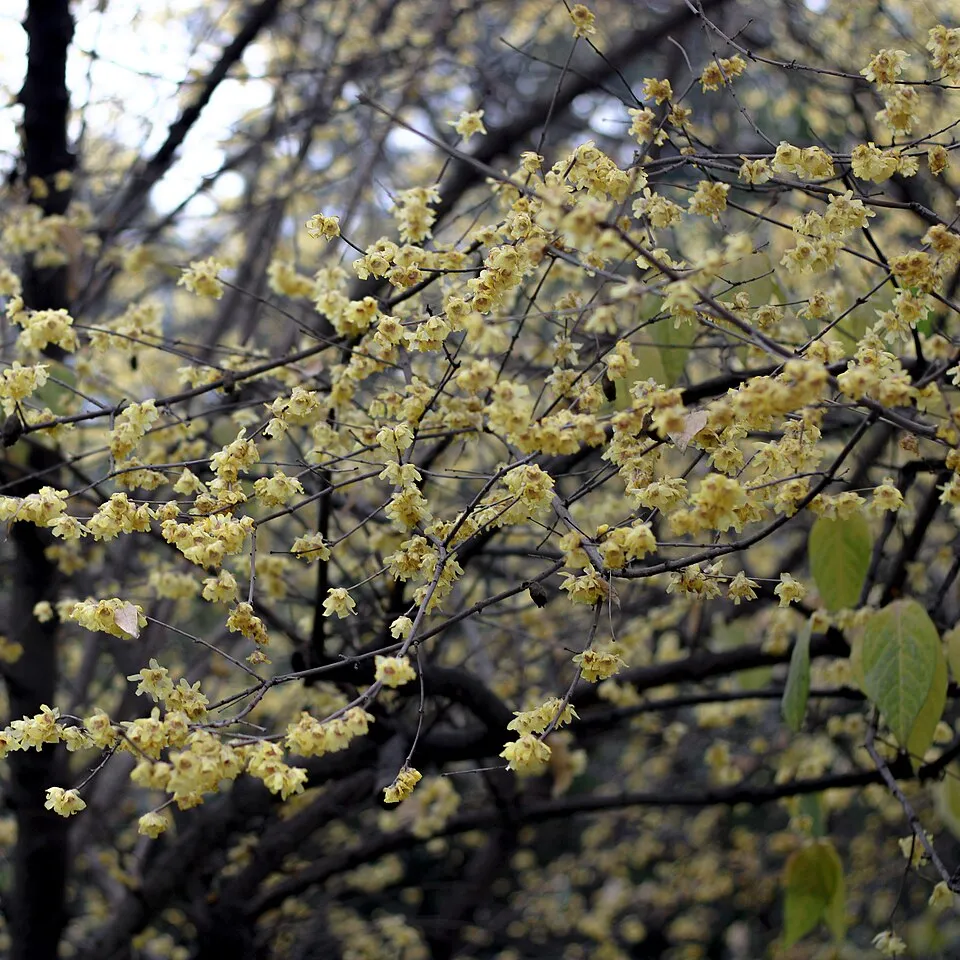
Chimonanthus praecox, commonly known as wintersweet or fragrant wintersweet, is a captivating deciduous shrub belonging to the Calycanthaceae family, a small and ancient lineage of flowering plants. This exquisite species is indigenous to the mountainous and wooded terrains of central and eastern China, flourishing in provinces such as Anhui, Fujian, Hubei, Hunan, Jiangsu, Jiangxi, Shaanxi, Sichuan, and Zhejiang.
It typically inhabits well-drained, humus-rich soils found on forest margins, slopes, and along streams, at elevations ranging from 200 to 1800 meters. Wintersweet is highly esteemed for its extraordinary ability to produce intensely fragrant blossoms in late winter to early spring, often bravely blooming amidst snow-covered landscapes, which gives rise to its evocative common name.
Morphologically, Chimonanthus praecox typically presents as a multi-stemmed shrub, achieving a height of 3 to 5 meters with a similar spread, developing a graceful, rounded, and somewhat fountain-like silhouette. Its bark is generally smooth and grayish-brown, gradually acquiring slight fissures with increasing age. The leaves are simple, arranged oppositely on the stems, ovate to elliptic or lanceolate in shape, measuring approximately 7-15 cm in length and 3-7 cm in width. They display a vibrant green hue, are typically glabrous or sparsely hairy on the underside, feature an entire margin, and terminate in a distinct acuminate apex.
These leaves emerge subsequent to the flowering period and often transition to a clear yellow in autumn before abscission. The true allure, however, lies in its waxy, cup-shaped flowers, which emerge on bare stems. Each flower, 2-4 cm in diameter, comprises numerous tepals; the outer ones are pale to bright yellow, while the inner ones are shorter and purplish-brown, creating a striking visual contrast. The plant's deep, sweet, and spicy fragrance is a hallmark, rendering it a prized ornamental and a source of valuable essential oils.
The fruit develops into an urn-shaped to ellipsoid capsule, 2-5 cm long, containing several dark brown, glossy seeds, which ripen in late summer to autumn. The root system is fibrous and spreading, providing robust anchorage.
Trusted Scientific References
1. Authoritative external sources for Chimonanthus praecox
1.1 Wikipedia — Chimonanthus praecox
1.2 Kew POWO (Plants of the World Online)
1.3 PubMed — peer-reviewed research
1.4 NCBI Taxonomy Browser
1.5 GBIF — Global Biodiversity
1.1.Chimonanthus Praecox — Key Features
- ✓ <strong>Deciduous Shrub</strong> — Loses its leaves in autumn, allowing its winter flowers to stand out.
- ✓ <strong>Winter Blooming</strong> — Produces highly fragrant flowers on bare stems from late winter to early spring.
- ✓ <strong>Intense Fragrance</strong> — Possesses a strong, sweet, and spicy aroma, a key characteristic.
- ✓ <strong>Yellow Flowers with Purple Centers</strong> — Outer tepals are pale to bright yellow, inner ones purplish-brown.
- ✓ <strong>Native to China</strong> — Indigenous to mountainous and wooded regions of central and eastern China.
- ✓ <strong>Ornamental Value</strong> — Highly prized in gardens for its unique winter appeal and scent.
- ✓ <strong>Essential Oil Source</strong> — Valued for its essential oil used in perfumery and aromatherapy.
- ✓ <strong>Cold Hardy</strong> — Tolerates cold temperatures, making it suitable for winter interest in many climates.
- ✓ <strong>Multi</strong> — stemmed Growth — Develops a graceful, rounded, and fountain-like silhouette.
- ✓ <strong>Low Maintenance</strong> — Generally free from serious pests and diseases.
1.2.Chimonanthus Praecox — Quick Summary
- ✓ Chimonanthus praecox, or Wintersweet, is a deciduous shrub native to China.
- ✓ Celebrated for its intensely fragrant, waxy yellow flowers blooming in late winter.
- ✓ Primarily valued as an ornamental plant and source of essential oils for perfumery.
- ✓ Traditional uses include aromatherapy for mood upliftment and respiratory comfort.
- ✓ Contains volatile essential oils, flavonoids, and phenolic acids.
- ✓ Requires well-drained soil, full sun to partial shade, and post-flowering pruning.
2.Chimonanthus Praecox — Scientific Identity
3.Chimonanthus Praecox — Quick Facts
4.Chimonanthus Praecox — Appearance & Identification
5.Chimonanthus Praecox — Native Habitat
6.Chimonanthus Praecox — Water Requirements
- ✓ Site Selection — Plant Chimonanthus praecox in a location receiving full sun to partial shade, ideally sheltered from harsh winds to protect delicate winter blooms.
- ✓ Soil Requirements — Thrives in moist, well-drained, humus-rich soils with a slightly acidic to neutral pH (6.0-7.0).
- ✓ Watering — Requires consistent moisture, especially during dry periods, but avoid waterlogging to prevent root rot.
- ✓ Fertilization — Apply a balanced, slow-release granular fertilizer in early spring, or compost around the base, to support vigorous growth and flowering.
- ✓ Pruning — Prune immediately after flowering to shape the shrub, remove old or leggy stems, and encourage new growth for future blooms; severe pruning can rejuvenate older plants.
- ✓ Propagation — Can be propagated by semi-hardwood cuttings taken in summer, or by layering. Seeds require stratification for germination.
- ✓ Pest and Disease Management — Generally a robust plant with no serious pest or disease problems; monitor for common garden pests like aphids and treat as necessary.
- ✓ Winter Protection — While cold-hardy, young plants in colder zones may benefit from a layer of mulch around the base for root protection during severe winters.
Reviewed by the Flora Medical Global Botanical Review Panel
Multi-disciplinary editorial group · Botany · Ethnobotany · Herbal-medicine literature
Who reviewed this: This page was checked by the Flora Medical Global Botanical Review Panel — an in-house editorial group of botany graduates, ethnobotany researchers, and horticulture practitioners who collectively maintain our 7,000+ plant encyclopedia. Meet the team.
Our 4-step verification process
1. Taxonomic verification
Scientific names and synonyms cross-checked against Kew POWO, World Flora Online, and The Plant List.
2. Phytochemical & medicinal cross-reference
Active compounds, traditional uses, and reported activities are cross-referenced with PubMed, USDA Dr. Duke's database, and peer-reviewed ethnobotanical literature.
3. Conservation & distribution check
Distribution, ecology, and conservation status confirmed against GBIF occurrence records and the IUCN Red List.
4. Editorial & safety review
Every entry passes an editorial pass for clarity, originality, and safety notices (toxicity, contraindications, dosage caveats) before publication.
Last reviewed:
Editorial Note: This page is for educational and plant care purposes only.
Written by: Flora Medical Global Editorial Team
Reviewed by: Flora Medical Global Botanical Review Panel
Last Updated: June 15, 2026







Chimonanthus Praecox — Comments & Community Reviews
Rate this plant