
Care Disclaimer: Plant care recommendations are general guidelines based on common growing conditions. Individual results may vary based on your local environment, climate, and care routine. If your plant is toxic, keep it away from children and pets, and consult a veterinarian if accidental ingestion occurs.
1.Chrysosplenium Alternifolium — Overview
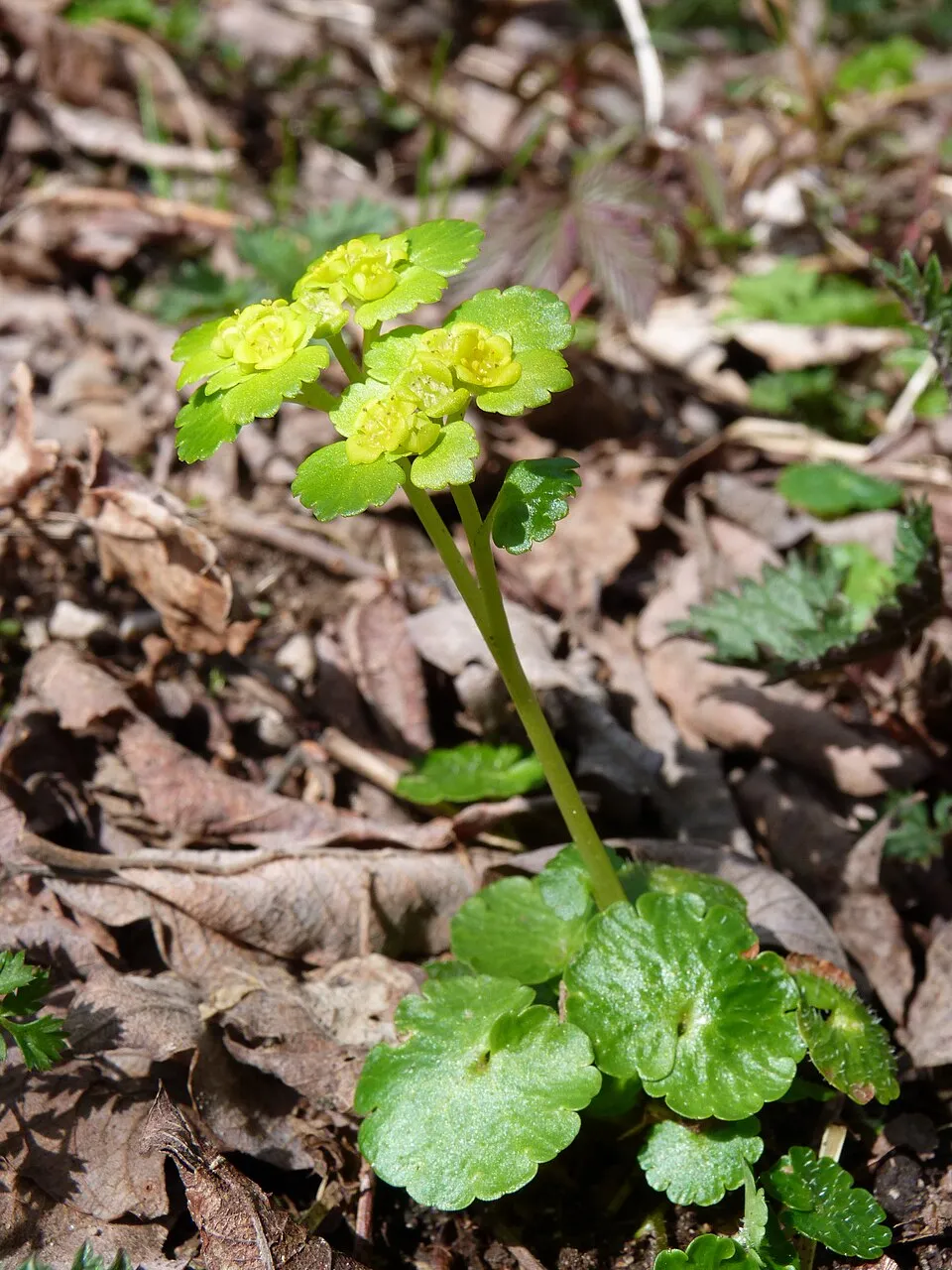
Chrysosplenium alternifolium, commonly known as Golden Saxifrage, Alternate-leaf golden saxifrage, or Iowa golden saxifrage, is a charming herbaceous perennial belonging to the Saxifragaceae family. This low-growing plant typically reaches a modest height of up to 0.3 meters and spreads to about 0.5 meters, forming dense, creeping mats.
Its distinctive foliage features alternate leaves, which are often small, somewhat reniform to ovate, and possess a vibrant green hue. These leaves are noted for a distinct bitterness, particularly when the plant is exposed to warmer conditions.
The floral display of Chrysosplenium alternifolium occurs from late spring to early summer, typically between April and July. It produces small, inconspicuous, yet intricate yellow-green flowers, often surrounded by brightly colored bracts that resemble petals, hence the "golden" in its common name.
These flowers are hermaphroditic, containing both male and female organs, and are primarily pollinated by generalist insects such as beetles and flies, contributing to the plant's self-fertility. The plant anchors itself with a fibrous root system that thrives in consistently moist to wet conditions.
Native to a wide range across Europe, extending from Scandinavia south to Central France, and eastward into Central Asia and the Himalayas, Chrysosplenium alternifolium is well-adapted to specific ecological niches. It predominantly colonizes acidic soils found along stream banks, on wet rocks, and within the damp, shaded understories of woodlands.
Its preference for semi-shade to full shade and consistently saturated ground makes it a characteristic species of bog gardens, damp woodlands, and riparian zones. This species is hardy in USDA zones 4-8, indicating its resilience to temperate climates.
Trusted Scientific References
1. Authoritative external sources for Chrysosplenium Alternifolium
1.1 Wikipedia — Chrysosplenium Alternifolium
1.2 Kew POWO (Plants of the World Online)
1.3 PubMed — peer-reviewed research
1.4 NCBI Taxonomy Browser
1.5 GBIF — Global Biodiversity
1.1.Chrysosplenium Alternifolium — Key Features
- ✓ <strong>Alternate</strong> — leaf Golden Saxifrage (Chrysosplenium alternifolium).
- ✓ <strong>Low</strong> — growing, creeping herbaceous perennial.
- ✓ <strong>Prefers consistently moist</strong> — Prefers consistently moist to wet, acidic soils.
- ✓ <strong>Thrives in semi</strong> — shade to full shade environments.
- ✓ <strong>Produces small, yellow</strong> — green flowers from April to July.
- ✓ <strong>Edible leaves, notable</strong> — Edible leaves, notable for their distinct bitter taste.
- ✓ <strong>Excellent choice for</strong> — Excellent choice for ground cover in damp, shaded areas.
- ✓ <strong>Supports local pollinators</strong> — Supports local pollinators like beetles and flies.
- ✓ <strong>Hardy in temperate climates (USDA zones 4</strong> — 8).
- ✓ <strong>Self</strong> — fertile and easily propagated by seed or division.
1.2.Chrysosplenium Alternifolium — Quick Summary
- ✓ Chrysosplenium alternifolium, or Golden Saxifrage, is a low-growing perennial.
- ✓ Member of the Saxifragaceae family, native to Europe and Asia.
- ✓ Thrives in moist, shaded environments, ideal for bog gardens and ground cover.
- ✓ Leaves are edible, but possess a distinct bitter flavor, especially in warm conditions.
- ✓ No known medicinal uses or hazards are widely documented, primarily valued ecologically.
- ✓ Propagated by seed or division, hardy in USDA zones 4-8.
2.Chrysosplenium Alternifolium — Scientific Identity
3.Chrysosplenium Alternifolium — Quick Facts
4.Chrysosplenium Alternifolium — Appearance & Identification
5.Chrysosplenium Alternifolium — Native Habitat
6.Chrysosplenium Alternifolium — Water Requirements
- ✓ Soil Preference — Thrives in acid soils, but is adaptable to mildly acid, neutral, and mildly alkaline (basic) soils, with a strong preference for constantly moist to wet conditions.
- ✓ Light Requirements — Prefers semi-shade (light woodland) or full shade; direct sun can be detrimental, especially in warmer climates, leading to increased bitterness in leaves.
- ✓ Watering — Requires consistently wet or very moist soil; suitable for bog gardens or riparian zones where water is plentiful and drainage is adequate.
- ✓ Hardiness — Hardy in USDA zones 4-8 and UK zone 4, tolerating cold temperatures well.
- ✓ Propagation by Seed — Sow seeds in spring or autumn in a lightly shaded cold frame, keeping the pot in 2 cm of water; prick out seedlings into individual pots and grow in water trays for the first winter before planting out.
- ✓ Propagation by Division — Easily propagated by division in spring; larger clumps can be directly replanted, while smaller clumps benefit from potting up and growing on in light shade until well-rooted before transplanting.
- ✓ Growth Habit — Its creeping nature makes it an excellent ground cover, particularly for damp, shaded areas, establishing a dense mat over time.
- ✓ Maintenance — Generally low maintenance once established, requiring consistent moisture and protection from intense sun.
Reviewed by the Flora Medical Global Botanical Review Panel
Multi-disciplinary editorial group · Botany · Ethnobotany · Herbal-medicine literature
Who reviewed this: This page was checked by the Flora Medical Global Botanical Review Panel — an in-house editorial group of botany graduates, ethnobotany researchers, and horticulture practitioners who collectively maintain our 7,000+ plant encyclopedia. Meet the team.
Our 4-step verification process
1. Taxonomic verification
Scientific names and synonyms cross-checked against Kew POWO, World Flora Online, and The Plant List.
2. Phytochemical & medicinal cross-reference
Active compounds, traditional uses, and reported activities are cross-referenced with PubMed, USDA Dr. Duke's database, and peer-reviewed ethnobotanical literature.
3. Conservation & distribution check
Distribution, ecology, and conservation status confirmed against GBIF occurrence records and the IUCN Red List.
4. Editorial & safety review
Every entry passes an editorial pass for clarity, originality, and safety notices (toxicity, contraindications, dosage caveats) before publication.
Last reviewed:
Editorial Note: This page is for educational and plant care purposes only.
Written by: Flora Medical Global Editorial Team
Reviewed by: Flora Medical Global Botanical Review Panel
Last Updated: June 15, 2026







Chrysosplenium Alternifolium — Comments & Community Reviews
Rate this plant