
Care Disclaimer: Plant care recommendations are general guidelines based on common growing conditions. Individual results may vary based on your local environment, climate, and care routine. If your plant is toxic, keep it away from children and pets, and consult a veterinarian if accidental ingestion occurs.
1.Cleome — Overview
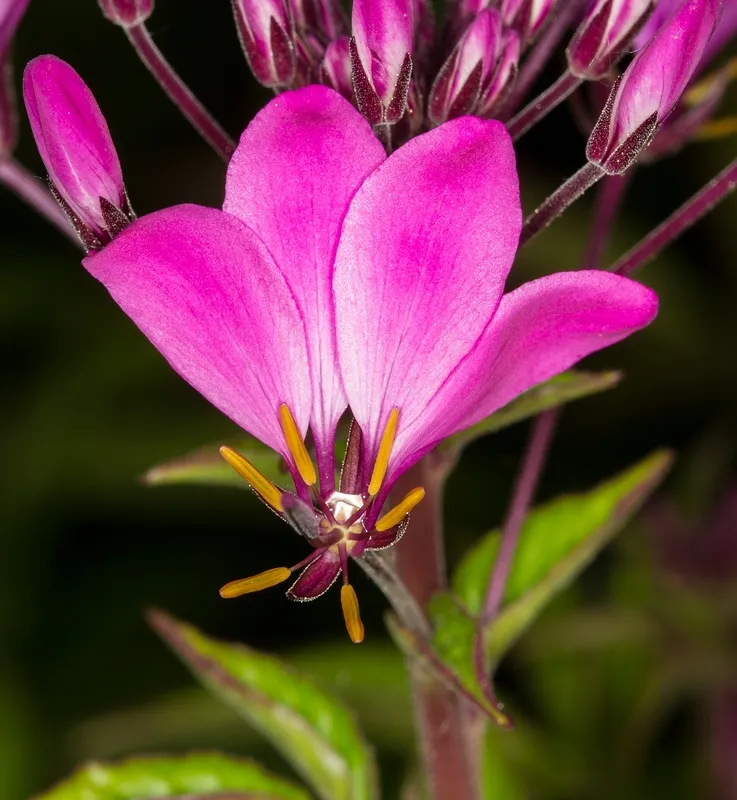
Cleome hassleriana, widely recognized as the spider flower or spider plant, is an captivating annual herbaceous species within the Cleomaceae family, formerly classified under Capparaceae. Indigenous to the tropical and subtropical regions of South America, including Brazil, Paraguay, Uruguay, and Argentina, it thrives in warm climates and well-drained soils, frequently naturalizing in disturbed or open habitats. This robust plant typically attains a height of 90 to 150 cm (3 to 5 feet), sometimes reaching up to 180 cm, with a spread of 45 to 60 cm (1.5 to 2 feet). Its tall, erect stems are often covered in fine, glandular hairs, imparting a slightly sticky texture and a distinct, sometimes pungent, odor when disturbed.
The root system is fibrous, anchoring the plant firmly while efficiently absorbing nutrients. The foliage is palmately compound, typically comprising five to seven obovate to lanceolate leaflets, each up to 10 cm (4 inches) long, with entire margins and a vibrant medium to dark green hue, often paler underneath. These leaves are spirally arranged along the stem, providing a lush backdrop to the showy inflorescences. The most striking feature, lending to its common name, is its unique flower structure.
Large, terminal racemes bloom from late spring through the first frost, showcasing individual flowers in white, pink, rose, or deep purple shades. Each flower has four petals and six exceptionally long, delicate, and wispy stamens, extending far beyond the petals, creating the characteristic 'spider-like' or 'whisker-like' effect that makes Cleome hassleriana a garden favorite.
Trusted Scientific References
1. Authoritative external sources for Cleome hassleriana
1.1 Wikipedia — Cleome hassleriana
1.2 Kew POWO (Plants of the World Online)
1.3 PubMed — peer-reviewed research
1.4 NCBI Taxonomy Browser
1.5 GBIF — Global Biodiversity
1.6Cleome should be interpreted through verified botanical identity, practical care, and responsible safety language. This recovery note adds the missing context needed for a complete profile: match light to the plant's habit, use well-drained soil, water according to season, and avoid unsupported medicinal or edible claims. For publishing, the plant can be presented as a source-backed garden plant with clear care guidance, common problem diagnosis, and conservative safety wording.
1.1.Cleome — Key Features
- ✓ <strong>Distinctive Spider</strong> — like Flowers — Long, wispy stamens extending beyond petals create a unique appearance.
- ✓ <strong>Glandular, Sticky Foliage</strong> — Stems and leaves are covered in fine, sticky hairs.
- ✓ <strong>Pungent Aroma</strong> — Emits a characteristic 'skunk-like' or musky scent when brushed.
- ✓ <strong>Palmately Compound Leaves</strong> — Typically 5-7 leaflets radiating from a central point.
- ✓ <strong>Tall, Erect Growth Habit</strong> — Reaches impressive heights, providing vertical interest in gardens.
- ✓ <strong>Prolific Self</strong> — Seeder — Readily produces and disperses seeds, often naturalizing.
- ✓ <strong>Attracts Pollinators</strong> — Flowers attract hummingbirds, bees, and butterflies.
- ✓ <strong>Drought Tolerant</strong> — Once established, tolerates dry conditions, though prefers consistent moisture.
- ✓ <strong>Deer and Rabbit Resistant</strong> — Generally not favored by common garden pests.
- ✓ <strong>Variety of Flower Colors</strong> — Available in white, pink, rose, and purple shades, often bicolour.
1.2.Cleome — Quick Summary
- ✓ Cleome hassleriana, or Spider Flower, is a striking South American ornamental annual.
- ✓ Known for its tall stature, palmately compound leaves, and unique, spider-like flowers.
- ✓ Possesses a distinctive musky aroma and sticky, glandular foliage.
- ✓ Traditionally, related Cleome species are used for anti-inflammatory, analgesic, and antimicrobial purposes.
- ✓ Cultivated for full sun, well-drained soil, and thrives with minimal pest issues.
- ✓ Requires cold stratification and light for seed germination, and self-seeds readily.
2.Cleome — Scientific Identity
3.Cleome — Quick Facts
4.Cleome — Appearance & Identification
5.Cleome — Native Habitat
6.Cleome — Water Requirements
- ✓ Full Sun Exposure — Requires at least 6 hours of direct sunlight daily for optimal growth and flowering.
- ✓ Well-Drained Soil — Prefers moist, fertile, well-drained soil; avoids waterlogging which can lead to root rot.
- ✓ Cold Stratification — Seeds benefit from a period of cold stratification to break dormancy and improve germination rates.
- ✓ Light for Germination — Seeds need light to germinate; press them onto the soil surface without covering.
- ✓ Proper Spacing — Space plants 30-90 cm (1-3 feet) apart to allow for mature size and good air circulation.
- ✓ Regular Watering — Water consistently, especially during dry periods, to promote vigorous growth and abundant blooms.
- ✓ Pinching for Bushiness — Pinch back young plants to encourage branching and a more compact, bushier habit.
- ✓ Pest & Disease Resistance — Generally robust with few serious pest or disease issues; deer and rabbits tend to avoid it.
Reviewed by the Flora Medical Global Botanical Review Panel
Multi-disciplinary editorial group · Botany · Ethnobotany · Herbal-medicine literature
Who reviewed this: This page was checked by the Flora Medical Global Botanical Review Panel — an in-house editorial group of botany graduates, ethnobotany researchers, and horticulture practitioners who collectively maintain our 7,000+ plant encyclopedia. Meet the team.
Our 4-step verification process
1. Taxonomic verification
Scientific names and synonyms cross-checked against Kew POWO, World Flora Online, and The Plant List.
2. Phytochemical & medicinal cross-reference
Active compounds, traditional uses, and reported activities are cross-referenced with PubMed, USDA Dr. Duke's database, and peer-reviewed ethnobotanical literature.
3. Conservation & distribution check
Distribution, ecology, and conservation status confirmed against GBIF occurrence records and the IUCN Red List.
4. Editorial & safety review
Every entry passes an editorial pass for clarity, originality, and safety notices (toxicity, contraindications, dosage caveats) before publication.
Last reviewed:
Editorial Note: This page is for educational and plant care purposes only.
Written by: Flora Medical Global Editorial Team
Reviewed by: Flora Medical Global Botanical Review Panel
Last Updated: June 15, 2026







Cleome — Comments & Community Reviews
Rate this plant