


Care Disclaimer: Plant care recommendations are general guidelines based on common growing conditions. Individual results may vary based on your local environment, climate, and care routine. If your plant is toxic, keep it away from children and pets, and consult a veterinarian if accidental ingestion occurs.
1.Clethra Alnifolia — Overview
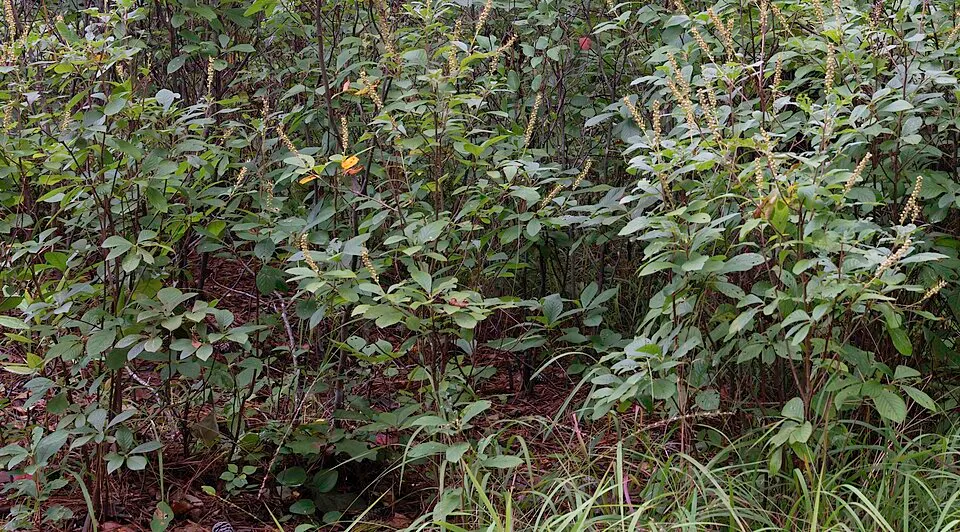
Clethra alnifolia, commonly known as summer sweet or sweet pepperbush, is a resilient deciduous shrub indigenous to the eastern United States, thriving from coastal Maine south to Florida and extending westward into East Texas. This member of the Clethraceae family typically adopts a multi-stemmed, upright to rounded growth habit, reaching heights of 0.9 to 2.4 meters (3 to 8 feet) with a similar spread. Its root system is characteristically shallow and fibrous, allowing it to flourish in consistently moist, acidic soils frequently encountered along stream banks, bog edges, swamp margins, and in the understory of woodlands. The foliage consists of alternate, simple, elliptical leaves, measuring between 5 to 15 centimeters (2 to 6 inches) in length, distinguished by serrated margins and prominent pinnate venation.
These leaves present a vibrant, glossy dark green throughout the growing season, transforming into a striking golden yellow in autumn, adding significant seasonal interest. The bark of young stems is smooth, gradually transitioning to a slightly textured, light brown to gray hue on older branches, often marked with subtle lenticels. The most captivating feature of Clethra alnifolia is its abundant floral display in mid-to-late summer. Fragrant, nectar-rich flowers are densely packed into upright, cylindrical racemes, typically 5 to 10 centimeters (2 to 4 inches) long.
These delicate, five-petaled blooms are predominantly white, though pink-tinged varieties exist, and emit a sweet, spicy fragrance reminiscent of cloves, acting as a powerful attractant for a diverse array of pollinators, including bees, butterflies, and various beneficial insects. Following successful pollination, small, brown, three-valved capsules develop, persisting into winter and providing a food source for birds. Ecologically, Clethra alnifolia plays a vital role in its native habitats, stabilizing soil in wetland areas and offering essential nectar and habitat for wildlife. Its adaptability to moist conditions makes it an excellent candidate for rain gardens and coastal landscapes, demonstrating resistance to salt spray and various common diseases.
Trusted Scientific References
1. Authoritative external sources for Clethra alnifolia
1.1 Wikipedia — Clethra alnifolia
1.2 Kew POWO (Plants of the World Online)
1.3 PubMed — peer-reviewed research
1.4 NCBI Taxonomy Browser
1.5 GBIF — Global Biodiversity
1.1.Clethra Alnifolia — Key Features
- ✓ <strong>Deciduous shrub native</strong> — Deciduous shrub native to Eastern North America.
- ✓ <strong>Fragrant white to</strong> — Fragrant white to pink flowers in cylindrical racemes.
- ✓ <strong>Blooms mid</strong> — to-late summer, providing late-season nectar.
- ✓ <strong>Attractive glossy dark</strong> — Attractive glossy dark green foliage turning golden yellow in autumn.
- ✓ <strong>Prefers moist, acidic</strong> — Prefers moist, acidic soils and tolerates partial shade.
- ✓ <strong>Important pollinator plant,</strong> — Important pollinator plant, attracting bees, butterflies, and hummingbirds.
- ✓ <strong>Ecologically significant for</strong> — Ecologically significant for soil stabilization in wetland areas.
- ✓ <strong>Relatively low maintenance</strong> — Relatively low maintenance and disease resistant.
- ✓ <strong>Features persistent brown</strong> — Features persistent brown seed capsules that feed birds in winter.
- ✓ <strong>Known for its sweet, clove</strong> — like aroma.
1.2.Clethra Alnifolia — Quick Summary
- ✓ Clethra alnifolia is a fragrant, deciduous shrub native to Eastern North America.
- ✓ Known for its late summer blooms and sweet, spicy scent.
- ✓ Traditionally valued for its potential anti-inflammatory, antioxidant, and astringent properties.
- ✓ Rich in phenolic acids, flavonoids, salicylates, and tannins.
- ✓ Thrives in moist, acidic soils and is a vital pollinator plant.
- ✓ Requires caution during pregnancy, lactation, and for individuals with salicylate sensitivity.
2.Clethra Alnifolia — Scientific Identity
3.Clethra Alnifolia — Quick Facts
4.Clethra Alnifolia — Appearance & Identification
5.Clethra Alnifolia — Native Habitat
6.Clethra Alnifolia — Water Requirements
- ✓ Soil Preference — Thrives in consistently moist, acidic soils (pH 4.5-6.5) rich in organic matter.
- ✓ Light Requirements — Tolerates full sun to partial shade; prefers partial shade in hotter climates to prevent leaf scorch.
- ✓ Watering — Requires regular watering, especially during dry periods, as it is naturally found in wetland margins.
- ✓ Pruning — Best pruned in late winter or early spring to shape the plant and encourage new growth, as flowers form on new wood.
- ✓ Fertilization — Benefits from a slow-release, acid-loving fertilizer in spring or a top-dressing of compost.
- ✓ Propagation — Can be propagated by softwood cuttings in early summer or by separating suckers from the base of the plant.
- ✓ Pest and Disease — Generally resistant to most pests and diseases, but spider mites can be an issue in very dry conditions.
- ✓ Mulching — Apply a thick layer of organic mulch to retain soil moisture and regulate soil temperature.
Reviewed by the Flora Medical Global Botanical Review Panel
Multi-disciplinary editorial group · Botany · Ethnobotany · Herbal-medicine literature
Who reviewed this: This page was checked by the Flora Medical Global Botanical Review Panel — an in-house editorial group of botany graduates, ethnobotany researchers, and horticulture practitioners who collectively maintain our 7,000+ plant encyclopedia. Meet the team.
Our 4-step verification process
1. Taxonomic verification
Scientific names and synonyms cross-checked against Kew POWO, World Flora Online, and The Plant List.
2. Phytochemical & medicinal cross-reference
Active compounds, traditional uses, and reported activities are cross-referenced with PubMed, USDA Dr. Duke's database, and peer-reviewed ethnobotanical literature.
3. Conservation & distribution check
Distribution, ecology, and conservation status confirmed against GBIF occurrence records and the IUCN Red List.
4. Editorial & safety review
Every entry passes an editorial pass for clarity, originality, and safety notices (toxicity, contraindications, dosage caveats) before publication.
Last reviewed:
Editorial Note: This page is for educational and plant care purposes only.
Written by: Flora Medical Global Editorial Team
Reviewed by: Flora Medical Global Botanical Review Panel
Last Updated: June 15, 2026







Clethra Alnifolia — Comments & Community Reviews
Rate this plant