
Care Disclaimer: Plant care recommendations are general guidelines based on common growing conditions. Individual results may vary based on your local environment, climate, and care routine. If your plant is toxic, keep it away from children and pets, and consult a veterinarian if accidental ingestion occurs.
1.Climbing Rose — Overview
Rosa setigera, commonly known as the Climbing Rose or Climbing Prairie Rose, is a robust, deciduous perennial vine native to the central and eastern regions of North America, including parts of southeast Canada and the United States. This vigorous species is characterized by its rambling and climbing habit, utilizing its numerous short, thick, and often slightly curved prickles to ascend structures or other vegetation, reaching impressive heights of 3 to 4.5 meters (10 to 15 feet) with adequate support.
The stems are typically greenish-red, providing a striking contrast to the foliage.
The leaves of Rosa setigera are pinnately compound, usually consisting of three distinct leaflets that are a lustrous dark green during spring and summer. These leaflets contribute to a dense, appealing canopy, which transitions to attractive bronze, purple, and red hues in the fall, adding seasonal interest. The flowers are a highlight, blooming profusely from mid-June through July.
They are typically solitary or borne in small clusters, exhibiting delicate shades of pink to rose-pink, often with a mild, pleasant rose scent and prominent golden stamens at their center. These blossoms are highly attractive to pollinators such as honeybees and bumblebees.
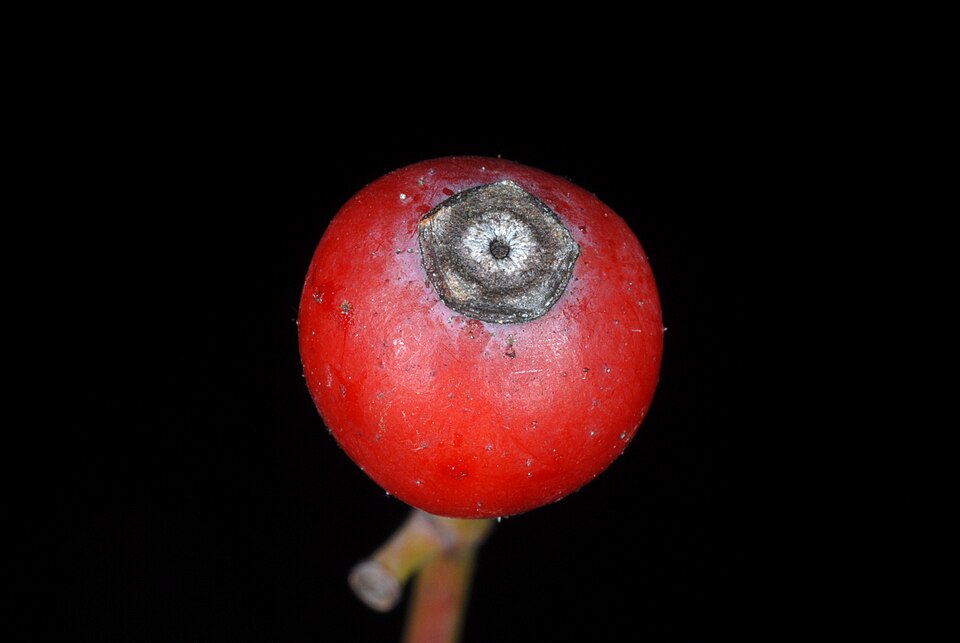
Following the flowering period, Rosa setigera produces small, globular, bright red hips in the fall, which mature through late summer. These fruits are a valuable food source for various birds and small mammals, contributing to local wildlife support. In terms of habitat, the Climbing Rose thrives in full sun to partial shade, preferring moist, well-drained soils.
It is commonly found in open woodlands, thickets, along roadsides, pastures, and fence rows, demonstrating its adaptability. While intolerant of standing water and drought, its suckering and rambling nature makes it an excellent choice for erosion control, informal garden settings, and enhancing vertical spaces, though its spread can be extensive, making it less suitable for very small gardens. This species has been in cultivation since 1810, valued for its hardiness and ornamental appeal.
Trusted Scientific References
1. Authoritative external sources for Rosa setigera
1.1 Wikipedia — Rosa setigera
1.2 Kew POWO (Plants of the World Online)
1.3 PubMed — peer-reviewed research
1.4 NCBI Taxonomy Browser
1.5 GBIF — Global Biodiversity
1.1.Climbing Rose — Key Features
- ✓ <strong>Native North American Species</strong> — Indigenous to central and eastern regions of the continent.
- ✓ <strong>Vigorous Climbing Habit</strong> — Utilizes prickles to ascend, reaching significant heights with support.
- ✓ <strong>Fragrant Pink Flowers</strong> — Blooms profusely in summer with a mild, pleasant rose scent.
- ✓ <strong>Attractive Foliage</strong> — Glossy dark green leaves that develop bronze, red, or purple fall color.
- ✓ <strong>Edible & Medicinal Hips</strong> — Produces bright red, nutrient-rich fruits high in Vitamin C.
- ✓ <strong>Pollinator Attractor</strong> — Flowers draw bees and butterflies, supporting local ecosystems.
- ✓ <strong>Erosion Control</strong> — Rambling and suckering habit makes it useful for stabilizing soils.
- ✓ <strong>Deciduous Perennial</strong> — Offers seasonal interest with its blooms and fall foliage.
- ✓ <strong>Adaptable Growth</strong> — Tolerates a range of conditions but prefers full sun and good drainage.
- ✓ <strong>Prickled Stems</strong> — Stems are covered with sharp prickles, aiding in climbing.
1.2.Climbing Rose — Quick Summary
- ✓ Rosa setigera is a native North American climbing rose known for its ornamental beauty.
- ✓ Features fragrant pink flowers, dark green foliage, and bright red, vitamin-rich hips.
- ✓ Traditionally valued for its potential antioxidant, anti-inflammatory, and immune-boosting properties.
- ✓ Thrives in full sun and well-drained soil, requiring support for its climbing habit.
- ✓ Hips are a source of Vitamin C and used in teas, syrups, and culinary dishes.
- ✓ Exercise caution due to prickles and potential allergic reactions.
2.Climbing Rose — Scientific Identity
3.Climbing Rose — Quick Facts
4.Climbing Rose — Appearance & Identification
5.Climbing Rose — Native Habitat
6.Climbing Rose — Water Requirements
- ✓ Site Selection — Plant in a location receiving full sun for at least 6 hours daily; partial shade may reduce flower production and increase disease risk.
- ✓ Soil Requirements — Prefers moist, well-drained loamy soils; intolerant of standing water and drought conditions.
- ✓ Support Structure — Requires a sturdy trellis, arbor, fence, or other support for its climbing and rambling stems to reach its full height.
- ✓ Watering — Water regularly to maintain consistent soil moisture, especially during dry periods, but avoid overwatering that leads to soggy conditions.
- ✓ Pruning — Conduct pruning in late winter or early spring to shape the plant, remove dead or damaged wood, and encourage vigorous growth and flowering.
- ✓ Fertilization — Apply a balanced slow-release fertilizer in spring to support robust growth and abundant blooms.
- ✓ Propagation — Can be propagated by seeds, stem suckers, cuttings, or grafting.
- ✓ Pest and Disease Management — While generally more disease-resistant than hybrid roses, monitor for common rose pests like aphids and spider mites, and diseases such as powdery mildew, especially in sub-optimal conditions.
Reviewed by the Flora Medical Global Botanical Review Panel
Multi-disciplinary editorial group · Botany · Ethnobotany · Herbal-medicine literature
Who reviewed this: This page was checked by the Flora Medical Global Botanical Review Panel — an in-house editorial group of botany graduates, ethnobotany researchers, and horticulture practitioners who collectively maintain our 7,000+ plant encyclopedia. Meet the team.
Our 4-step verification process
1. Taxonomic verification
Scientific names and synonyms cross-checked against Kew POWO, World Flora Online, and The Plant List.
2. Phytochemical & medicinal cross-reference
Active compounds, traditional uses, and reported activities are cross-referenced with PubMed, USDA Dr. Duke's database, and peer-reviewed ethnobotanical literature.
3. Conservation & distribution check
Distribution, ecology, and conservation status confirmed against GBIF occurrence records and the IUCN Red List.
4. Editorial & safety review
Every entry passes an editorial pass for clarity, originality, and safety notices (toxicity, contraindications, dosage caveats) before publication.
Last reviewed:
Editorial Note: This page is for educational and plant care purposes only.
Written by: Flora Medical Global Editorial Team
Reviewed by: Flora Medical Global Botanical Review Panel
Last Updated: June 15, 2026







Climbing Rose — Comments & Community Reviews
Rate this plant