


Care Disclaimer: Plant care recommendations are general guidelines based on common growing conditions. Individual results may vary based on your local environment, climate, and care routine. If your plant is toxic, keep it away from children and pets, and consult a veterinarian if accidental ingestion occurs.
1.Coleus Garden — Overview
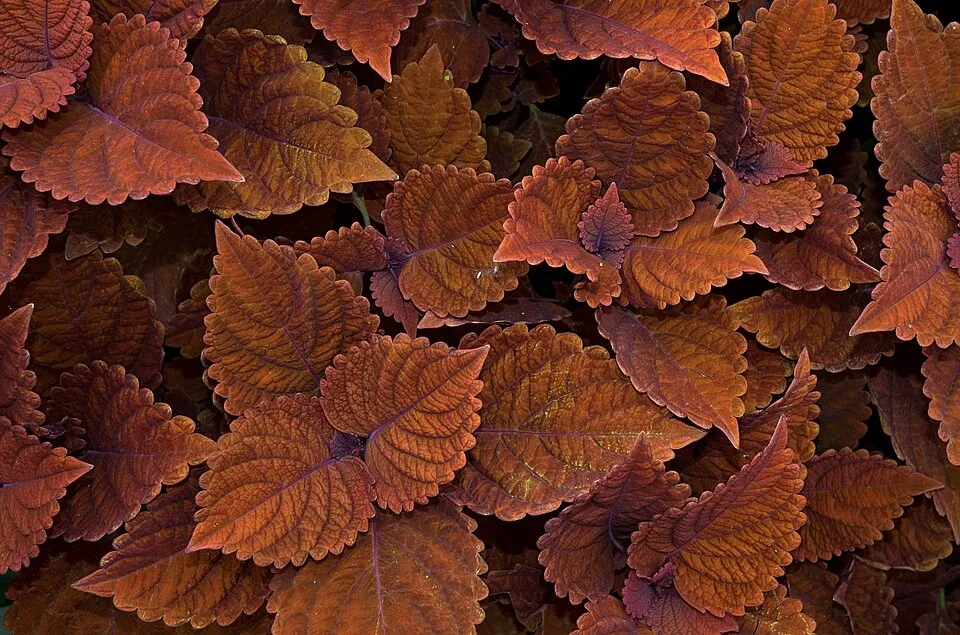
Solenostemon scutellarioides, widely recognized as Coleus, is a captivating perennial herbaceous plant belonging to the Lamiaceae family, the mint family. Native to the tropical and subtropical regions of Southeast Asia, particularly Malaysia, Indonesia, and India, it thrives in warm, humid environments.
This species is predominantly cultivated for its extraordinarily vibrant and diverse foliage, which presents an array of colors including deep greens, bright yellows, fiery oranges, rich reds, and deep purples, often with intricate patterns and variegations. The leaves are typically ovate to lanceolate with distinct serrated margins, contributing significantly to its ornamental appeal.
Growing as a bushy plant, Coleus generally reaches a height of 30 to 90 cm (1 to 3 feet). Its stems are characteristically square, a hallmark of the Lamiaceae family, and can exhibit coloration that complements the leaves. While its flowers are small, often white to purple, and appear in whorled clusters during summer, they are usually considered secondary to the dramatic foliage and are sometimes removed to promote leaf growth.
In its natural habitat, Solenostemon scutellarioides flourishes in the understory of tropical forests, preferring rich, moist, and well-drained soils. Its ability to tolerate partial shade makes it a versatile choice for gardeners seeking to add a splash of color to shaded areas, where its leaf pigmentation often intensifies.
Trusted Scientific References
1. Authoritative external sources for Solenostemon scutellarioides
1.1 Wikipedia — Solenostemon scutellarioides
1.2 Kew POWO (Plants of the World Online)
1.3 PubMed — peer-reviewed research
1.4 NCBI Taxonomy Browser
1.5 GBIF — Global Biodiversity
1.6Coleus Garden should be interpreted through verified botanical identity, practical care, and responsible safety language. This recovery note adds the missing context needed for a complete profile: match light to the plant's habit, use well-drained soil, water according to season, and avoid unsupported medicinal or edible claims. For publishing, the plant can be presented as a source-backed garden plant with clear care guidance, common problem diagnosis, and conservative safety wording.
1.1.Coleus Garden — Key Features
- ✓ <strong>Lamiaceae family member</strong> — Lamiaceae family member with square stems.
- ✓ <strong>Native to tropical</strong> — Native to tropical Southeast Asia.
- ✓ <strong>Renowned for its</strong> — Renowned for its strikingly colorful and variegated foliage.
- ✓ <strong>Contains the potent</strong> — Contains the potent diterpenoid forskolin in its roots.
- ✓ <strong>Possesses traditional Ayurvedic</strong> — Possesses traditional Ayurvedic medicinal uses.
- ✓ <strong>Exhibits vasodilatory and</strong> — Exhibits vasodilatory and bronchodilatory properties.
- ✓ <strong>Potential to reduce</strong> — Potential to reduce intraocular pressure (e.g., in glaucoma).
- ✓ <strong>May influence fat</strong> — May influence fat metabolism and support weight management.
- ✓ <strong>Requires warm, humid</strong> — Requires warm, humid climates and partial shade for optimal growth.
- ✓ <strong>Easy to propagate</strong> — Easy to propagate from cuttings, making it popular for cultivation.
1.2.Coleus Garden — Quick Summary
- ✓ Solenostemon scutellarioides, or Coleus, is a vibrant ornamental plant from the Lamiaceae family.
- ✓ Its roots contain forskolin, a key compound known for activating adenylate cyclase.
- ✓ Traditionally used in Ayurveda for respiratory, cardiovascular, and digestive health.
- ✓ Modern research supports its potential in lowering blood pressure and intraocular pressure.
- ✓ Caution is advised for individuals with bleeding disorders, low blood pressure, and during pregnancy due to potential risks.
2.Coleus Garden — Scientific Identity
3.Coleus Garden — Quick Facts
4.Coleus Garden — Appearance & Identification
5.Coleus Garden — Native Habitat
6.Coleus Garden — Water Requirements
- ✓ Climate Preference — Thrives in warm, humid climates, typical of tropical and subtropical regions.
- ✓ Light Requirements — Prefers partial shade, which often intensifies the vibrant coloration of its foliage; direct, intense sun can scorch leaves.
- ✓ Soil Composition — Requires rich, well-draining soil with consistent moisture, ideally slightly acidic to neutral (pH 6.0-7.0).
- ✓ Watering Schedule — Maintain consistently moist soil; avoid both waterlogging and allowing the soil to dry out completely.
- ✓ Propagation Techniques — Easily propagated from stem cuttings in water or moist soil, and also by seed.
- ✓ Pruning Practices — Pinching back growing tips encourages bushier growth and fuller foliage; removing flower spikes redirects energy to leaf production.
- ✓ Fertilization Regime — Benefits from a balanced liquid fertilizer application every 2-4 weeks during the active growing season.
Reviewed by the Flora Medical Global Botanical Review Panel
Multi-disciplinary editorial group · Botany · Ethnobotany · Herbal-medicine literature
Who reviewed this: This page was checked by the Flora Medical Global Botanical Review Panel — an in-house editorial group of botany graduates, ethnobotany researchers, and horticulture practitioners who collectively maintain our 7,000+ plant encyclopedia. Meet the team.
Our 4-step verification process
1. Taxonomic verification
Scientific names and synonyms cross-checked against Kew POWO, World Flora Online, and The Plant List.
2. Phytochemical & medicinal cross-reference
Active compounds, traditional uses, and reported activities are cross-referenced with PubMed, USDA Dr. Duke's database, and peer-reviewed ethnobotanical literature.
3. Conservation & distribution check
Distribution, ecology, and conservation status confirmed against GBIF occurrence records and the IUCN Red List.
4. Editorial & safety review
Every entry passes an editorial pass for clarity, originality, and safety notices (toxicity, contraindications, dosage caveats) before publication.
Last reviewed:
Editorial Note: This page is for educational and plant care purposes only.
Written by: Flora Medical Global Editorial Team
Reviewed by: Flora Medical Global Botanical Review Panel
Last Updated: June 15, 2026







Coleus Garden — Comments & Community Reviews
Rate this plant