
Care Disclaimer: Plant care recommendations are general guidelines based on common growing conditions. Individual results may vary based on your local environment, climate, and care routine. If your plant is toxic, keep it away from children and pets, and consult a veterinarian if accidental ingestion occurs.
1.Coronilla Varia — Overview
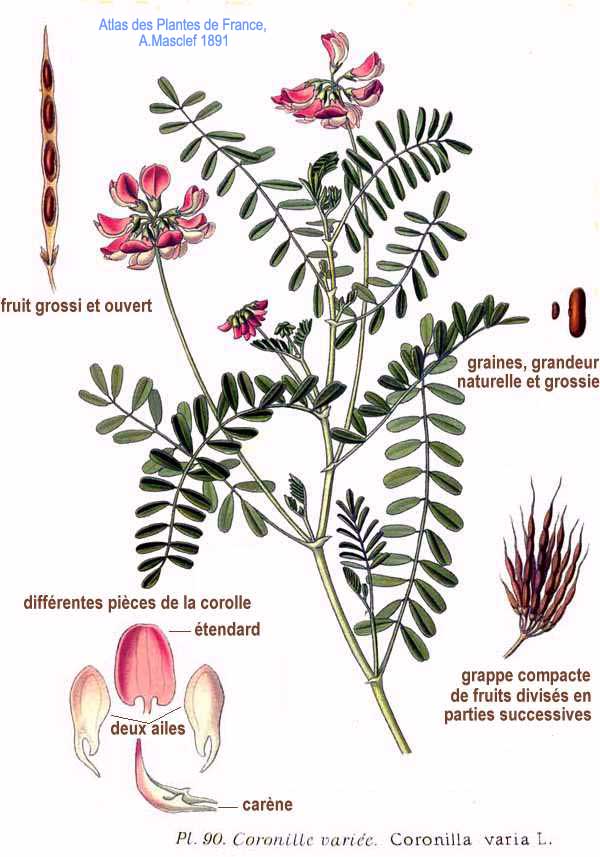
Coronilla varia, widely recognized as Crown Vetch or Purple Crown Vetch, is a robust perennial herbaceous plant belonging to the Fabaceae (legume) family. Originating from Europe, Asia, and northern Africa, this species has been extensively introduced globally, particularly in North America, where it is now classified as an invasive species due to its aggressive growth habit.
The plant typically grows as a sprawling vine, reaching heights of 30 to 90 centimeters (1 to 3 feet), and forms dense groundcover through its extensive rhizomatous root system. Its foliage consists of delicate, pinnately compound leaves, each composed of 12 to 25 small, ovate to lanceolate leaflets, giving the plant a fine-textured appearance.
A defining characteristic of Coronilla varia is its distinctive flower clusters, which are dense, rounded umbels resembling small crowns—hence its common name. These showy flowers, typically ranging in color from pink to purple or white, bloom profusely from late spring through the autumn months, serving as a significant nectar source for various pollinators, including bees. Following the flowering period, slender, segmented seed pods develop.
Crown Vetch is remarkably adaptable, thriving in a wide array of conditions from full sun to partial shade and tolerating diverse, well-drained soil types, including sandy, loamy, and clay substrates. Its vigorous root system and ability to fix nitrogen contribute to its success in colonizing disturbed areas such as roadsides, embankments, and abandoned fields. While effective for erosion control, its rapid spread and competitive nature pose a considerable threat to native plant communities, leading to ecological imbalances in many introduced regions.
Its resilience and minimal care requirements allow it to establish dense monocultures if not carefully managed.
Trusted Scientific References
1. Authoritative external sources for Coronilla Varia
1.1 Wikipedia — Coronilla Varia
1.2 Kew POWO (Plants of the World Online)
1.3 PubMed — peer-reviewed research
1.4 NCBI Taxonomy Browser
1.5 GBIF — Global Biodiversity
1.1.Coronilla Varia — Key Features
- ✓ <strong>Scientific Name</strong> — Coronilla varia (syn. Securigera varia)
- ✓ <strong>Common Names</strong> — Crown Vetch, Purple Crown Vetch
- ✓ <strong>Plant Family</strong> — Fabaceae (Legume Family)
- ✓ <strong>Native Range</strong> — Europe, Asia, Northern Africa
- ✓ <strong>Growth Habit</strong> — Vining, spreading perennial herbaceous plant
- ✓ <strong>Flower Characteristics</strong> — Pink to white, crown-like clusters (umbels)
- ✓ <strong>Leaf Structure</strong> — Pinnately compound with 12-25 small leaflets
- ✓ <strong>Primary Toxicity</strong> — Contains neurotoxic and cardiotoxic nitropropanol glycosides
- ✓ <strong>Main Applications</strong> — Erosion control, ruminant livestock forage
- ✓ <strong>Invasive Potential</strong> — Highly invasive in many introduced regions, outcompeting native flora
1.2.Coronilla Varia — Quick Summary
- ✓ Invasive perennial groundcover native to Europe, Asia, and Africa.
- ✓ Characterized by pink to white crown-like flower clusters and pinnately compound leaves.
- ✓ Contains toxic nitropropanol glycosides, poisonous to humans and non-ruminant animals.
- ✓ Primarily used for erosion control and as forage for specific ruminant livestock.
- ✓ NOT safe for human consumption or medicinal use due to high toxicity.
- ✓ Spreads aggressively via rhizomes and seeds, requiring careful management.
2.Coronilla Varia — Scientific Identity
3.Coronilla Varia — Quick Facts
4.Coronilla Varia — Appearance & Identification
5.Coronilla Varia — Native Habitat
6.Coronilla Varia — Water Requirements
- ✓ Site Selection — Choose locations where its aggressive spreading can be either contained or where its rapid ground cover is specifically desired for erosion control, avoiding proximity to sensitive native ecosystems.
- ✓ Soil Preference — Exhibits high adaptability, thriving in a wide range of well-drained soil types, including sandy, loamy, and clay, and tolerating various pH levels and low nutrient availability.
- ✓ Light Requirements — Performs optimally in full sun, which promotes denser growth and more abundant flowering, but can also tolerate partial shade conditions.
- ✓ Watering — Highly drought-tolerant once established, requiring minimal supplemental irrigation; overwatering should be avoided to prevent root rot and other moisture-related issues.
- ✓ Fertilization — Generally does not require additional fertilization due to its nitrogen-fixing capabilities, which naturally enrich the soil; excess nutrients can promote unwanted vigorous growth.
- ✓ Propagation — Easily propagated from seeds, which may benefit from scarification to aid germination, or through division of its extensive rhizomatous root system for quick establishment.
- ✓ Maintenance — Low maintenance once established, but requires vigilant monitoring and active management to prevent its invasive spread into unintended areas.
- ✓ Pest and Disease Resistance — Shows strong natural resistance to most common insect pests and plant diseases, contributing to its hardiness and competitive advantage.
Reviewed by the Flora Medical Global Botanical Review Panel
Multi-disciplinary editorial group · Botany · Ethnobotany · Herbal-medicine literature
Who reviewed this: This page was checked by the Flora Medical Global Botanical Review Panel — an in-house editorial group of botany graduates, ethnobotany researchers, and horticulture practitioners who collectively maintain our 7,000+ plant encyclopedia. Meet the team.
Our 4-step verification process
1. Taxonomic verification
Scientific names and synonyms cross-checked against Kew POWO, World Flora Online, and The Plant List.
2. Phytochemical & medicinal cross-reference
Active compounds, traditional uses, and reported activities are cross-referenced with PubMed, USDA Dr. Duke's database, and peer-reviewed ethnobotanical literature.
3. Conservation & distribution check
Distribution, ecology, and conservation status confirmed against GBIF occurrence records and the IUCN Red List.
4. Editorial & safety review
Every entry passes an editorial pass for clarity, originality, and safety notices (toxicity, contraindications, dosage caveats) before publication.
Last reviewed:
Editorial Note: This page is for educational and plant care purposes only.
Written by: Flora Medical Global Editorial Team
Reviewed by: Flora Medical Global Botanical Review Panel
Last Updated: June 15, 2026







Coronilla Varia — Comments & Community Reviews
Rate this plant