
Care Disclaimer: Plant care recommendations are general guidelines based on common growing conditions. Individual results may vary based on your local environment, climate, and care routine. If your plant is toxic, keep it away from children and pets, and consult a veterinarian if accidental ingestion occurs.
1.Corydalis Lutea — Overview
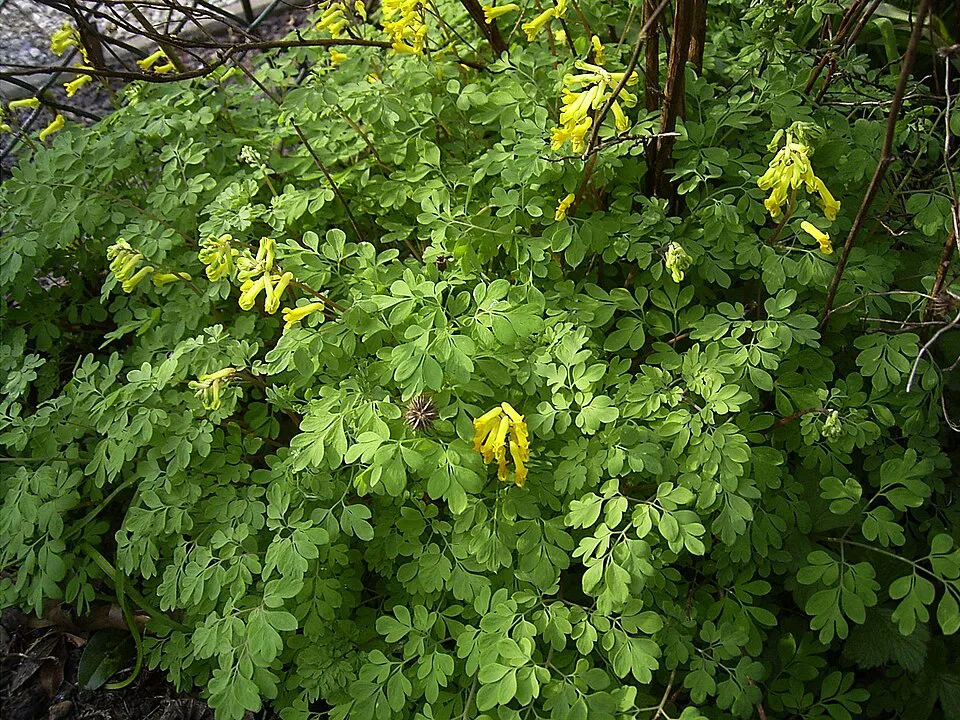
Corydalis lutea, commonly known as Yellow Corydalis or Yellow Fumitory, is a charming, short-lived perennial herbaceous plant belonging to the Fumariaceae family. Native to the southern Alps of Europe, it thrives in rocky crevices and shaded walls, often self-seeding readily to form attractive mounds of delicate foliage. This species typically grows to a height of 30 to 45 centimeters (12 to 18 inches), though it can be shorter, forming neat, compact clumps. Its leaves are finely dissected, resembling those of a maidenhair fern or bleeding heart, with a vibrant light green to blue-green hue.
The pinnately compound leaves feature three lobes, appearing pale green on the upper surface and glaucous below. Throughout a remarkably long blooming season, from late spring until the first frost, Corydalis lutea produces abundant bright golden-yellow flowers. These irregular, tubular flowers, approximately 2.5 to 5 cm (1-2 inches) long, are arranged in racemes containing 6 to 16 individual blossoms, each characterized by a distinctive spur at the back. After flowering, slender, dehiscent capsules develop, which eventually burst to scatter the seeds.
This hardy plant is suitable for USDA zones 5a-8b, preferring well-drained, nutrient-rich soils with a pH between 6.0 and 7.0. While it enjoys full sun for at least 6-8 hours daily, it can also tolerate partial shade, especially in hotter climates, where consistent soil moisture helps prevent summer dormancy.
Trusted Scientific References
1. Authoritative external sources for Corydalis Lutea
1.1 Wikipedia — Corydalis Lutea
1.2 Kew POWO (Plants of the World Online)
1.3 PubMed — peer-reviewed research
1.4 NCBI Taxonomy Browser
1.5 GBIF — Global Biodiversity
1.6Corydalis Lutea should be interpreted through verified botanical identity, practical care, and responsible safety language. This recovery note adds the missing context needed for a complete profile: match light to the plant's habit, use well-drained soil, water according to season, and avoid unsupported medicinal or edible claims. For publishing, the plant can be presented as a source-backed garden plant with clear care guidance, common problem diagnosis, and conservative safety wording.
1.1.Corydalis Lutea — Key Features
- ✓ <strong>Striking Yellow Blooms</strong> — Produces abundant bright golden-yellow flowers from late spring to frost.
- ✓ <strong>Delicate Fern</strong> — like Foliage — Features finely cut, light green to blue-green leaves that form neat mounds.
- ✓ <strong>Self</strong> — Seeding Habit — Readily self-seeds, making it excellent for naturalizing in rock gardens or walls.
- ✓ <strong>Extended Bloom Period</strong> — Offers a prolonged display of flowers throughout much of the growing season.
- ✓ <strong>Cold and Heat Tolerant</strong> — Hardy in zones 5a-8b, showing resilience to varying temperatures.
- ✓ <strong>Medicinal Alkaloids</strong> — Contains isoquinoline alkaloids, characteristic of the *Corydalis* genus, with known pharmacological activities.
- ✓ <strong>Traditional Pain Relief</strong> — Other *Corydalis* species are historically valued for their potent analgesic and anti-inflammatory effects.
- ✓ <strong>Low Maintenance Perennial</strong> — Easy to cultivate in well-drained soil with minimal care requirements.
- ✓ <strong>Attracts Pollinators</strong> — Its vibrant flowers can attract bees and other beneficial insects to the garden.
- ✓ <strong>Adaptable Growth</strong> — Thrives in both full sun and partial shade, adapting to various garden environments.
1.2.Corydalis Lutea — Quick Summary
- ✓ Ornamental Charm — *Corydalis lutea* is primarily cherished for its vibrant yellow flowers and delicate foliage, making it a popular garden perennial.
- ✓ Medicinal Genus — The *Corydalis* genus, particularly *C. yanhusuo*, is renowned in traditional medicine for its analgesic, anti-inflammatory, and sedative properties.
- ✓ Key Phytochemistry — Rich in isoquinoline alkaloids like tetrahydropalmatine, which are responsible for many of its pharmacological actions.
- ✓ Traditional Uses — Employed in TCM and other systems for pain, nerve damage, mood support, and gastrointestinal issues.
- ✓ Cultivation Ease — *Corydalis lutea* is easy to grow, self-seeding readily in well-drained soil and partial to full sun.
- ✓ Safety Caution — Contraindicated in pregnancy and requires careful use due to potential side effects and drug interactions.
2.Corydalis Lutea — Scientific Identity
3.Corydalis Lutea — Quick Facts
4.Corydalis Lutea — Appearance & Identification
5.Corydalis Lutea — Native Habitat
6.Corydalis Lutea — Water Requirements
- ✓ Soil Preference — Thrive in well-drained, nutrient-rich soil with a pH range of 6.0 to 7.0.
- ✓ Light Requirements — Prefers full sun exposure for at least 6-8 hours a day, but tolerates partial shade, especially in hot climates.
- ✓ Watering Schedule — Requires regular watering, particularly during dry spells, to maintain consistent soil moisture and prevent summer dormancy.
- ✓ Temperature and Hardiness — Hardy in USDA zones 5a-8b; plants may die back to the ground in cold winters or during hot, dry summers but often resume growth in favorable conditions.
- ✓ Propagation — Readily self-seeds, often establishing itself in cracks and crevices; can also be propagated by division in spring or fall.
- ✓ Growth Habit — Forms neat mounds of delicate foliage; ideal for rock gardens, borders, or naturalizing in woodland settings.
- ✓ Maintenance — Low maintenance; deadheading spent flowers can encourage more blooms, though allowing some to go to seed facilitates self-propagation.
Reviewed by the Flora Medical Global Botanical Review Panel
Multi-disciplinary editorial group · Botany · Ethnobotany · Herbal-medicine literature
Who reviewed this: This page was checked by the Flora Medical Global Botanical Review Panel — an in-house editorial group of botany graduates, ethnobotany researchers, and horticulture practitioners who collectively maintain our 7,000+ plant encyclopedia. Meet the team.
Our 4-step verification process
1. Taxonomic verification
Scientific names and synonyms cross-checked against Kew POWO, World Flora Online, and The Plant List.
2. Phytochemical & medicinal cross-reference
Active compounds, traditional uses, and reported activities are cross-referenced with PubMed, USDA Dr. Duke's database, and peer-reviewed ethnobotanical literature.
3. Conservation & distribution check
Distribution, ecology, and conservation status confirmed against GBIF occurrence records and the IUCN Red List.
4. Editorial & safety review
Every entry passes an editorial pass for clarity, originality, and safety notices (toxicity, contraindications, dosage caveats) before publication.
Last reviewed:
Editorial Note: This page is for educational and plant care purposes only.
Written by: Flora Medical Global Editorial Team
Reviewed by: Flora Medical Global Botanical Review Panel
Last Updated: June 15, 2026







Corydalis Lutea — Comments & Community Reviews
Rate this plant