

Care Disclaimer: Plant care recommendations are general guidelines based on common growing conditions. Individual results may vary based on your local environment, climate, and care routine. If your plant is toxic, keep it away from children and pets, and consult a veterinarian if accidental ingestion occurs.
1.Crocosmia — Overview
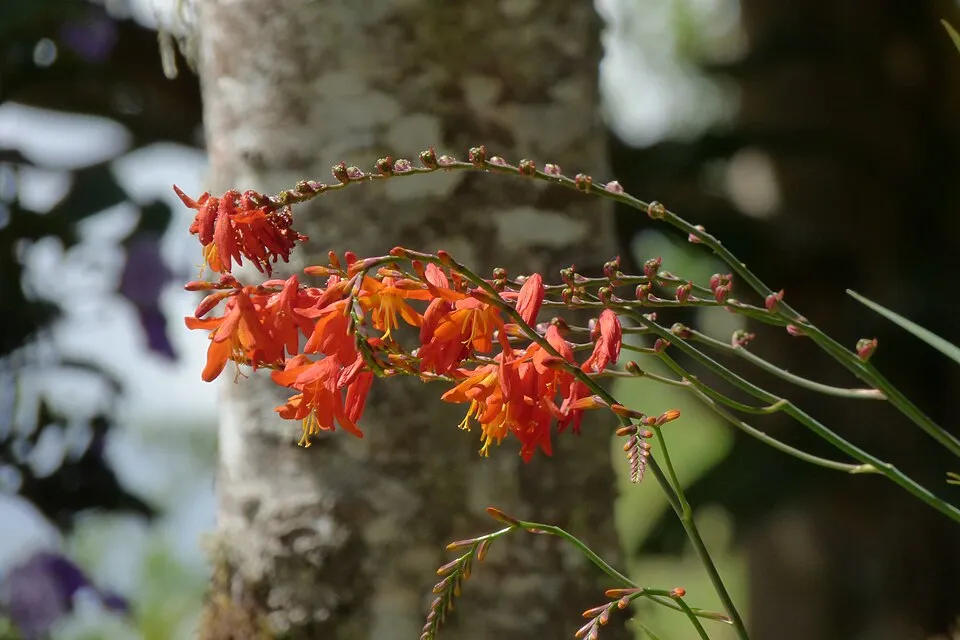
Crocosmia x crocosmiiflora, commonly known as Montbretia or Garden Montbretia, is a striking perennial herbaceous plant belonging to the Iridaceae family, which also includes irises and gladioli. This particular species is a hybrid, first cultivated in France in 1879 from a cross between Crocosmia aurea and Crocosmia pottsii, both native to South Africa.
Interestingly, this hybrid has also been observed occurring naturally in regions of South Africa where its parent species overlap. The plant typically grows to an impressive height of 60-90 cm (24-35 inches), though its narrow, sword-shaped leaves can extend up to a meter in length, emerging in a distinctive fan-like arrangement from an underground corm.
Montbretia is highly valued for its vibrant summer blooms, which appear on elongated, arching flower spikes. These tubular flowers, usually in shades of bright orange, yellow, or red, are arranged in two rows along the branches at the stem top, attracting a variety of pollinators, most notably hummingbirds and bees. While primarily cultivated for its ornamental appeal in gardens and landscapes, where its corms readily spread to form captivating clumps, Crocosmia x crocosmiiflora is also recognized for its robust adaptability.
It thrives in moist, well-drained, humus-rich soils and tolerates a range from full sun to partial shade. However, its vigorous spreading habit means it can easily naturalize and become invasive in disturbed sites, wet grasslands, and open woodlands in suitable climates, requiring careful management.
Trusted Scientific References
1. Authoritative external sources for Crocosmia x crocosmiiflora
1.1 Wikipedia — Crocosmia x crocosmiiflora
1.2 Kew POWO (Plants of the World Online)
1.3 PubMed — peer-reviewed research
1.4 NCBI Taxonomy Browser
1.5 GBIF — Global Biodiversity
1.6Crocosmia should be interpreted through verified botanical identity, practical care, and responsible safety language. This recovery note adds the missing context needed for a complete profile: match light to the plant's habit, use well-drained soil, water according to season, and avoid unsupported medicinal or edible claims. For publishing, the plant can be presented as a source-backed garden plant with clear care guidance, common problem diagnosis, and conservative safety wording.
1.1.Crocosmia — Key Features
- ✓ <strong>Ornamental Value</strong> — Highly prized for its vivid, showy flowers in shades of orange, yellow, and red.
- ✓ <strong>Hybrid Vigor</strong> — A robust hybrid cross of Crocosmia aurea and Crocosmia pottsii, displaying strong growth.
- ✓ <strong>Corm</strong> — Propagated — Grows from corms, which facilitate its easy spread and naturalization.
- ✓ <strong>Attracts Pollinators</strong> — Flowers are a magnet for hummingbirds, bees, and other beneficial insects.
- ✓ <strong>Sword</strong> — Shaped Foliage — Features distinctive, long, narrow, sword-like leaves arranged in a fan.
- ✓ <strong>Perennial Herbaceous</strong> — Returns year after year, forming dense clumps over time.
- ✓ <strong>Iridaceae Family Member</strong> — Belongs to the iris family, sharing characteristics with other well-known bulbous plants.
- ✓ <strong>Adaptable Growth</strong> — Tolerates a range of light and soil conditions, from full sun to partial shade.
- ✓ <strong>Traditional Medicinal Uses</strong> — Historically noted for limited traditional applications, particularly for digestive and inflammatory concerns.
- ✓ <strong>Invasive Potential</strong> — Can be aggressive in favorable environments, spreading rapidly and requiring management.
1.2.Crocosmia — Quick Summary
- ✓ Crocosmia x crocosmiiflora, or Montbretia, is a vibrant hybrid perennial from the Iridaceae family.
- ✓ Primarily an ornamental plant known for its striking orange-red flowers and sword-shaped leaves.
- ✓ Traditionally used in some cultures for potential anti-inflammatory and digestive benefits.
- ✓ Contains flavonoids and saponins, which are active compounds with known biological properties.
- ✓ Exhibits invasive tendencies in certain climates, requiring careful garden management.
- ✓ Modern scientific research on its medicinal efficacy is limited, highlighting the need for caution.
2.Crocosmia — Scientific Identity
3.Crocosmia — Quick Facts
4.Crocosmia — Appearance & Identification
5.Crocosmia — Native Habitat
6.Crocosmia — Water Requirements
- ✓ Soil Preference — Thrives in moist, well-drained, humus-rich soil with good moisture retention.
- ✓ Light Requirements — Prefers full sun for optimal flowering but can tolerate partial shade.
- ✓ Planting Corms — Plant corms in spring at a depth of approximately 5-10 cm (2-4 inches), spaced about 10-15 cm apart.
- ✓ Watering — Requires regular watering until established, then medium watering, especially during dry periods and flowering.
- ✓ Division — Divide corms every two to three years in late winter or early spring to maintain vigor and prevent overcrowding.
- ✓ Maintenance — Remove dead stems and leaves in early spring before new growth emerges to encourage healthy development.
- ✓ Weed Management — Be mindful of its aggressive nature; take care when planting and disposing of unwanted corms to prevent its spread as a weed.
- ✓ Pest and Disease — Generally robust, but can be susceptible to twospotted spider mites, especially in dry conditions.
Reviewed by the Flora Medical Global Botanical Review Panel
Multi-disciplinary editorial group · Botany · Ethnobotany · Herbal-medicine literature
Who reviewed this: This page was checked by the Flora Medical Global Botanical Review Panel — an in-house editorial group of botany graduates, ethnobotany researchers, and horticulture practitioners who collectively maintain our 7,000+ plant encyclopedia. Meet the team.
Our 4-step verification process
1. Taxonomic verification
Scientific names and synonyms cross-checked against Kew POWO, World Flora Online, and The Plant List.
2. Phytochemical & medicinal cross-reference
Active compounds, traditional uses, and reported activities are cross-referenced with PubMed, USDA Dr. Duke's database, and peer-reviewed ethnobotanical literature.
3. Conservation & distribution check
Distribution, ecology, and conservation status confirmed against GBIF occurrence records and the IUCN Red List.
4. Editorial & safety review
Every entry passes an editorial pass for clarity, originality, and safety notices (toxicity, contraindications, dosage caveats) before publication.
Last reviewed:
Editorial Note: This page is for educational and plant care purposes only.
Written by: Flora Medical Global Editorial Team
Reviewed by: Flora Medical Global Botanical Review Panel
Last Updated: June 15, 2026







Crocosmia — Comments & Community Reviews
Rate this plant