
Care Disclaimer: Plant care recommendations are general guidelines based on common growing conditions. Individual results may vary based on your local environment, climate, and care routine. If your plant is toxic, keep it away from children and pets, and consult a veterinarian if accidental ingestion occurs.
1.Crocosmia Lucifer — Overview
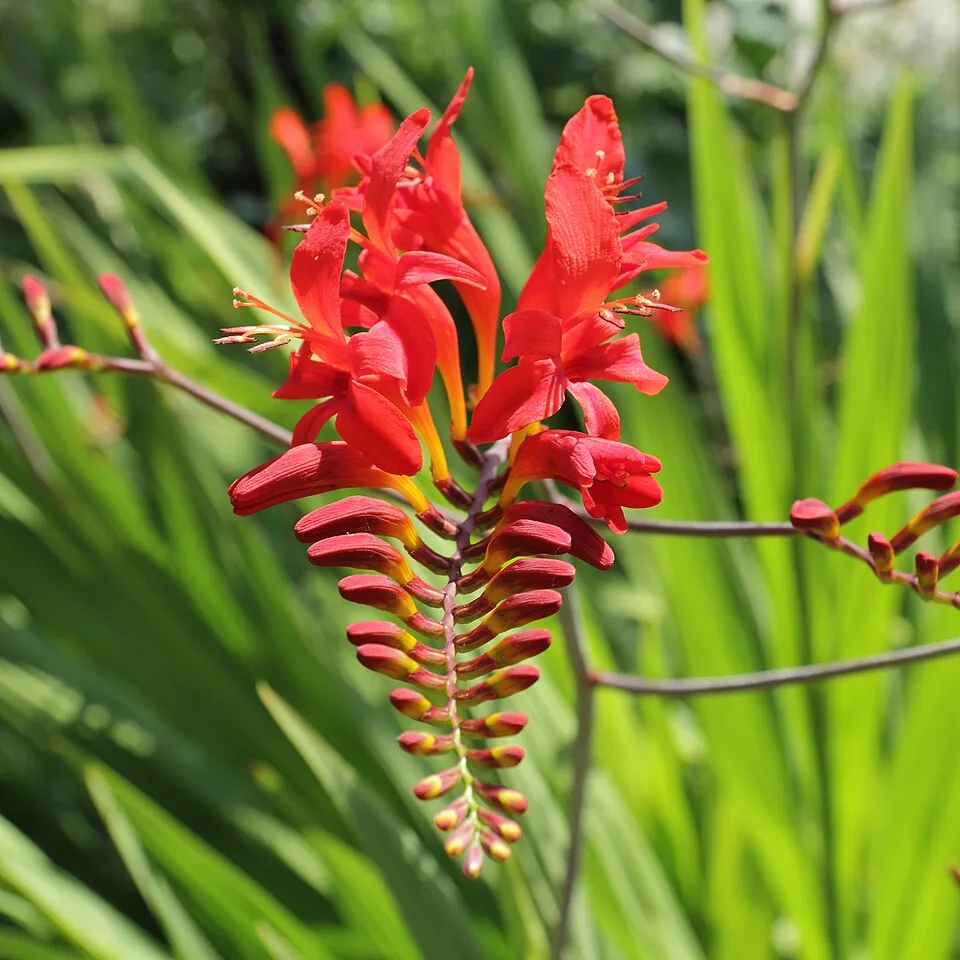
Crocosmia 'Lucifer', a distinguished cultivar within the genus Crocosmia, is a prominent member of the Iridaceae family, which is also home to well-known plants like irises and gladioli. This specific hybrid was expertly developed by Alan Bloom in 1969, resulting from a cross between two South African species: Crocosmia masoniorum and Crocosmia paniculata. While its wild ancestors originate from the diverse grasslands and rocky terrains of Southern and East Africa, 'Lucifer' is a horticultural marvel, celebrated globally for its striking visual impact and robust nature. It was deservedly awarded the Royal Horticultural Society's Award of Garden Merit in 1993, a testament to its outstanding garden performance. This perennial cormous plant establishes dense clumps, producing dramatic, upright flower spikes that can impressively reach heights of 1 to 1.5 meters (3 to 5 feet), sometimes exceeding this under ideal growing conditions.
Its foliage consists of elegant, sword-shaped, bright green leaves, often gracefully arching, which can extend up to 50 cm (20 inches) in length. These leaves provide a lush, vertical architectural element in the garden, contributing significantly to its ornamental charm even before the vibrant blooms emerge. The plant's underground structure is a corm, a specialized swollen stem base that stores nutrients, enabling the plant to endure adverse conditions and regenerate reliably each year. The true allure of Crocosmia 'Lucifer' lies in its fiery, trumpet-shaped flowers, which unfurl in an intense spectrum of bright red-orange to scarlet hues. These captivating blossoms are arranged in elegant, one-sided racemes along tall, slender, and often branched stalks that rise proudly above the foliage.
Each impressive flower cluster can bear numerous individual florets, creating a spectacular display from mid-summer through early autumn. The vivid coloration and distinct form of the flowers act as a powerful magnet for various pollinators, particularly hummingbirds, which are drawn to their nectar-rich depths, and several butterfly species. Its adaptable nature allows it to flourish in diverse garden settings, ranging from formal borders and informal cottage gardens to naturalized areas and mass plantings, thriving best in full sun to partial shade and moderately moist, well-drained soils. Trusted Scientific References Authoritative external sources for Crocosmia Lucifer : Wikipedia — Crocosmia Lucifer Kew POWO (Plants of the World Online) P ...[CURRENT TEXT EXISTS: 2579 chars]
1.1.Crocosmia Lucifer — Key Features
- ✓ <strong>Dramatic Fiery Red Flowers</strong> — Produces intense, trumpet-shaped, scarlet-orange blooms.
- ✓ <strong>Tall Architectural Spikes</strong> — Reaches impressive heights of 1 to 1.5 meters, adding vertical drama.
- ✓ <strong>Pollinator Magnet</strong> — Actively attracts hummingbirds and butterflies with its nectar-rich flowers.
- ✓ <strong>Robust and Resilient</strong> — A hardy perennial that thrives in various garden conditions once established.
- ✓ <strong>Cormous Growth Habit</strong> — Grows from corms, storing energy for reliable annual regeneration.
- ✓ <strong>Sword</strong> — shaped Foliage — Offers lush, bright green, arching leaves that complement its blooms.
- ✓ <strong>Mid</strong> — to-Late Summer Bloom — Provides vibrant color when many other plants are fading.
- ✓ <strong>RHS Award of Garden Merit</strong> — Recognized for outstanding garden performance and reliability.
- ✓ <strong>Low Maintenance</strong> — Requires minimal care, naturalizing easily in suitable environments.
- ✓ <strong>Versatile Garden Use</strong> — Excellent for borders, mass plantings, cottage gardens, and cut flowers.
1.2.Crocosmia Lucifer — Quick Summary
- ✓ Crocosmia 'Lucifer' is a striking perennial cormous plant celebrated for its fiery red-orange flowers.
- ✓ A horticultural hybrid, it belongs to the Iridaceae family and was awarded the RHS Award of Garden Merit.
- ✓ Reaching up to 1.5 meters, it provides dramatic vertical interest and blooms from mid-summer to early autumn.
- ✓ Highly attractive to hummingbirds and butterflies, supporting garden biodiversity.
- ✓ Thrives in full sun to partial shade with well-drained soil, making it a robust and adaptable garden plant.
- ✓ Primarily an ornamental plant with no documented traditional or modern medicinal uses.
2.Crocosmia Lucifer — Scientific Identity
3.Crocosmia Lucifer — Quick Facts
4.Crocosmia Lucifer — Appearance & Identification
5.Crocosmia Lucifer — Native Habitat
6.Crocosmia Lucifer — Water Requirements
- ✓ Site Selection — Plant Crocosmia 'Lucifer' in a location receiving full sun to partial shade for optimal flowering, ensuring it receives at least 6 hours of direct sunlight daily.
- ✓ Soil Requirements — Prefers moderately moist, well-drained soils; avoid waterlogged conditions which can lead to corm rot. Amend heavy clay soils with organic matter to improve drainage.
- ✓ Planting Depth and Spacing — Plant corms 5 to 8 inches deep and about 6 inches apart (approximately 6 bulbs per square foot) to allow for naturalization and dense clumping.
- ✓ Watering — Maintain consistent moisture, especially during dry spells and the active growing season, but allow the soil to dry slightly between waterings once established.
- ✓ Fertilization — A balanced, slow-release granular fertilizer applied in early spring can promote vigorous growth and abundant flowering, though it is not strictly necessary in fertile soils.
- ✓ Division and Maintenance — Divide clumps every 3-5 years in early spring to prevent overcrowding and maintain vigor, as Crocosmia 'Lucifer' naturalizes readily.
- ✓ Winter Care (Cooler Climates) — In USDA Zones below 6, corms may require lifting and storing indoors in a cool, dry, dark place over winter, or providing a thick layer of mulch for protection.
- ✓ Pest and Disease Management — Monitor for spider mites, which can cause foliage damage, and rabbits, which may browse on leaves; generally a robust plant with few serious issues.
Reviewed by the Flora Medical Global Botanical Review Panel
Multi-disciplinary editorial group · Botany · Ethnobotany · Herbal-medicine literature
Who reviewed this: This page was checked by the Flora Medical Global Botanical Review Panel — an in-house editorial group of botany graduates, ethnobotany researchers, and horticulture practitioners who collectively maintain our 7,000+ plant encyclopedia. Meet the team.
Our 4-step verification process
1. Taxonomic verification
Scientific names and synonyms cross-checked against Kew POWO, World Flora Online, and The Plant List.
2. Phytochemical & medicinal cross-reference
Active compounds, traditional uses, and reported activities are cross-referenced with PubMed, USDA Dr. Duke's database, and peer-reviewed ethnobotanical literature.
3. Conservation & distribution check
Distribution, ecology, and conservation status confirmed against GBIF occurrence records and the IUCN Red List.
4. Editorial & safety review
Every entry passes an editorial pass for clarity, originality, and safety notices (toxicity, contraindications, dosage caveats) before publication.
Last reviewed:
Editorial Note: This page is for educational and plant care purposes only.
Written by: Flora Medical Global Editorial Team
Reviewed by: Flora Medical Global Botanical Review Panel
Last Updated: June 15, 2026







Crocosmia Lucifer — Comments & Community Reviews
Rate this plant