
Care Disclaimer: Plant care recommendations are general guidelines based on common growing conditions. Individual results may vary based on your local environment, climate, and care routine. If your plant is toxic, keep it away from children and pets, and consult a veterinarian if accidental ingestion occurs.
1.Crocus Garden — Overview
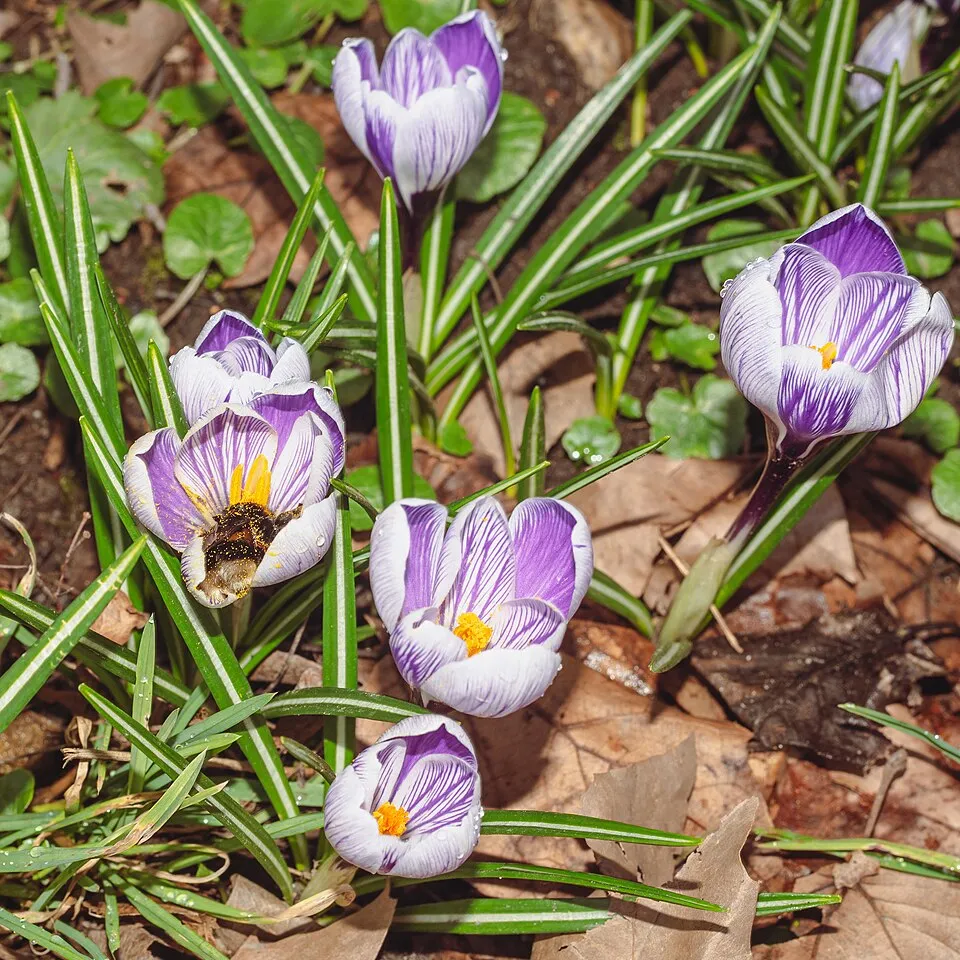
Crocus Garden, scientifically known as Crocus vernus, is a charming perennial herbaceous plant belonging to the Iridaceae family, renowned for its vibrant display in early spring. Typically growing to a modest height of 8 to 15 cm (3 to 6 inches), this species features narrow, linear leaves that can extend up to 30 cm (12 inches) long. These bright green leaves, often subtly ribbed, emerge from the soil, frequently preceding the flowers and forming an attractive basal rosette around the developing floral stems.
Each slender stem proudly bears one to three large, cup-shaped flowers, measuring approximately 5 to 8 cm (2 to 3 inches) in diameter. The floral palette of Crocus vernus is diverse, encompassing shades of regal purple, sunny yellow, pristine white, and soft lavender, often adorned with contrasting markings that enhance their visual appeal. The flowers are characterized by six petal-like tepals that gracefully unfurl to reveal the vivid purple or yellow stigmas within, a signature trait of the genus.
Native to the alpine meadows and woodlands of central and southern Europe, Crocus vernus thrives in well-drained soils rich in organic matter. It is particularly well-suited for rock gardens, border edges, and naturalized areas, where it can push through residual winter snow, symbolizing the arrival of spring. This species exhibits remarkable adaptability, flourishing in a range of light conditions from full sun to partial shade, and tolerating various soil types, though it prefers sandy or loamy compositions with moderate moisture.
Its resilience is partly due to its corm, an underground storage organ that ensures survival through dormant periods. Crocus vernus is primarily cultivated for its ornamental value, providing essential early-season nectar for pollinators and enhancing biodiversity in temperate garden ecosystems as it awakens the landscape from winter slumber.
Trusted Scientific References
1. Authoritative external sources for Crocus vernus
1.1 Wikipedia — Crocus vernus
1.2 Kew POWO (Plants of the World Online)
1.3 PubMed — peer-reviewed research
1.4 NCBI Taxonomy Browser
1.5 GBIF — Global Biodiversity
1.1.Crocus Garden — Key Features
- ✓ <strong>Early Spring Bloomer</strong> — One of the first flowers to emerge, often through snow.
- ✓ <strong>Diverse Color Palette</strong> — Flowers in shades of purple, yellow, white, and lavender.
- ✓ <strong>Ornamental Value</strong> — Highly prized for garden aesthetics and landscaping.
- ✓ <strong>Corm</strong> — forming Perennial — Survives dormancy via an underground storage organ.
- ✓ <strong>Attracts Early Pollinators</strong> — Provides vital nectar for bees and insects.
- ✓ <strong>Adaptable Growth</strong> — Thrives in full sun to partial shade and various soil types.
- ✓ <strong>Low Maintenance</strong> — Relatively easy to grow once established.
- ✓ <strong>Symbol of New Beginnings</strong> — Represents the end of winter and onset of spring.
- ✓ <strong>Non</strong> — Medicinal Species — Primarily ornamental, distinct from Saffron Crocus.
- ✓ <strong>Potential Toxicity</strong> — Ingestion of Crocus vernus is not recommended.
1.2.Crocus Garden — Quick Summary
- ✓ Crocus vernus (Spring Crocus) is a beautiful ornamental plant, blooming early spring.
- ✓ It features vibrant purple, yellow, or white flowers and narrow leaves.
- ✓ Primarily grown for aesthetic appeal and early pollinator support in gardens.
- ✓ Critically, Crocus vernus is NOT the medicinal Saffron Crocus (Crocus sativus).
- ✓ Ingestion of Crocus vernus is potentially toxic and should be avoided.
- ✓ Medicinal benefits attributed to "Crocus" largely stem from Crocus sativus.
2.Crocus Garden — Scientific Identity
3.Crocus Garden — Quick Facts
4.Crocus Garden — Appearance & Identification
5.Crocus Garden — Native Habitat
6.Crocus Garden — Water Requirements
- ✓ Site Selection — Choose a location with full sun to partial shade, ideally receiving at least 6 hours of direct sunlight daily for optimal flowering.
- ✓ Soil Preparation — Plant Crocus vernus in well-drained soil rich in organic matter. A sandy or loamy soil pH between 6.0 and 7.0 is ideal. Amend heavy clay soils with compost or grit to improve drainage.
- ✓ Planting Corms — Plant corms in autumn, typically 6-8 weeks before the first hard frost. Bury them 3-4 inches (8-10 cm) deep and 3-4 inches apart, with the pointed side facing upwards.
- ✓ Watering — Water thoroughly after planting. During active growth in spring, keep the soil consistently moist but not waterlogged. Reduce watering once foliage begins to yellow and die back for summer dormancy.
- ✓ Fertilization — Apply a balanced, slow-release granular fertilizer or compost in early spring as new growth emerges. Avoid over-fertilizing, which can promote foliage at the expense of flowers.
- ✓ Pest and Disease Management — Crocus vernus is relatively pest-resistant. Watch for rodents that may eat corms; protective wire cages can be used. Ensure good air circulation to prevent fungal issues.
- ✓ Post-Bloom Care — Allow foliage to fully die back naturally before removing it. This process provides essential nutrients back to the corm for the following year's bloom.
- ✓ Propagation — Crocus vernus can be propagated by dividing offsets from mature corms during their dormant period in late summer.
Reviewed by the Flora Medical Global Botanical Review Panel
Multi-disciplinary editorial group · Botany · Ethnobotany · Herbal-medicine literature
Who reviewed this: This page was checked by the Flora Medical Global Botanical Review Panel — an in-house editorial group of botany graduates, ethnobotany researchers, and horticulture practitioners who collectively maintain our 7,000+ plant encyclopedia. Meet the team.
Our 4-step verification process
1. Taxonomic verification
Scientific names and synonyms cross-checked against Kew POWO, World Flora Online, and The Plant List.
2. Phytochemical & medicinal cross-reference
Active compounds, traditional uses, and reported activities are cross-referenced with PubMed, USDA Dr. Duke's database, and peer-reviewed ethnobotanical literature.
3. Conservation & distribution check
Distribution, ecology, and conservation status confirmed against GBIF occurrence records and the IUCN Red List.
4. Editorial & safety review
Every entry passes an editorial pass for clarity, originality, and safety notices (toxicity, contraindications, dosage caveats) before publication.
Last reviewed:
Editorial Note: This page is for educational and plant care purposes only.
Written by: Flora Medical Global Editorial Team
Reviewed by: Flora Medical Global Botanical Review Panel
Last Updated: June 15, 2026







Crocus Garden — Comments & Community Reviews
Rate this plant