
Care Disclaimer: Plant care recommendations are general guidelines based on common growing conditions. Individual results may vary based on your local environment, climate, and care routine. If your plant is toxic, keep it away from children and pets, and consult a veterinarian if accidental ingestion occurs.
1.Cuphea Ignea — Overview
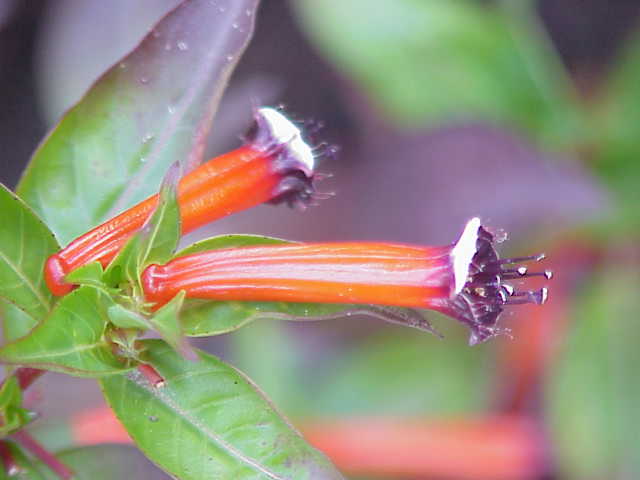
Cuphea ignea, widely recognized by its evocative common names such as the Cigar Plant, Firecracker Plant, and Mexican Cigar Plant, is a captivating broadleaf evergreen perennial sub-shrub belonging to the Lythraceae family. Native to the warm, humid regions of Southeast and Southwest Mexico, this species is celebrated for its distinctive morphology and vibrant floral display.
It typically grows into a rounded, bushy form, reaching heights of 30 to 60 cm (18 to 30 inches) and spreading equally wide, supported by densely branched stems. The foliage comprises small, dark green, lance-shaped leaves arranged oppositely along the stems, providing a lush backdrop for its striking flowers.
The most remarkable feature of Cuphea ignea is its tubular, reddish-orange blossoms, which are elegantly tipped with black and often feature a small white petal at the opening, giving them the appearance of a lit cigar or a tiny firecracker. These charming flowers bloom profusely from late spring through fall, or even year-round in consistently warm climates, making it a favorite for continuous color. The plant thrives in full sun to partial shade, preferring moist, well-drained soils, ideally a sandy loam, but demonstrating adaptability to various soil types including clay, provided drainage is adequate.
It is particularly tolerant of heat and humidity, and once established, shows good drought resistance, making it an excellent choice for xeriscaping or low-maintenance gardens. However, it is intolerant to frost and is best grown as an annual or overwintered indoors in cooler zones. Ecologically, Cuphea ignea is a significant magnet for pollinators, especially hummingbirds, butterflies, and bees, who are drawn to its rich nectar, enhancing biodiversity in any garden setting.
The genus name 'Cuphea' derives from the Greek word 'kyphos,' meaning curved or humped, likely referring to the shape of its seed capsules. The specific epithet 'ignea' is Latin for 'fire,' aptly describing the fiery hue of its characteristic flowers.
Trusted Scientific References
1. Authoritative external sources for Cuphea ignea
1.1 Wikipedia — Cuphea ignea
1.2 Kew POWO (Plants of the World Online)
1.3 PubMed — peer-reviewed research
1.4 NCBI Taxonomy Browser
1.5 GBIF — Global Biodiversity
1.1.Cuphea Ignea — Key Features
- ✓ <strong>Striking tubular orange</strong> — red flowers with distinctive black tips.
- ✓ <strong>Common names include</strong> — Common names include Cigar Plant, Firecracker Plant, and Mexican Cigar Plant.
- ✓ <strong>Excellent for attracting</strong> — Excellent for attracting hummingbirds, butterflies, and bees to gardens.
- ✓ <strong>Broadleaf evergreen perennial sub</strong> — shrub with a bushy growth habit.
- ✓ <strong>Adaptable to a</strong> — Adaptable to a range of light conditions, from full sun to partial shade.
- ✓ <strong>Prefers moist, well</strong> — drained sandy loam but tolerates various soil types.
- ✓ <strong>Exhibits good drought</strong> — Exhibits good drought tolerance once established in the landscape.
- ✓ <strong>Grows to a</strong> — Grows to a manageable height and width of approximately 18-30 inches.
- ✓ <strong>Versatile plant suitable</strong> — Versatile plant suitable for garden beds, containers, and as a houseplant.
- ✓ <strong>Generally considered resistant</strong> — Generally considered resistant to most common pests and diseases.
1.2.Cuphea Ignea — Quick Summary
- ✓ Vibrant ornamental with unique cigar-shaped, orange-red flowers.
- ✓ Attracts hummingbirds, butterflies, and other pollinators.
- ✓ Native to Mexico, thriving in warm, sunny, well-drained conditions.
- ✓ Contains flavonoids and phenolic acids, suggesting antioxidant potential.
- ✓ Low-maintenance, drought-tolerant, suitable for containers and gardens.
- ✓ Primarily ornamental; specific traditional medicinal uses are not widely documented.
2.Cuphea Ignea — Scientific Identity
3.Cuphea Ignea — Quick Facts
4.Cuphea Ignea — Appearance & Identification
5.Cuphea Ignea — Native Habitat
6.Cuphea Ignea — Water Requirements
- ✓ Climate and Hardiness — Thrives in warm, humid tropical to subtropical conditions (USDA Zones 10-12). In cooler climates, it is best grown as an annual or overwintered indoors as a houseplant.
- ✓ Light Requirements — Prefers full sun exposure for optimal flowering, but can tolerate partial shade, especially in very hot climates to prevent scorching of foliage.
- ✓ Soil Preferences — Requires moist, well-drained soil; ideally a sandy loam, but adaptable to various soil types including clay, as long as drainage is adequate. Tolerates acidic soils.
- ✓ Watering — Water moderately, allowing the soil surface to dry out between waterings. While somewhat drought-tolerant once established, consistent moisture promotes vibrant growth and abundant blooming.
- ✓ Fertilization — Apply a balanced liquid fertilizer every 2-4 weeks during the active growing and blooming season to encourage robust plant health and prolific flower production.
- ✓ Pruning and Maintenance — Pinching stem tips helps maintain a bushy, rounded shape and prevents legginess. Regular deadheading of spent flowers promotes continuous blooming and a tidy appearance.
- ✓ Propagation — Easily propagated by seeds or stem cuttings; cuttings are best taken in fall or winter for indoor cultivation or propagation.
- ✓ Pest and Disease Resistance — Generally robust and mostly free of significant insect pests and diseases, making it a low-maintenance choice for gardeners.
Reviewed by the Flora Medical Global Botanical Review Panel
Multi-disciplinary editorial group · Botany · Ethnobotany · Herbal-medicine literature
Who reviewed this: This page was checked by the Flora Medical Global Botanical Review Panel — an in-house editorial group of botany graduates, ethnobotany researchers, and horticulture practitioners who collectively maintain our 7,000+ plant encyclopedia. Meet the team.
Our 4-step verification process
1. Taxonomic verification
Scientific names and synonyms cross-checked against Kew POWO, World Flora Online, and The Plant List.
2. Phytochemical & medicinal cross-reference
Active compounds, traditional uses, and reported activities are cross-referenced with PubMed, USDA Dr. Duke's database, and peer-reviewed ethnobotanical literature.
3. Conservation & distribution check
Distribution, ecology, and conservation status confirmed against GBIF occurrence records and the IUCN Red List.
4. Editorial & safety review
Every entry passes an editorial pass for clarity, originality, and safety notices (toxicity, contraindications, dosage caveats) before publication.
Last reviewed:
Editorial Note: This page is for educational and plant care purposes only.
Written by: Flora Medical Global Editorial Team
Reviewed by: Flora Medical Global Botanical Review Panel
Last Updated: June 15, 2026







Cuphea Ignea — Comments & Community Reviews
Rate this plant