
Care Disclaimer: Plant care recommendations are general guidelines based on common growing conditions. Individual results may vary based on your local environment, climate, and care routine. If your plant is toxic, keep it away from children and pets, and consult a veterinarian if accidental ingestion occurs.
1.Daboecia Cantabrica — Overview
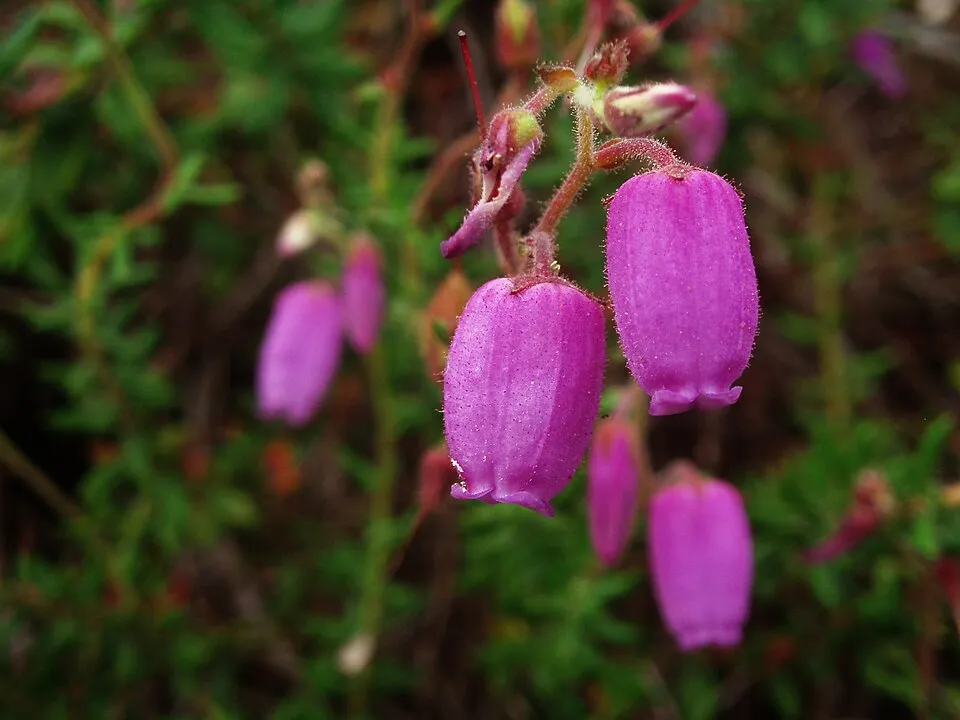
Daboecia cantabrica, commonly known as St. Daboec's Heath or Irish Heath, is a distinctive evergreen shrub native to the Atlantic coastal regions of Western Europe, specifically found in Ireland (notably Connemara), Western France, Northern Spain, and Portugal. It belongs to the Ericaceae family, sharing characteristics with other heaths and heathers.
This low-growing plant typically reaches heights of 1.5 to 2 feet, forming dense, twiggy colonies that are integral to its native bog and heathland ecosystems. Its slender, erect stems are often furnished with fine glandular hairs, contributing to its unique texture.
Botanically, the Irish Heath is recognized by its small, alternate, ovate-oblong leaves, which measure about 1/4 to 5/8 inch long. These leaves are a glossy, dark green on the upper surface and covered with a characteristic close white wool or silvery pubescence on the underside, creating a subtle two-toned effect. The plant's most striking feature is its profusion of bell-shaped or urceolate flowers, which emerge from June through November.
These flowers are typically a rich rosy-purple, 3/8 to 1/2 inch long, with four tiny reflexed lobes at the mouth. Cultivars offer a spectrum of colors, including pure white (f. alba), various pinks ('Praegerae'), richer red-purples (f.
atropurpurea), and even bicolors. These vibrant blossoms are a significant nectar source, attracting numerous pollinators, especially bees, which are vital for ecosystem health. Propagation is typically by seed for the species or by cuttings for its various cultivars, and regular early spring pruning helps maintain a compact habit and promotes abundant flowering.
Trusted Scientific References
1. Authoritative external sources for Daboecia cantabrica
1.1 Wikipedia — Daboecia cantabrica
1.2 Kew POWO (Plants of the World Online)
1.3 PubMed — peer-reviewed research
1.4 NCBI Taxonomy Browser
1.5 GBIF — Global Biodiversity
1.6Daboecia Cantabrica should be interpreted through verified botanical identity, practical care, and responsible safety language. This recovery note adds the missing context needed for a complete profile: match light to the plant's habit, use well-drained soil, water according to season, and avoid unsupported medicinal or edible claims. For publishing, the plant can be presented as a source-backed garden plant with clear care guidance, common problem diagnosis, and conservative safety wording.
1.1.Daboecia Cantabrica — Key Features
- ✓ <strong>Native to Western</strong> — Native to Western European Heathlands
- ✓ <strong>Evergreen Foliage with</strong> — Evergreen Foliage with Silvery Underside
- ✓ <strong>Distinctive Urceolate (Urn</strong> — shaped) Flowers
- ✓ <strong>Extended Flowering Season</strong> — Extended Flowering Season from Summer to Autumn
- ✓ <strong>Significant Attractor for</strong> — Significant Attractor for Pollinators, especially Bees
- ✓ <strong>Thrives in Acidic, Lime</strong> — Free Soils
- ✓ <strong>Resilient to Harsh</strong> — Resilient to Harsh Coastal and Temperate Climates
- ✓ <strong>Highly Prized for</strong> — Highly Prized for Ornamental Gardening
- ✓ <strong>Rich in Potential</strong> — Rich in Potential Bioactive Polyphenolic Compounds
- ✓ <strong>Low</strong> — Maintenance Shrub when Grown in Suitable Conditions
1.2.Daboecia Cantabrica — Quick Summary
- ✓ Evergreen shrub, Ericaceae family, native to Western Europe.
- ✓ Features glossy dark green leaves and vibrant, bell-shaped flowers.
- ✓ Primarily valued for its ornamental beauty and role as a pollinator plant.
- ✓ Contains polyphenolic compounds, including flavonoids and phenolic acids.
- ✓ Modern research into its medicinal properties is nascent; no established traditional uses.
- ✓ Requires acidic, well-drained soil and thrives in full sun to partial shade.
2.Daboecia Cantabrica — Scientific Identity
3.Daboecia Cantabrica — Quick Facts
4.Daboecia Cantabrica — Appearance & Identification
5.Daboecia Cantabrica — Native Habitat
6.Daboecia Cantabrica — Water Requirements
- ✓ Soil Preference — Thrives in acidic, peaty soil or a light, sandy loam that is entirely lime-free; incorporating leaf-mould enhances growing conditions.
- ✓ Sunlight Exposure — Prefers full sun to partial shade for optimal flowering and robust growth, though it can tolerate some shade.
- ✓ Watering Requirements — Requires consistently moist but very well-drained soil; avoid waterlogging, especially in winter.
- ✓ Pruning — Prune in early spring to remove old flower spikes and about one-third of the previous year's growth to maintain a compact habit and encourage prolific blooming.
- ✓ Propagation — Can be propagated by seed for the species, or more commonly by semi-ripe cuttings taken in late summer for specific cultivars.
- ✓ Hardiness Zone — Hardy to USDA Zone 6, tolerating temperatures down to -10°F (-23°C), and resilient to harsh coastal conditions.
- ✓ Fertilization — Generally requires minimal fertilization; use an ericaceous (acid-loving) fertilizer sparingly if growth appears weak.
- ✓ Pest and Disease Management — Relatively pest-free, but watch for common ericaceous issues like root rot in poorly drained soils or fungal leaf spots.
Reviewed by the Flora Medical Global Botanical Review Panel
Multi-disciplinary editorial group · Botany · Ethnobotany · Herbal-medicine literature
Who reviewed this: This page was checked by the Flora Medical Global Botanical Review Panel — an in-house editorial group of botany graduates, ethnobotany researchers, and horticulture practitioners who collectively maintain our 7,000+ plant encyclopedia. Meet the team.
Our 4-step verification process
1. Taxonomic verification
Scientific names and synonyms cross-checked against Kew POWO, World Flora Online, and The Plant List.
2. Phytochemical & medicinal cross-reference
Active compounds, traditional uses, and reported activities are cross-referenced with PubMed, USDA Dr. Duke's database, and peer-reviewed ethnobotanical literature.
3. Conservation & distribution check
Distribution, ecology, and conservation status confirmed against GBIF occurrence records and the IUCN Red List.
4. Editorial & safety review
Every entry passes an editorial pass for clarity, originality, and safety notices (toxicity, contraindications, dosage caveats) before publication.
Last reviewed:
Editorial Note: This page is for educational and plant care purposes only.
Written by: Flora Medical Global Editorial Team
Reviewed by: Flora Medical Global Botanical Review Panel
Last Updated: June 15, 2026







Daboecia Cantabrica — Comments & Community Reviews
Rate this plant